HOME

Stratosphere Chamber

Stratosphere Chamber

Brooklands Museum, Brooklands Road,  Weybridge,  Surrey,  KT13 0QN,  United Kingdom

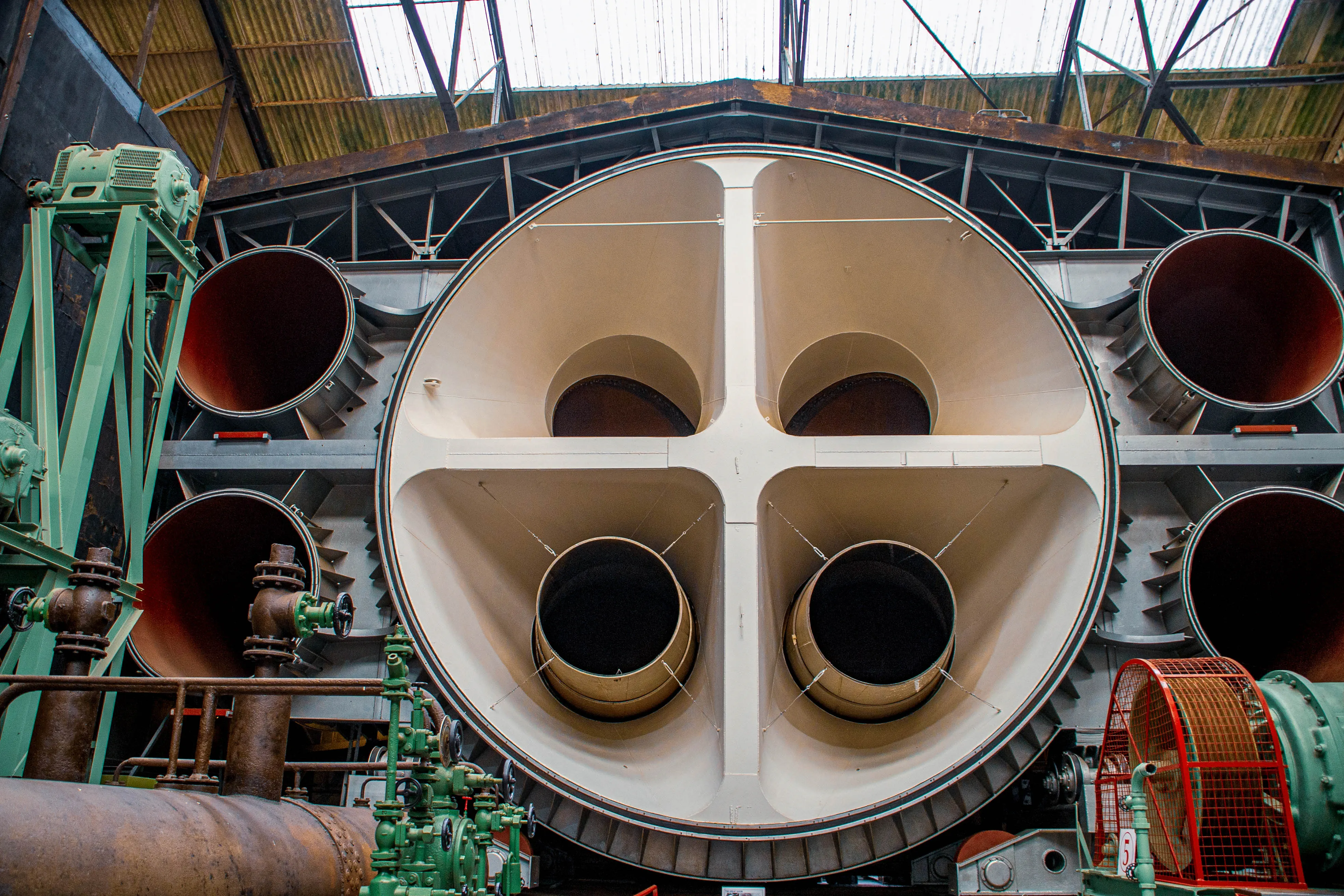
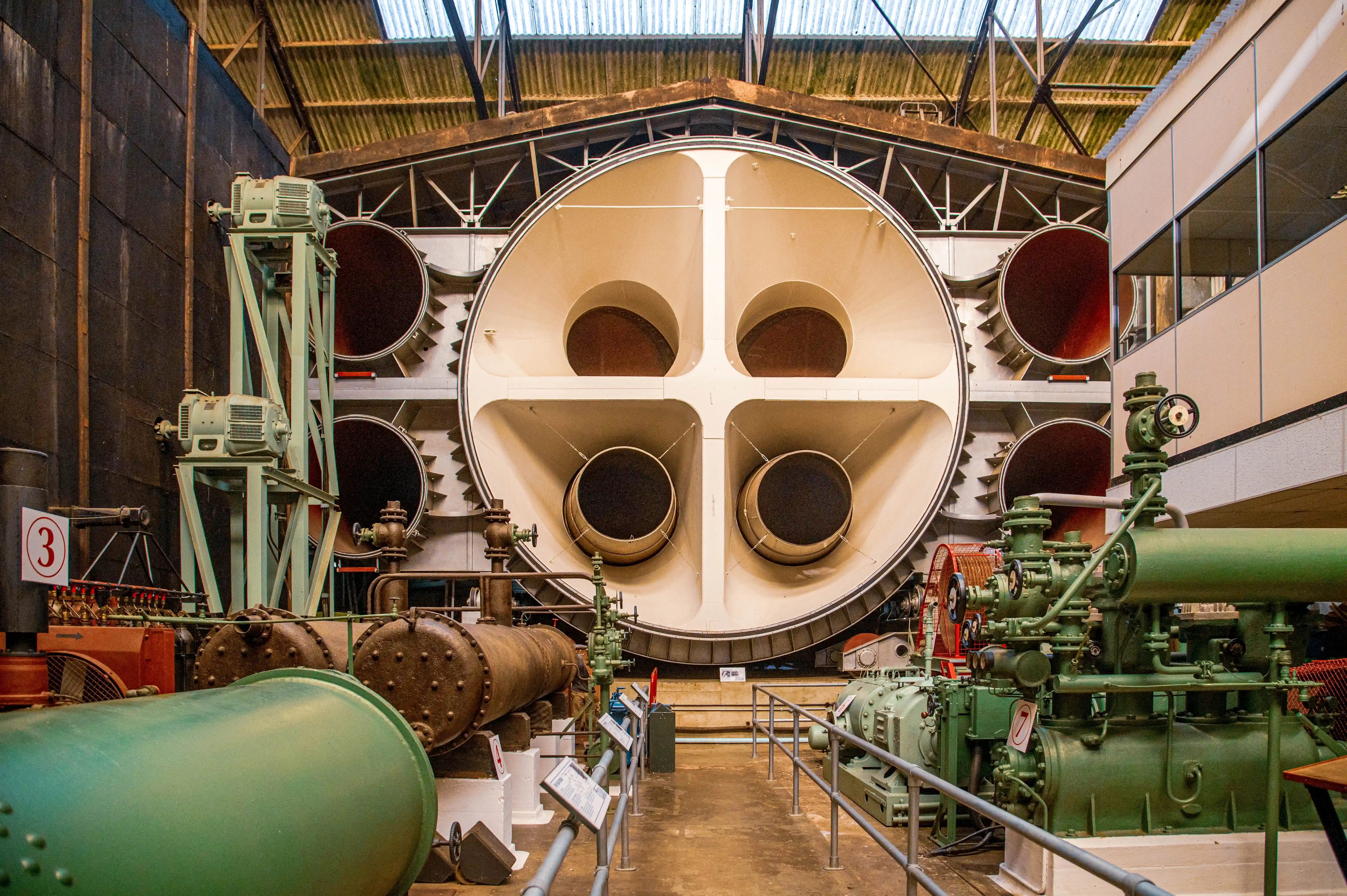
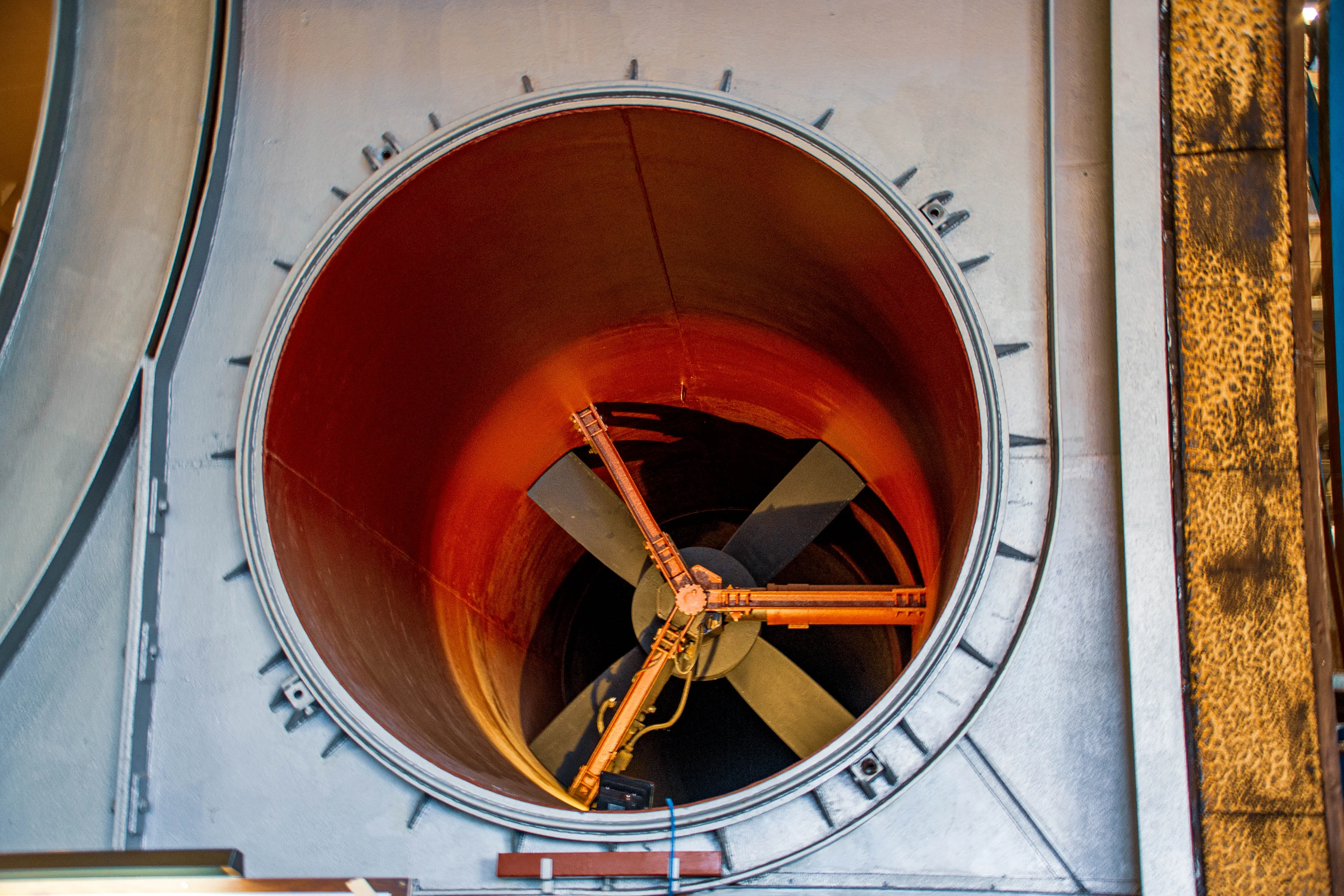
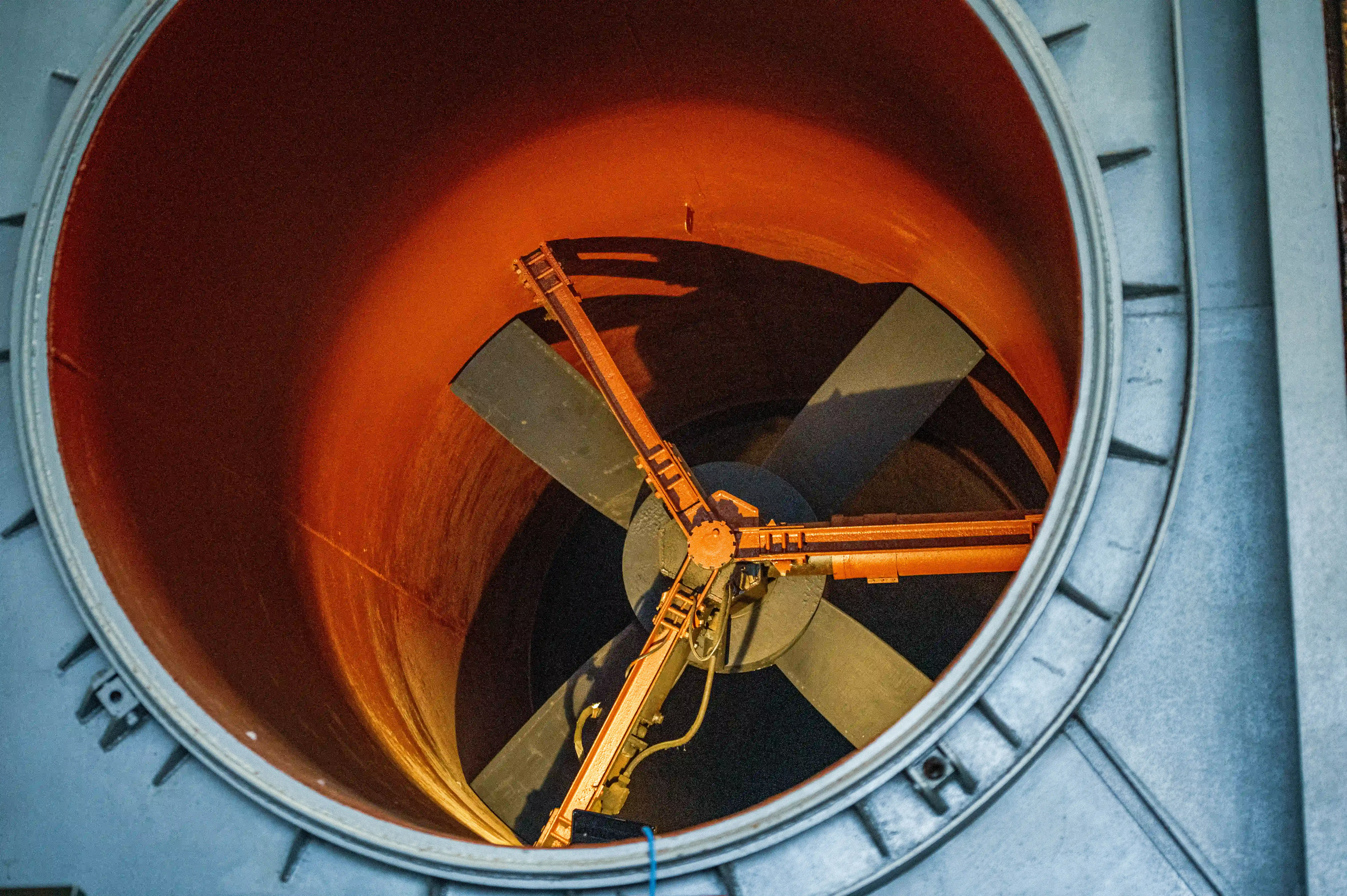
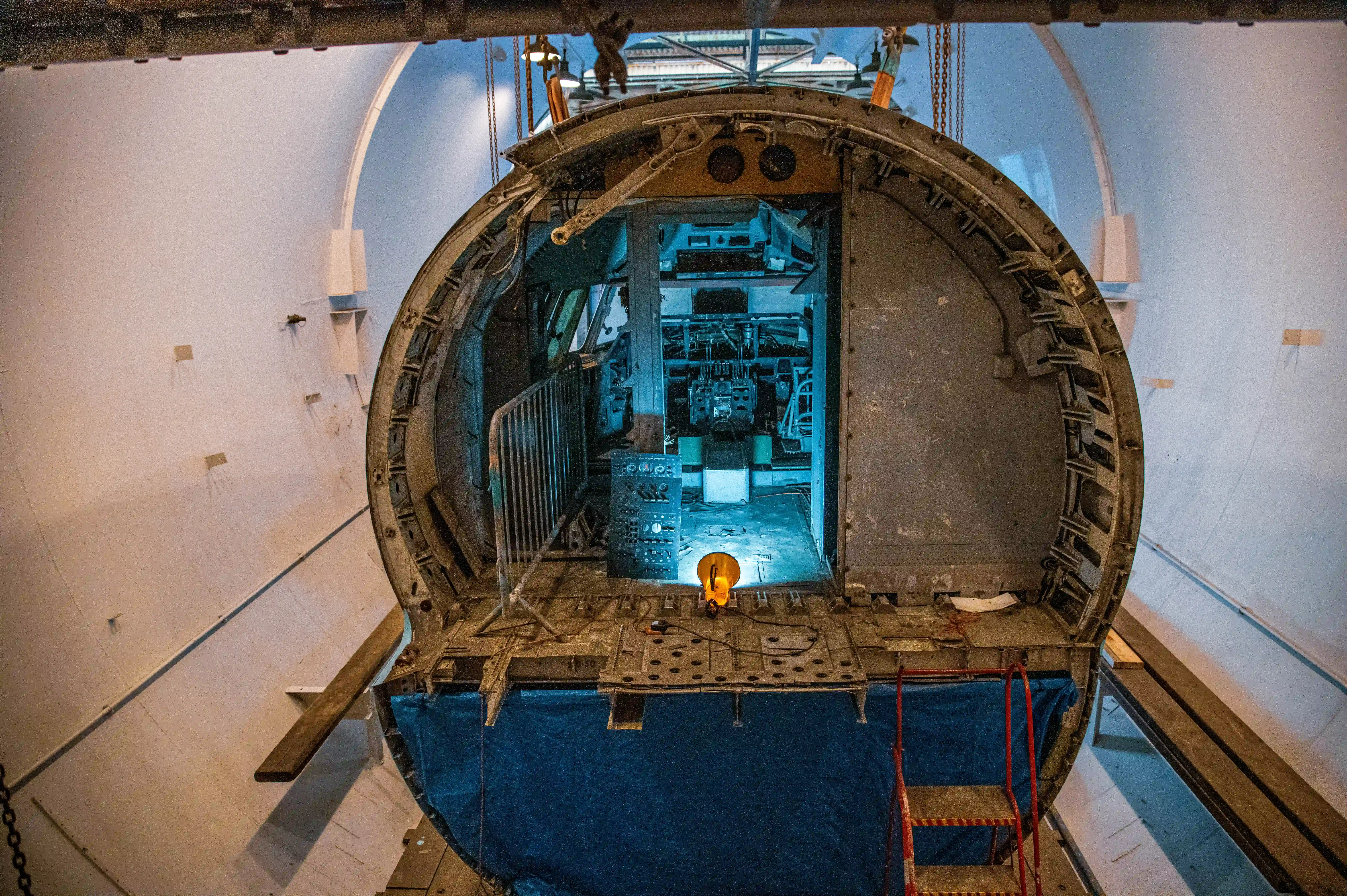
The Stratosphere Chamber at Brooklands Museum is a historic and innovative exhibit that highlights early aviation and space exploration technology. Originally built in the 1930s, the Stratosphere Chamber was used for testing aircraft components and equipment under high-altitude conditions, simulating the extreme environments encountered in the upper atmosphere. This chamber played a pivotal role in the development of aviation technology, particularly during the interwar years and World War II, when advancements in high-altitude flight were critical. Today, the Stratosphere Chamber is preserved as part of Brooklands Museum, offering visitors a unique glimpse into the history of aviation research and innovation.
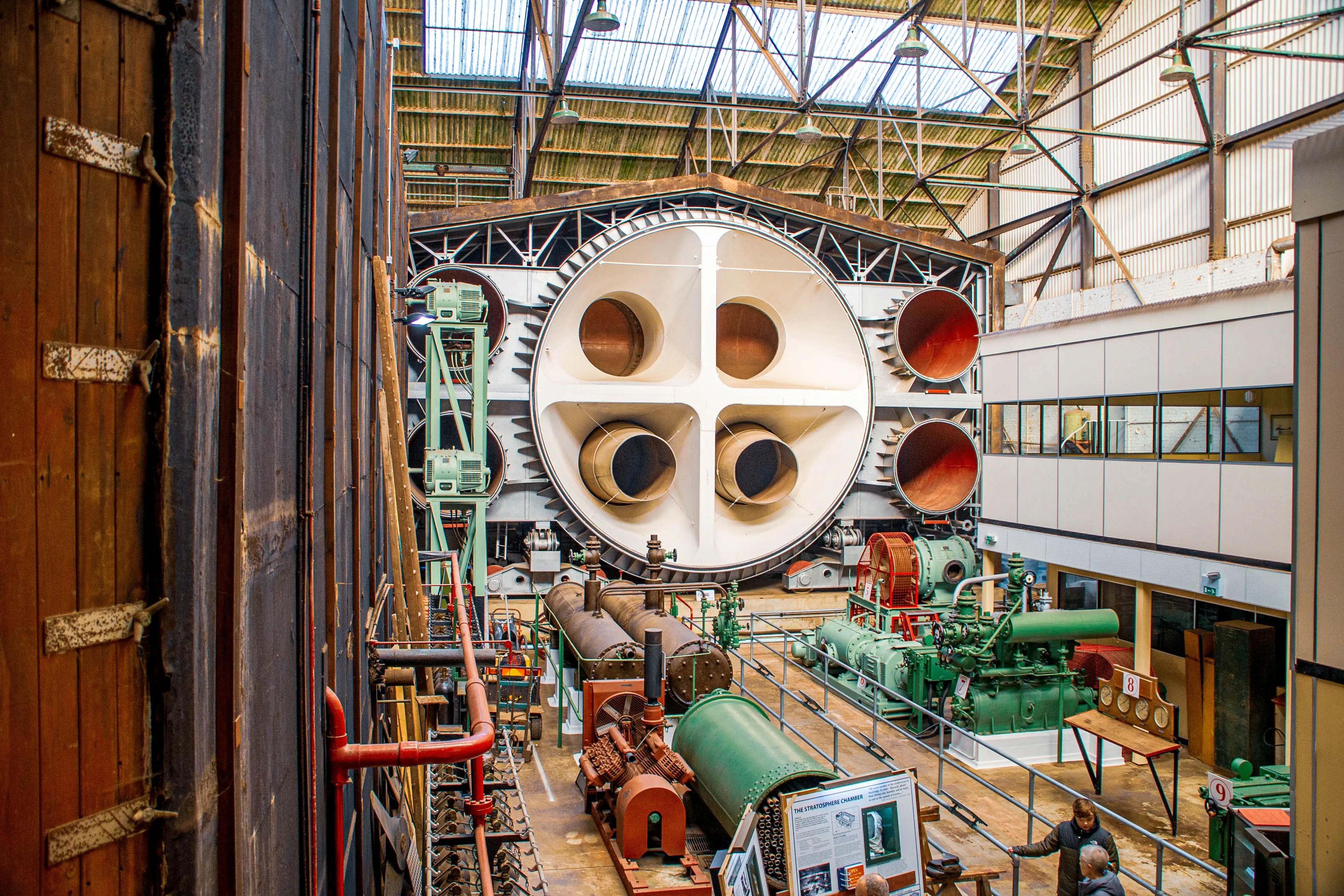
Interior view of a museum showcasing a large, circular scientific apparatus with multiple openings, surrounded by industrial machinery and equipment.
Stratosphere Chamber Plant Room
photo by
©www.mgaylard.co.uk.
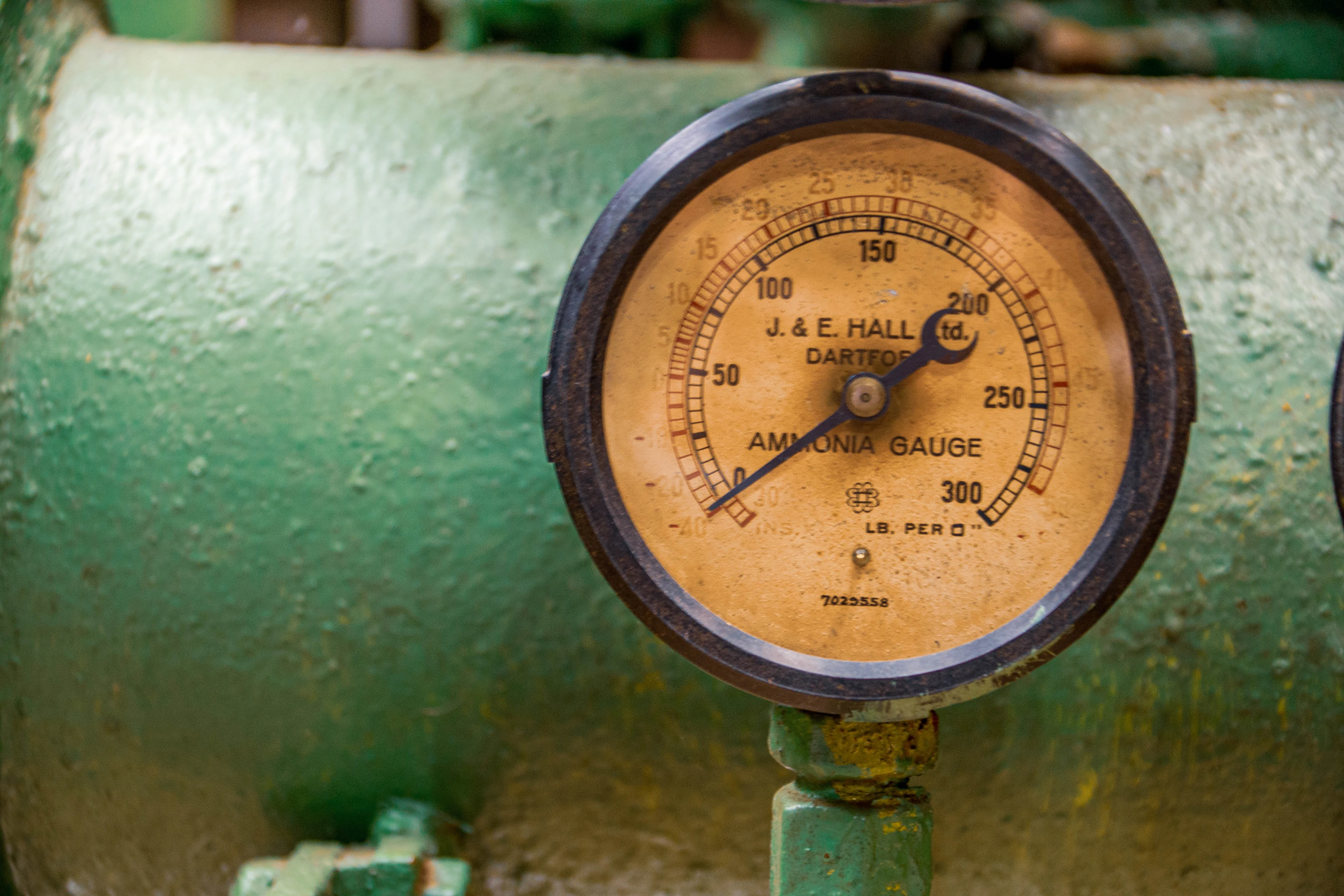
A circular, yellowed ammonia gauge with black markings and a dark blue needle is attached to a rough, green painted pipe. The gauge face reads AMMONIA GAUGE and J. & E. HALL TD. DARTFORD. The needle points to approximately 40 LB. PER
Stratosphere Chamber Plant Room
photo by
©www.mgaylard.co.uk.
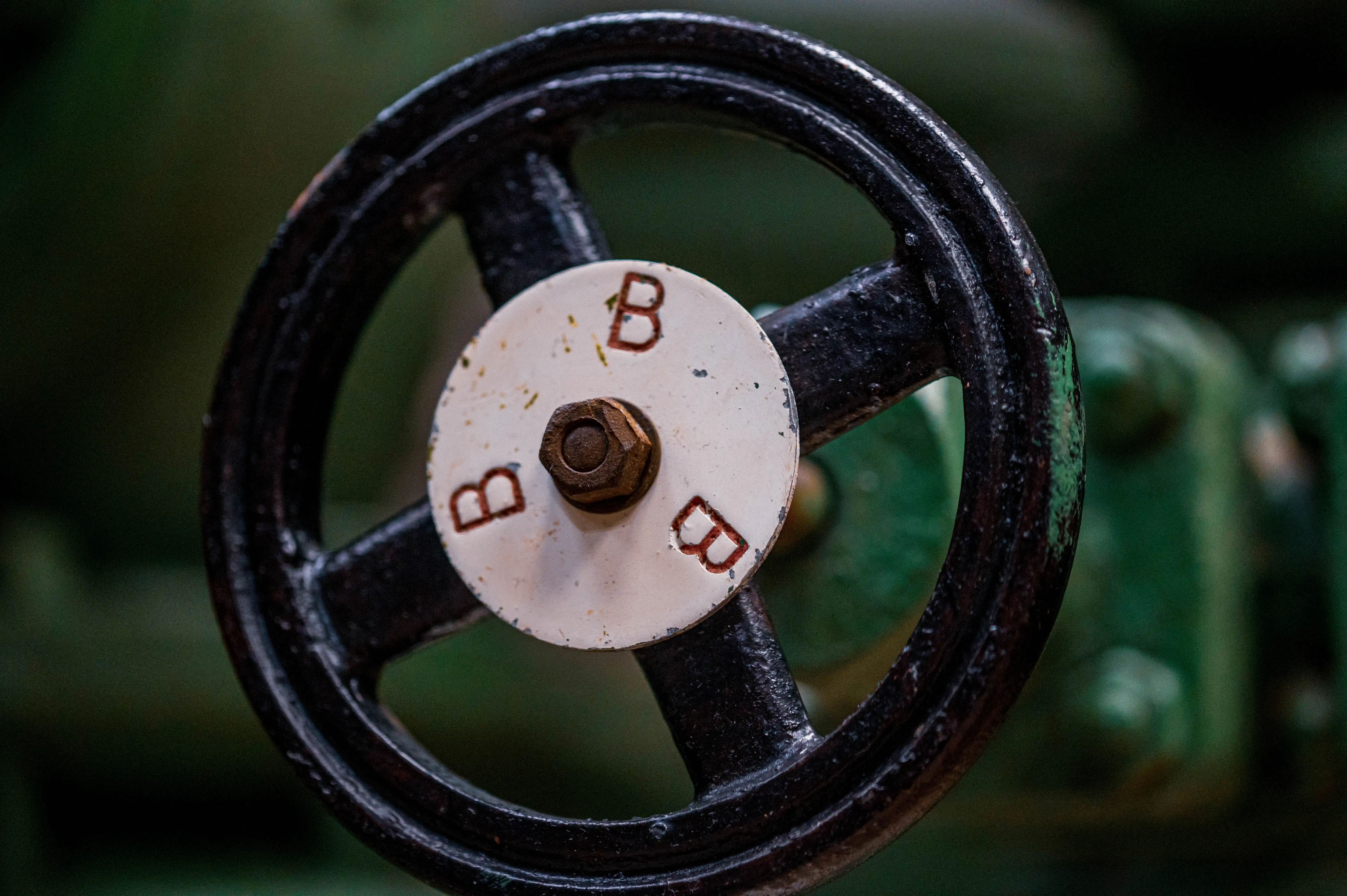
A close-up photograph of a black, industrial valve wheel with a white central cap. The cap features three red stencilled letters 'B' around a rusted bolt. The background is out of focus and a muted green colour.
Industrial Valve Wheel with 'B' Markings
photo by
©www.mgaylard.co.uk.
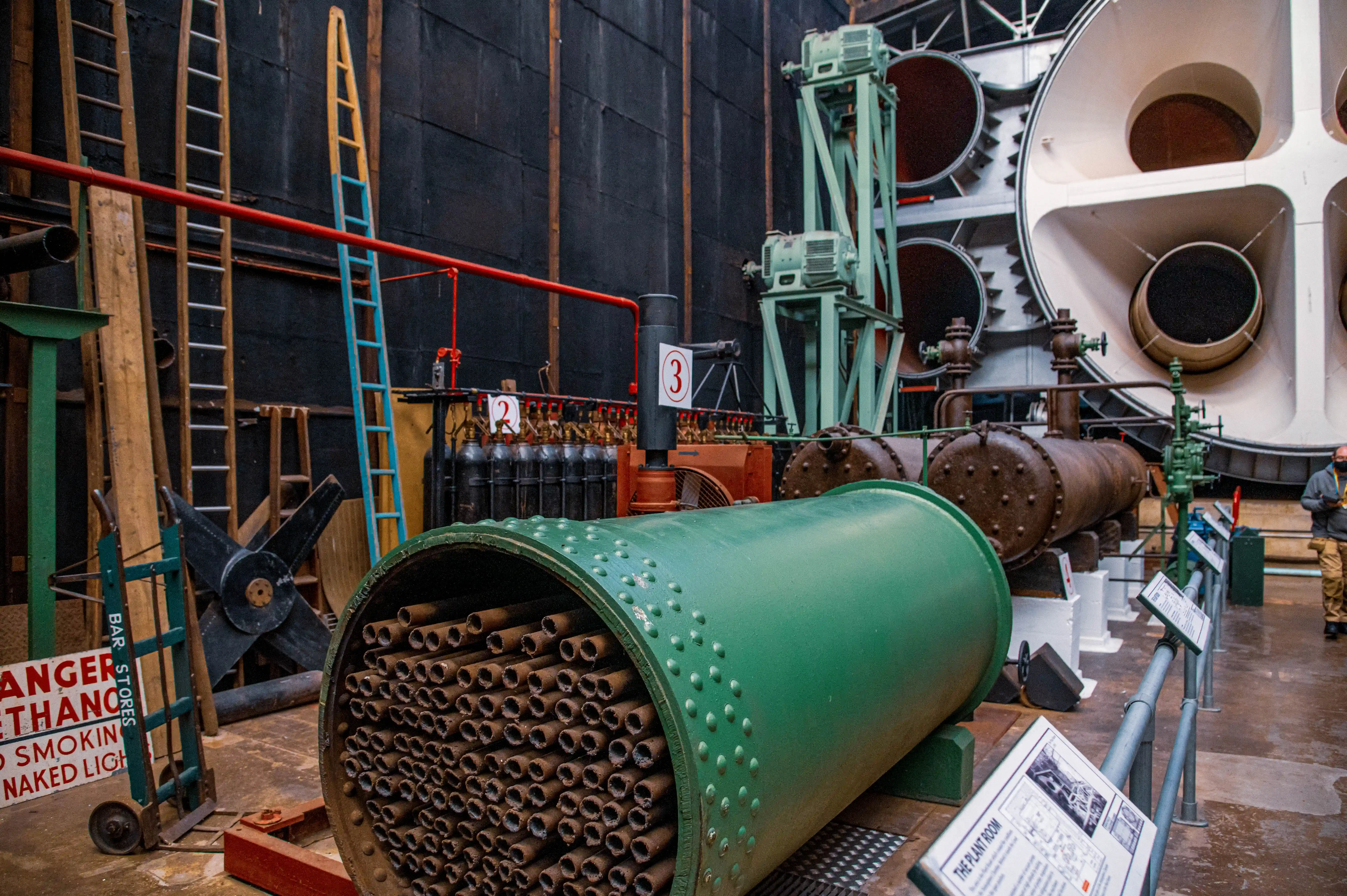
Industrial machinery displayed in a museum, including a green cylindrical unit with internal tubes, numbered tanks and surrounding pipes.
Industrial Machinery — Museum Exhibit
photo by
©www.mgaylard.co.uk.
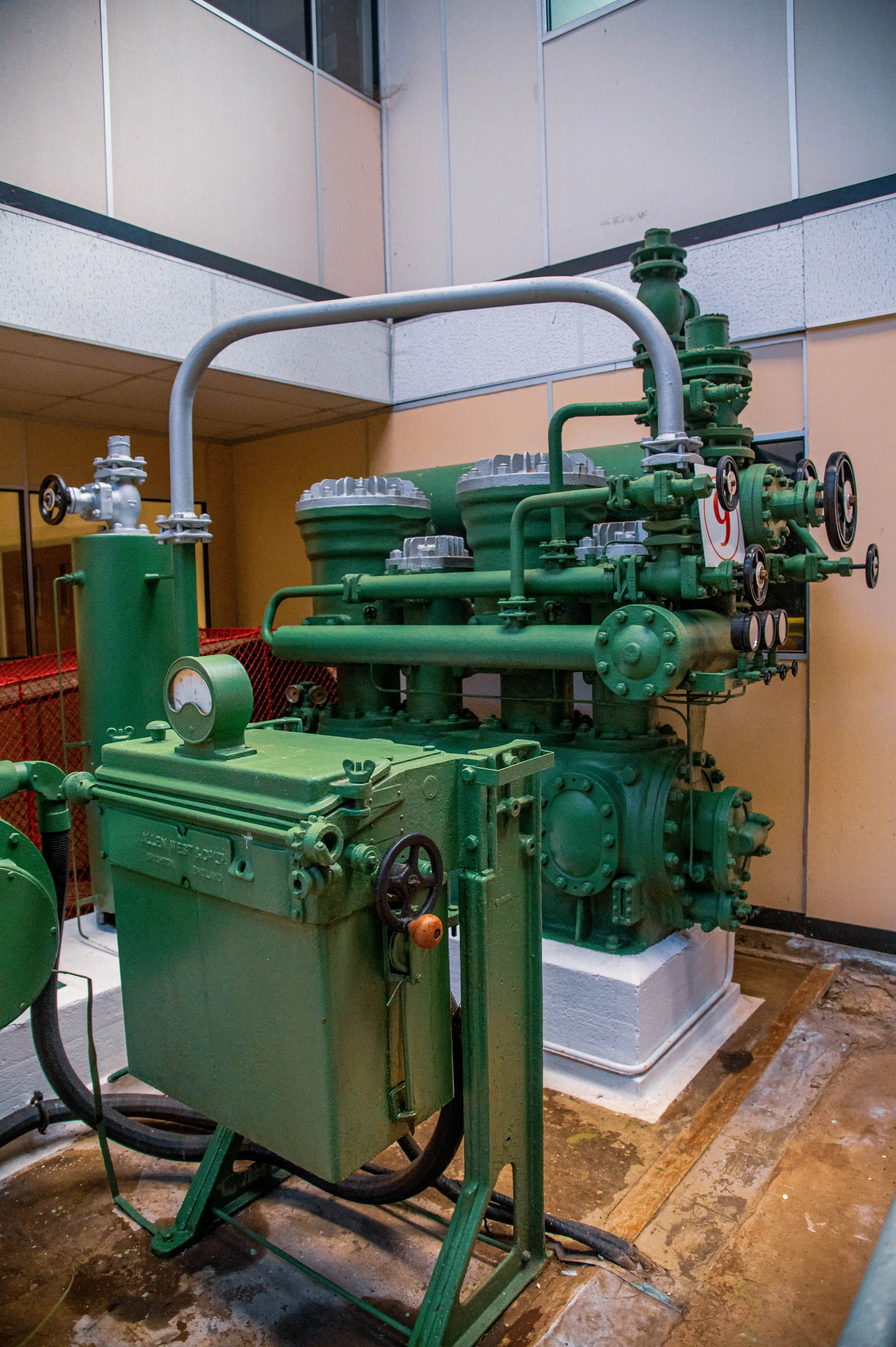
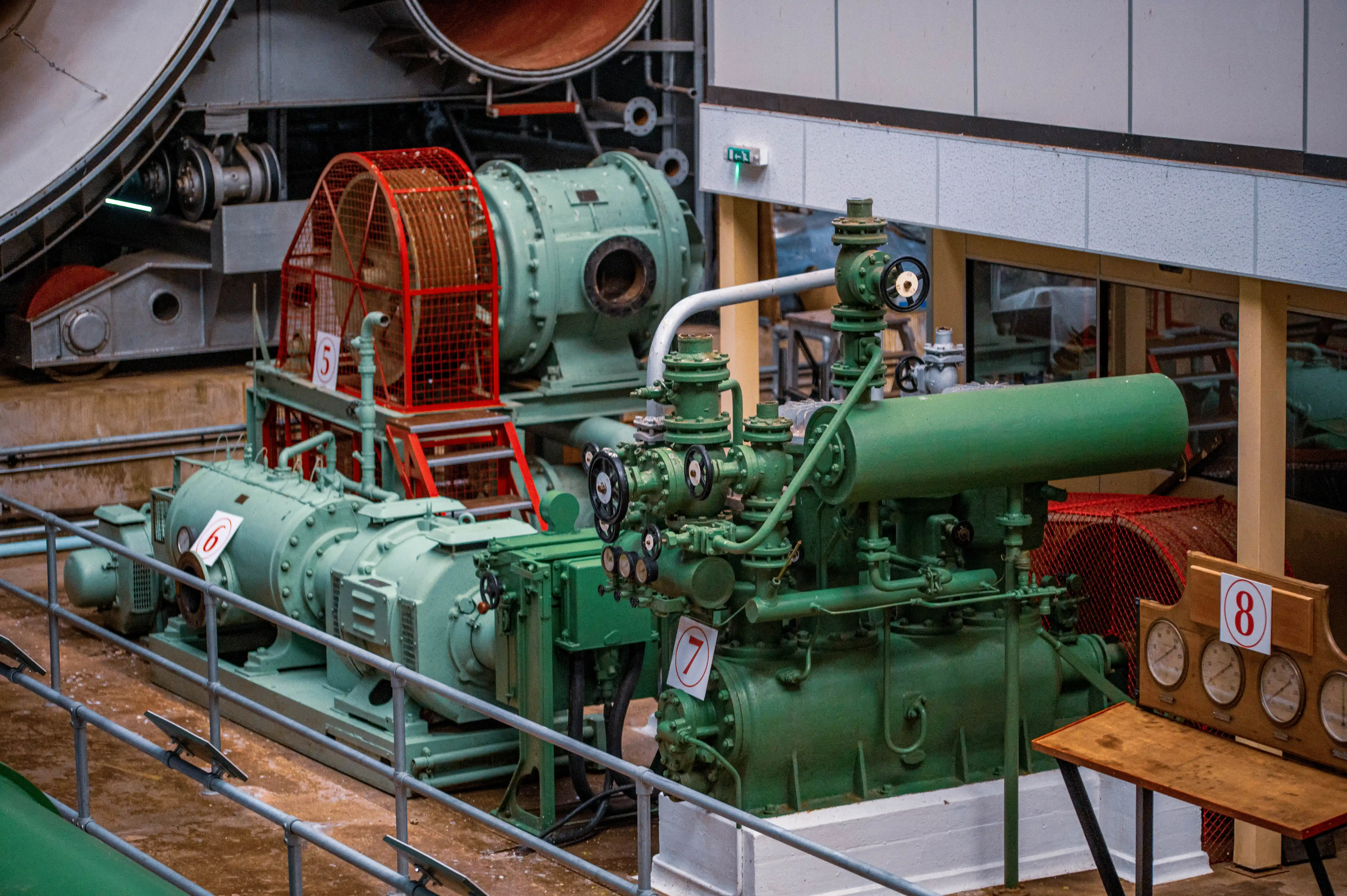
Green industrial compressor with pipes, valves and a pressure gauge displayed indoors behind a red safety barrier.
Industrial Compressor — Museum Exhibit
photo by
©www.mgaylard.co.uk.
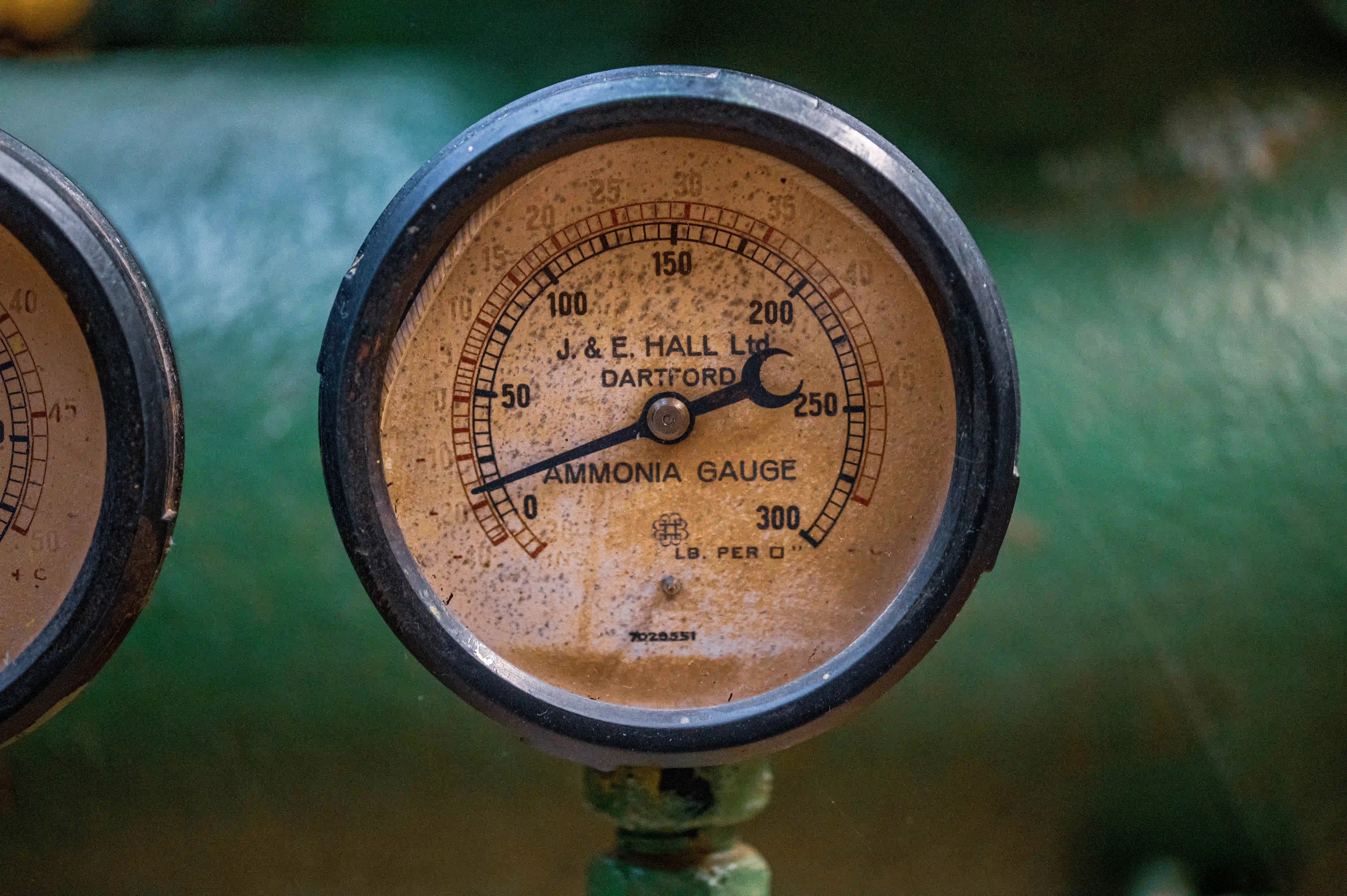
A close-up of an old ammonia pressure gauge with a dial face showing markings from 0 to 300 lb. per sq. in. and a needle indicating around 120 lb. per sq. in.
Vintage J. & E. Hall Ltd Ammonia Gauge
photo by
©www.mgaylard.co.uk.
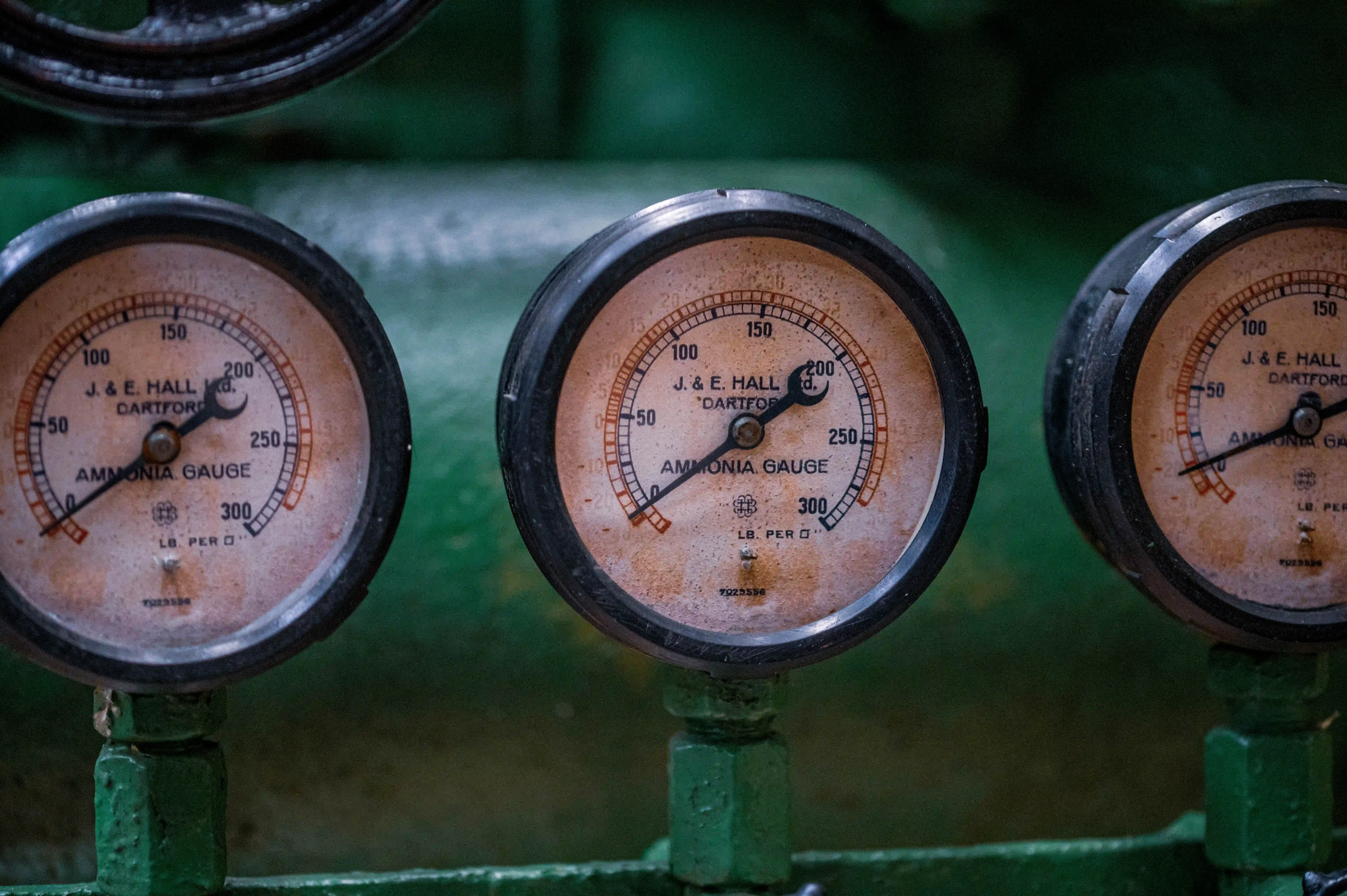
Three circular, old-fashioned ammonia pressure gauges are arranged horizontally against a blurred green background. Each gauge has a white face with black and red markings, a central needle, and text indicating J. & E. HALL LTD. DARTFORD AMMONIA GAUGE.
Vintage Ammonia Gauges
photo by
©www.mgaylard.co.uk.
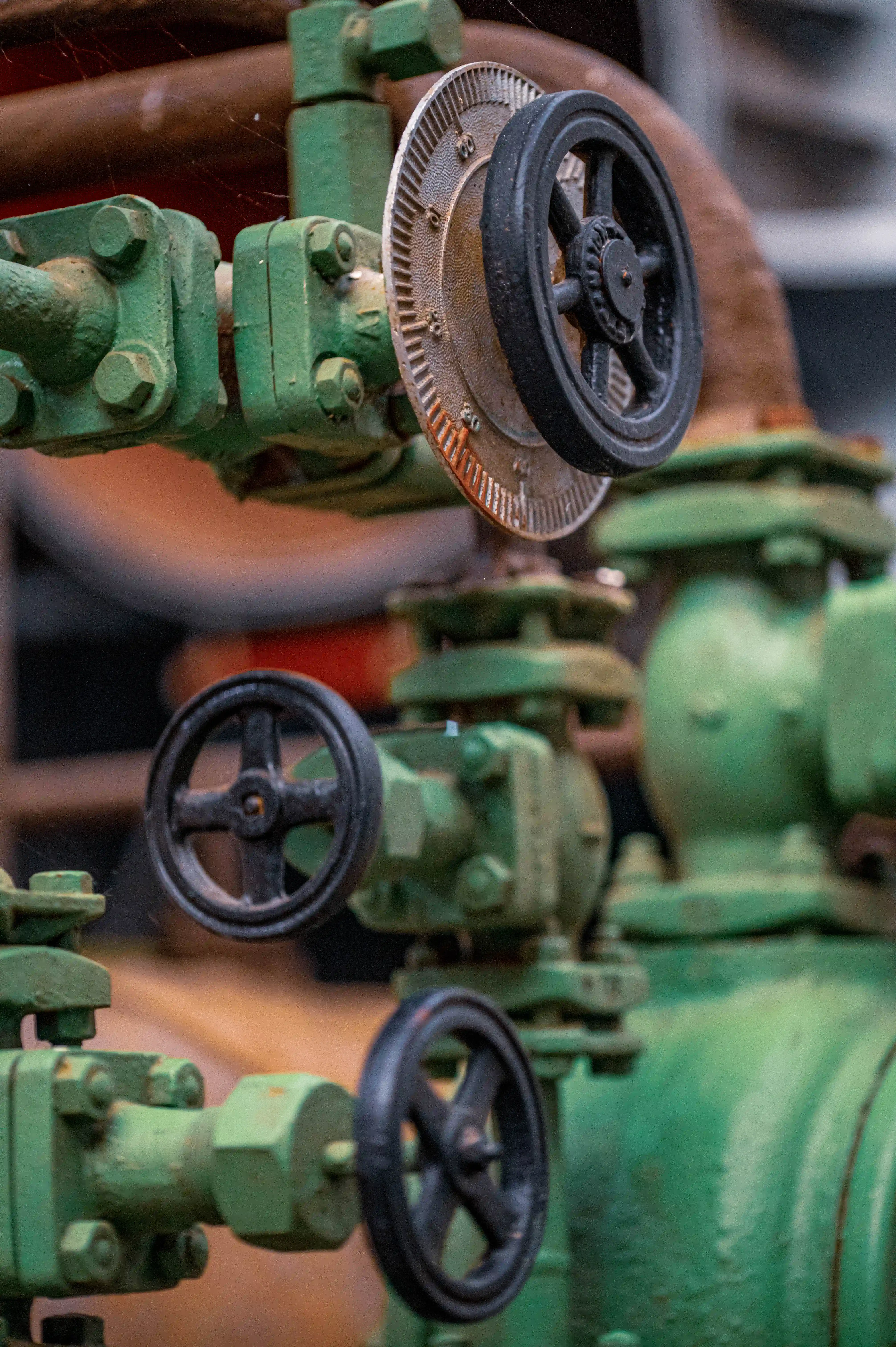
A detailed shot of industrial pipes and valves painted green, with several black handwheels used for operation.
Industrial Valves and Pipework
photo by
©www.mgaylard.co.uk.
meta itemprop="encodingFormat" content="image/jpeg">
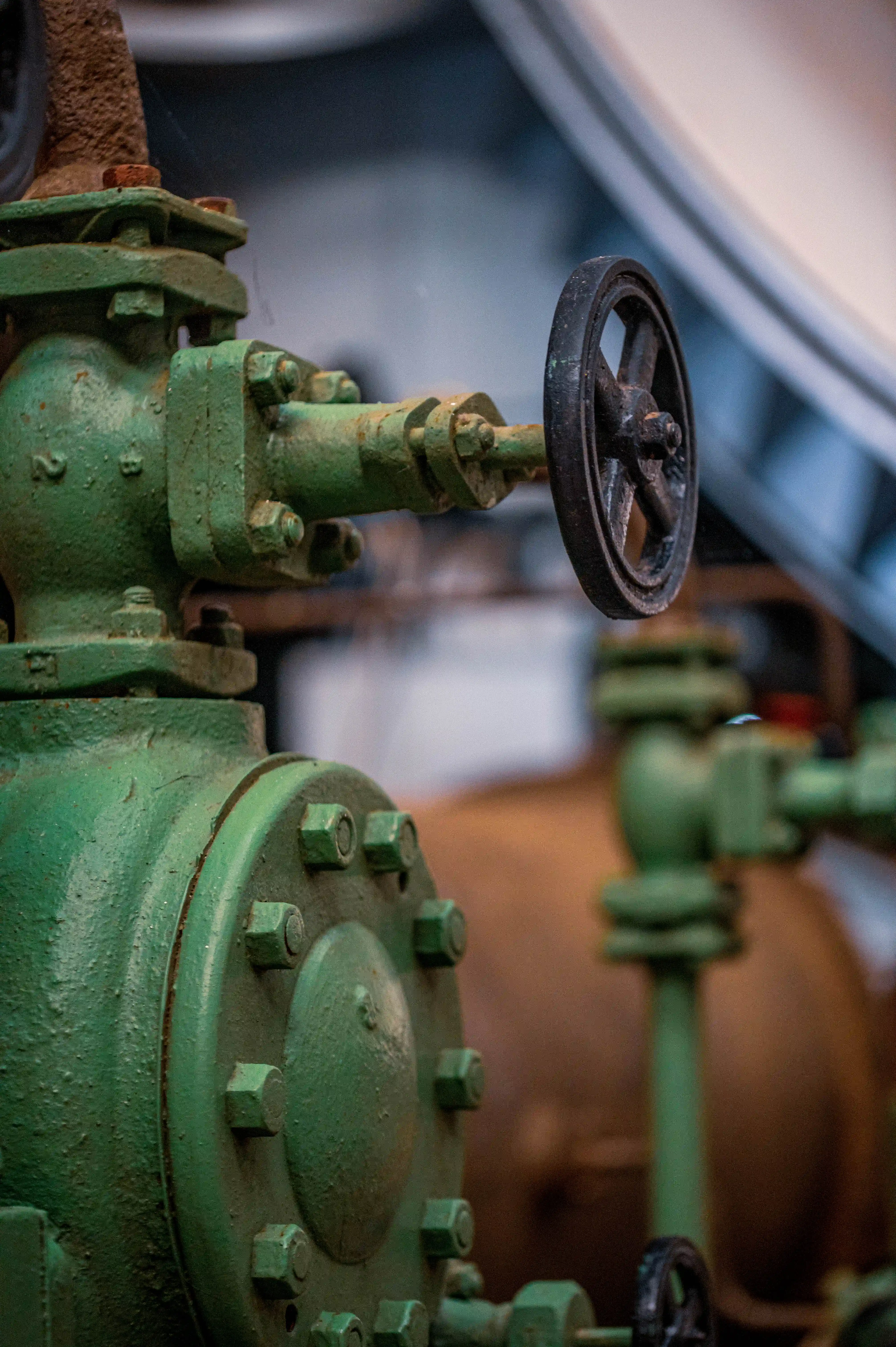
Close-up of a vintage green industrial valve with a black wheel, showing a textured surface and rust on the connecting pipe.
Industrial Valve Close-Up
photo by
©www.mgaylard.co.uk.
meta itemprop="encodingFormat" content="image/jpeg">
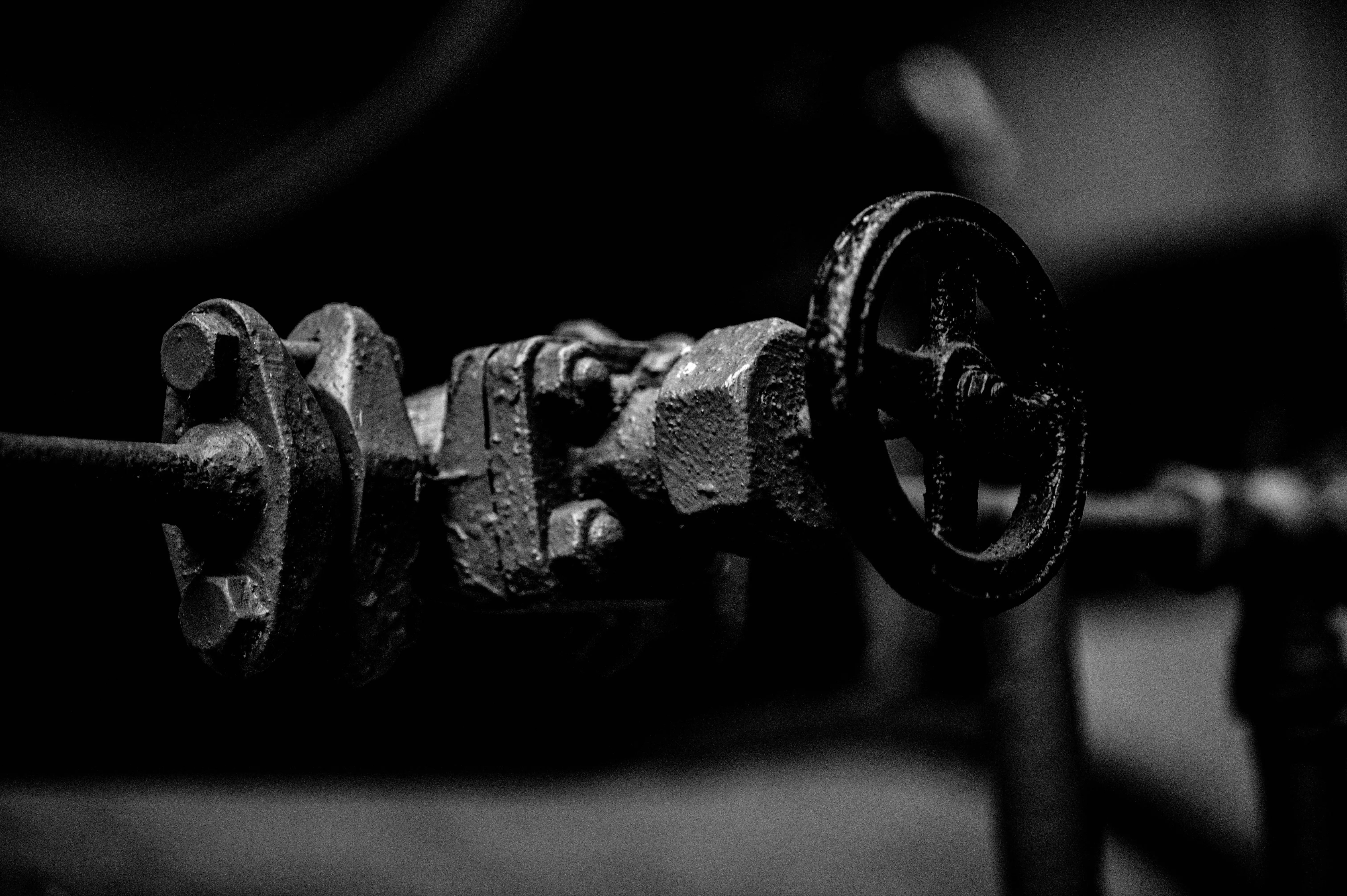
A monochrome close-up image of an industrial valve with a handwheel, showcasing its rough, metallic texture and bolted construction.
Industrial Valve Detail
photo by
©www.mgaylard.co.uk.
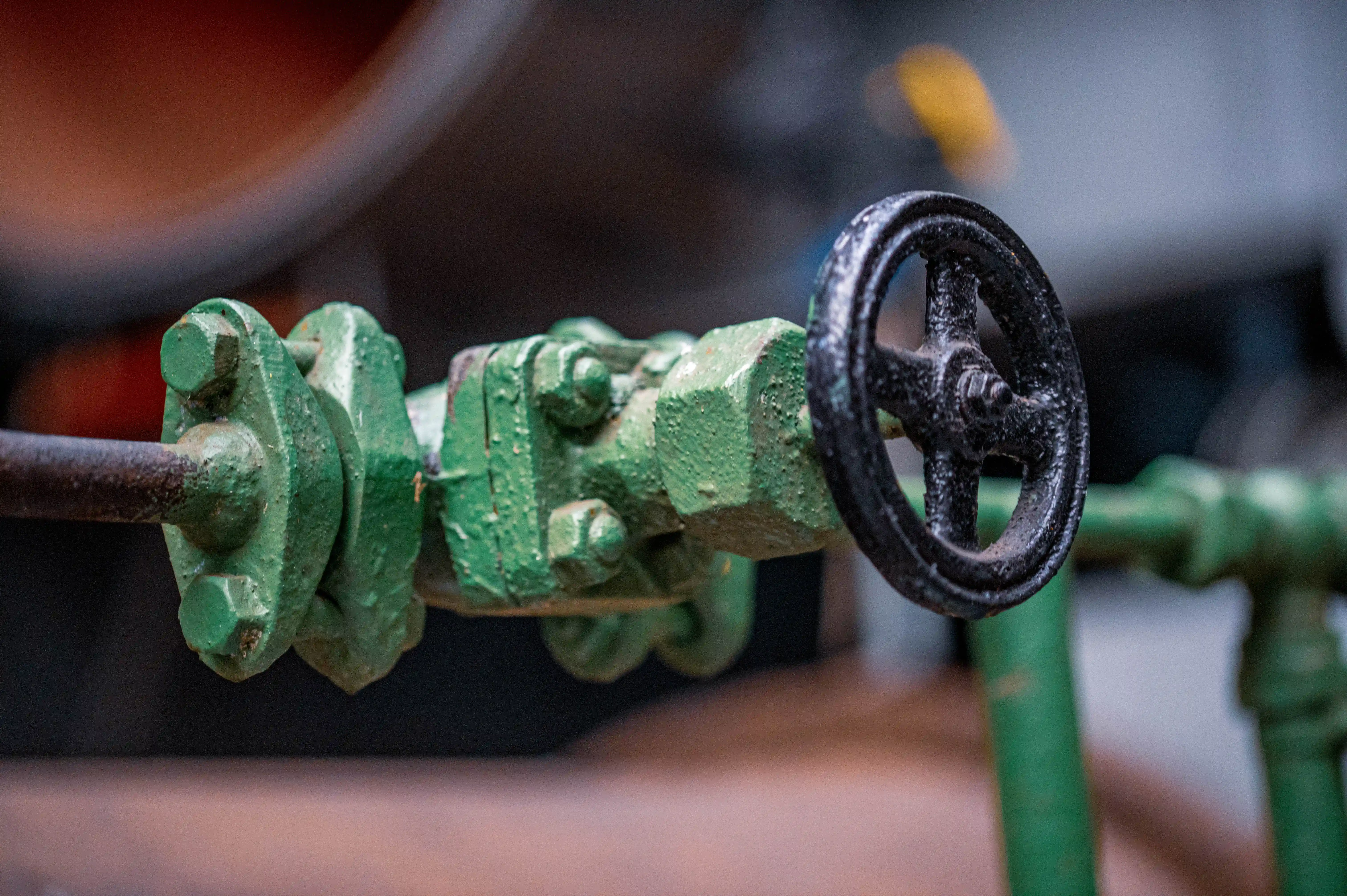
Close-up of a textured, green industrial valve with a black handwheel, set against a softly blurred background.
Industrial Valve Wheel
photo by
©www.mgaylard.co.uk.
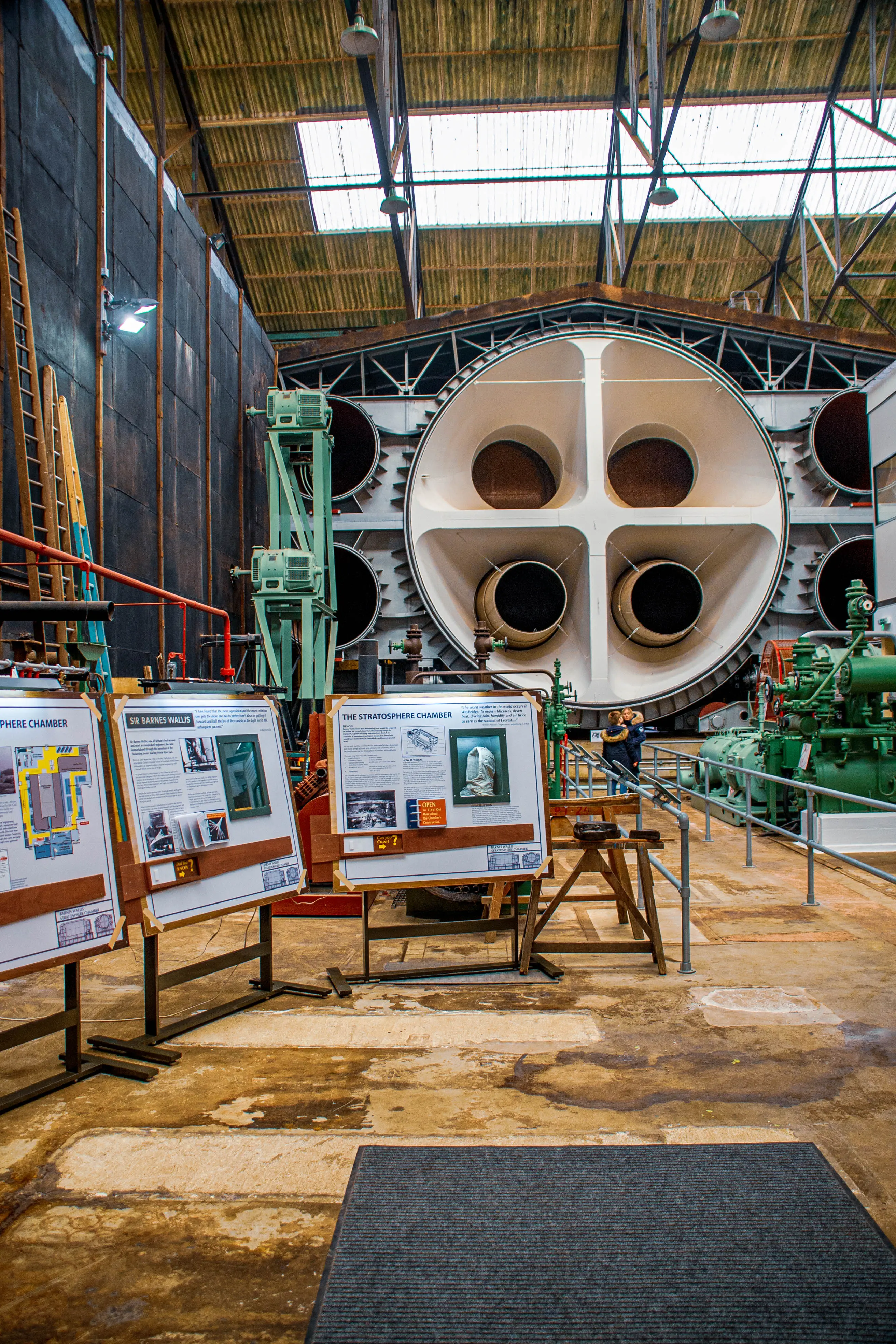
Display boards detailing the Stratosphere Chamber and Sir Barnes Wallis are positioned in front of a large, round, industrial engineering structure with multiple large openings.
Exhibition of Stratosphere Chamber and Engineering History
photo by
©www.mgaylard.co.uk.
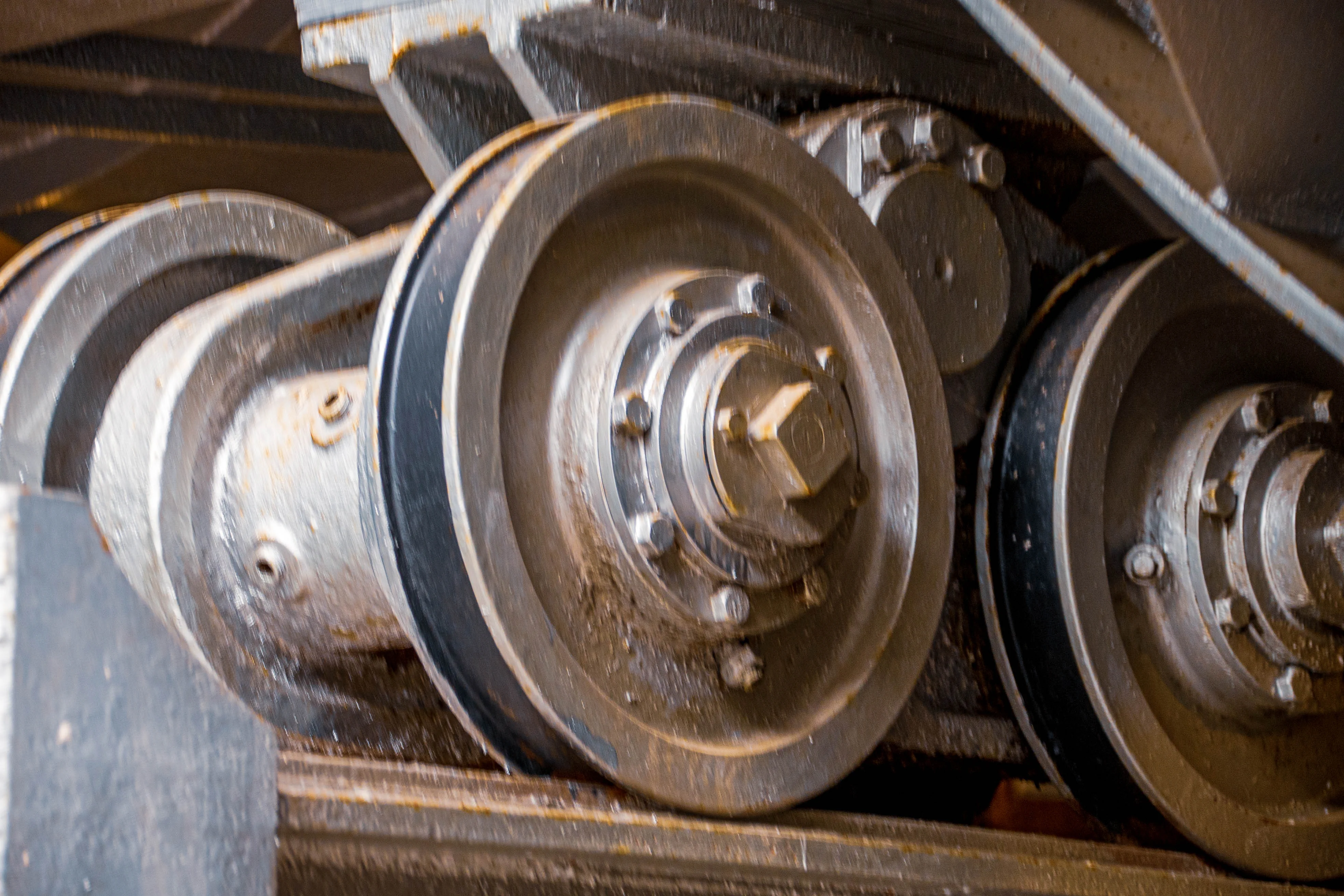
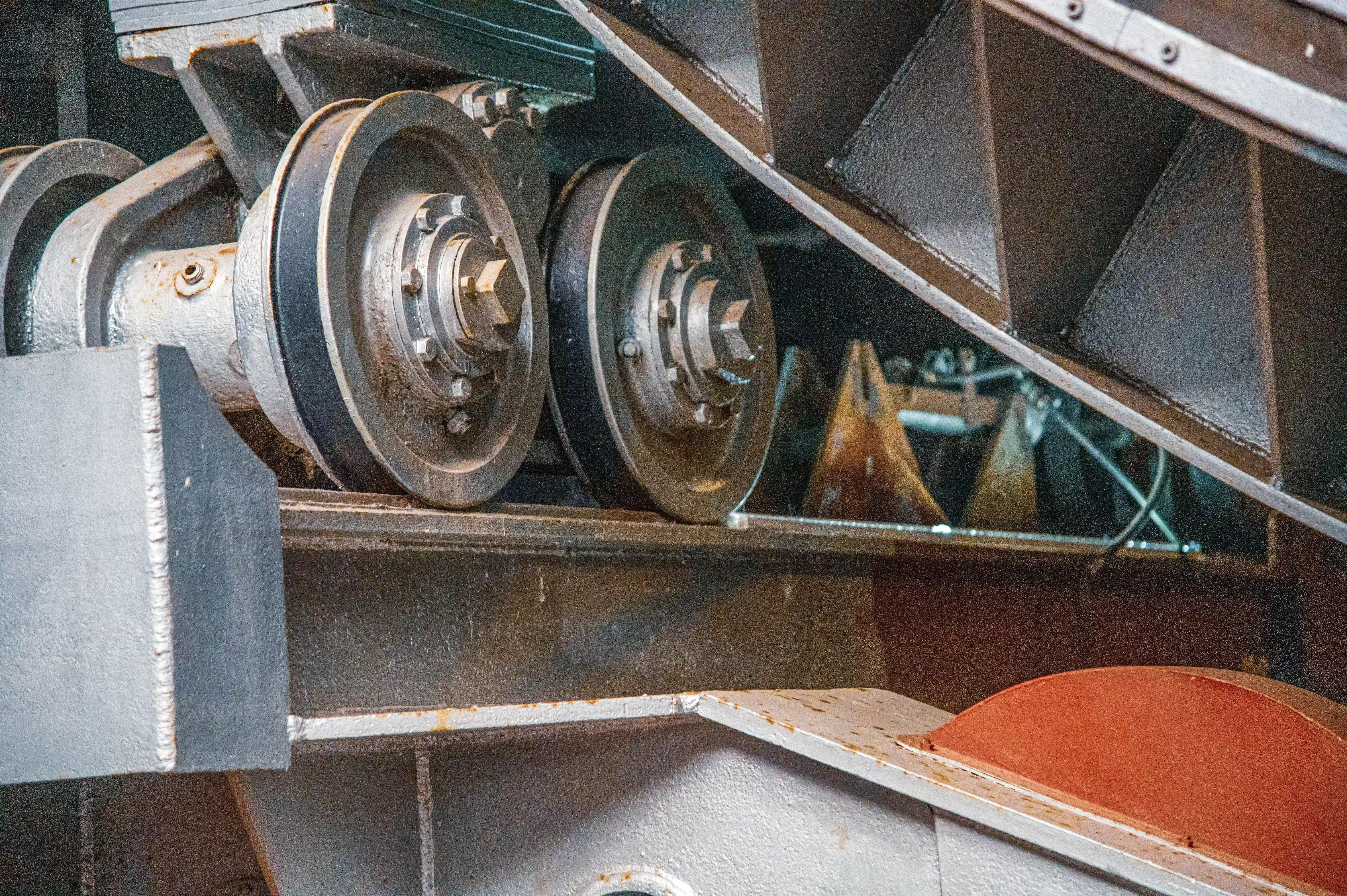
Close-up view of several heavy-duty industrial wheels, each with a black rubber or composite band around its circumference, mounted on metal axes with visible bolts.
Industrial Machinery Wheels
photo by
©www.mgaylard.co.uk.
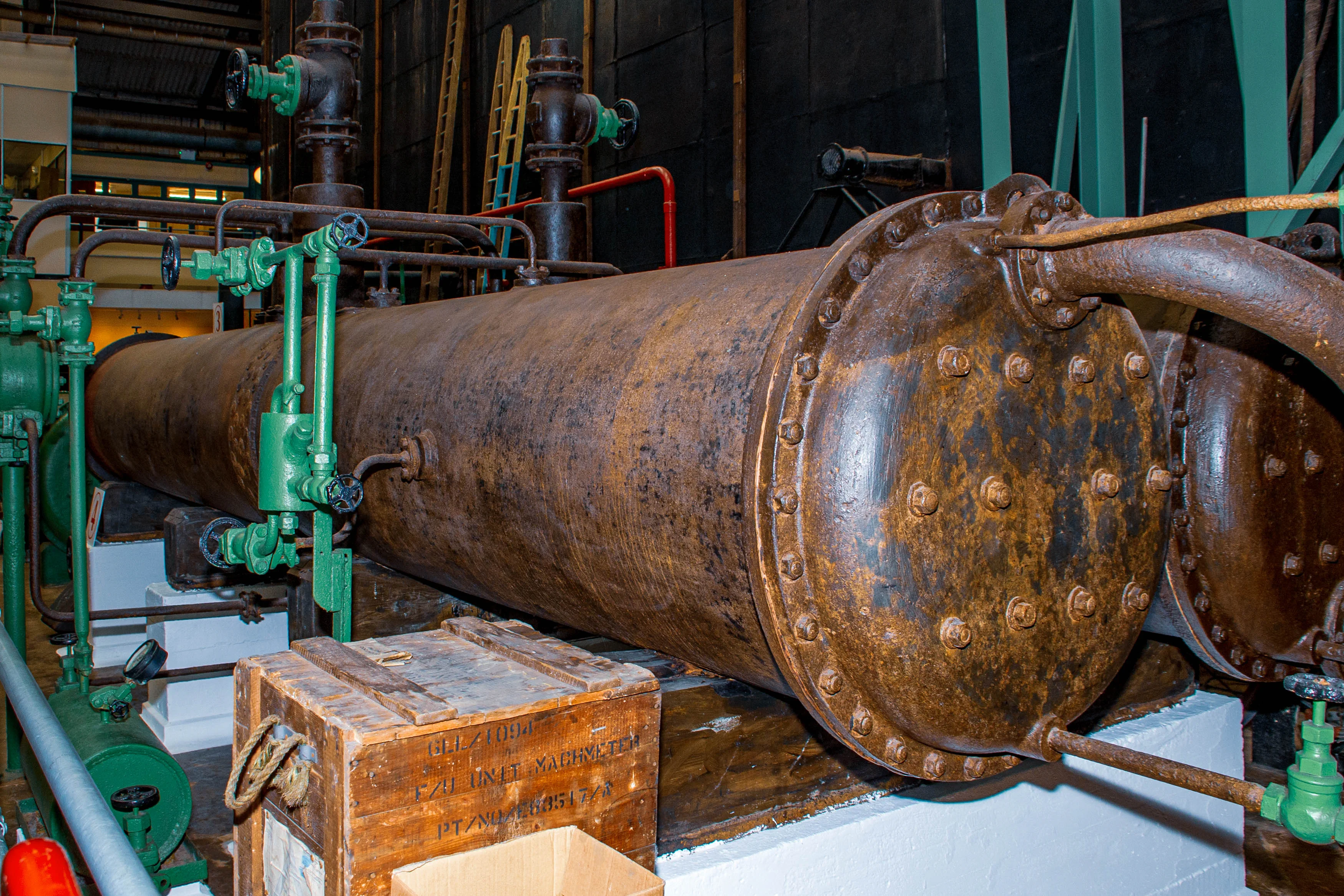
A large, rusty, cylindrical steam boiler with bolted end caps and an intricate system of pipes and valves in an industrial setting. A wooden crate is placed in front of the boiler.
Industrial Valve Detail
photo by
©www.mgaylard.co.uk.
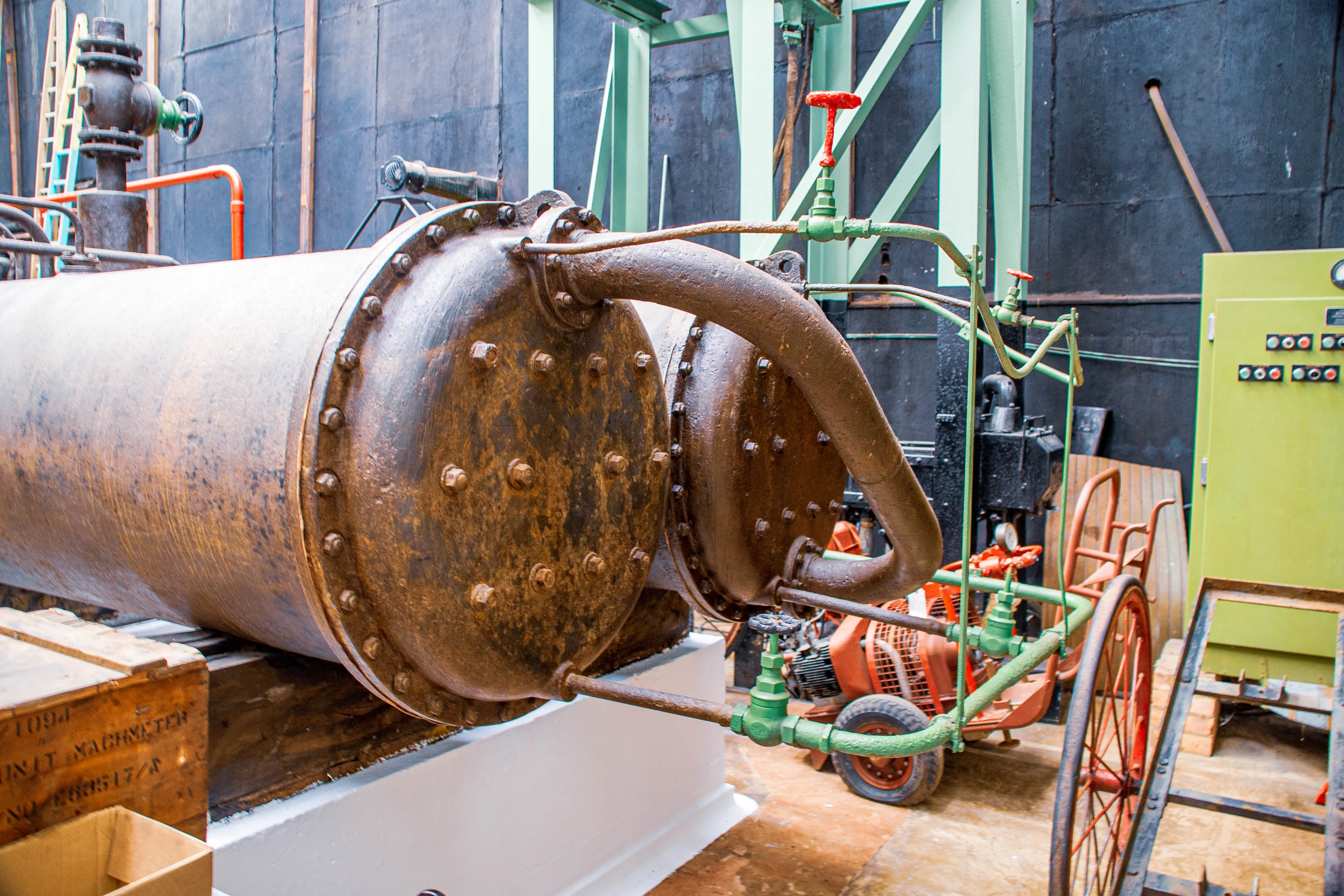
A detailed shot of a large, corroded cylindrical tank with a series of visible bolts around its circumference. Green pipes connect to the tank and lead to other industrial equipment, including a small orange engine with wheels and a green electrical cabinet with buttons.
Vintage Industrial Machinery Display
photo by
©www.mgaylard.co.uk.
Close-up of heavy industrial wheels and rollers fixed to a steel frame with bolts and nuts.
Industrial Wheel and Roller Assembly
photo by
©www.mgaylard.co.uk.
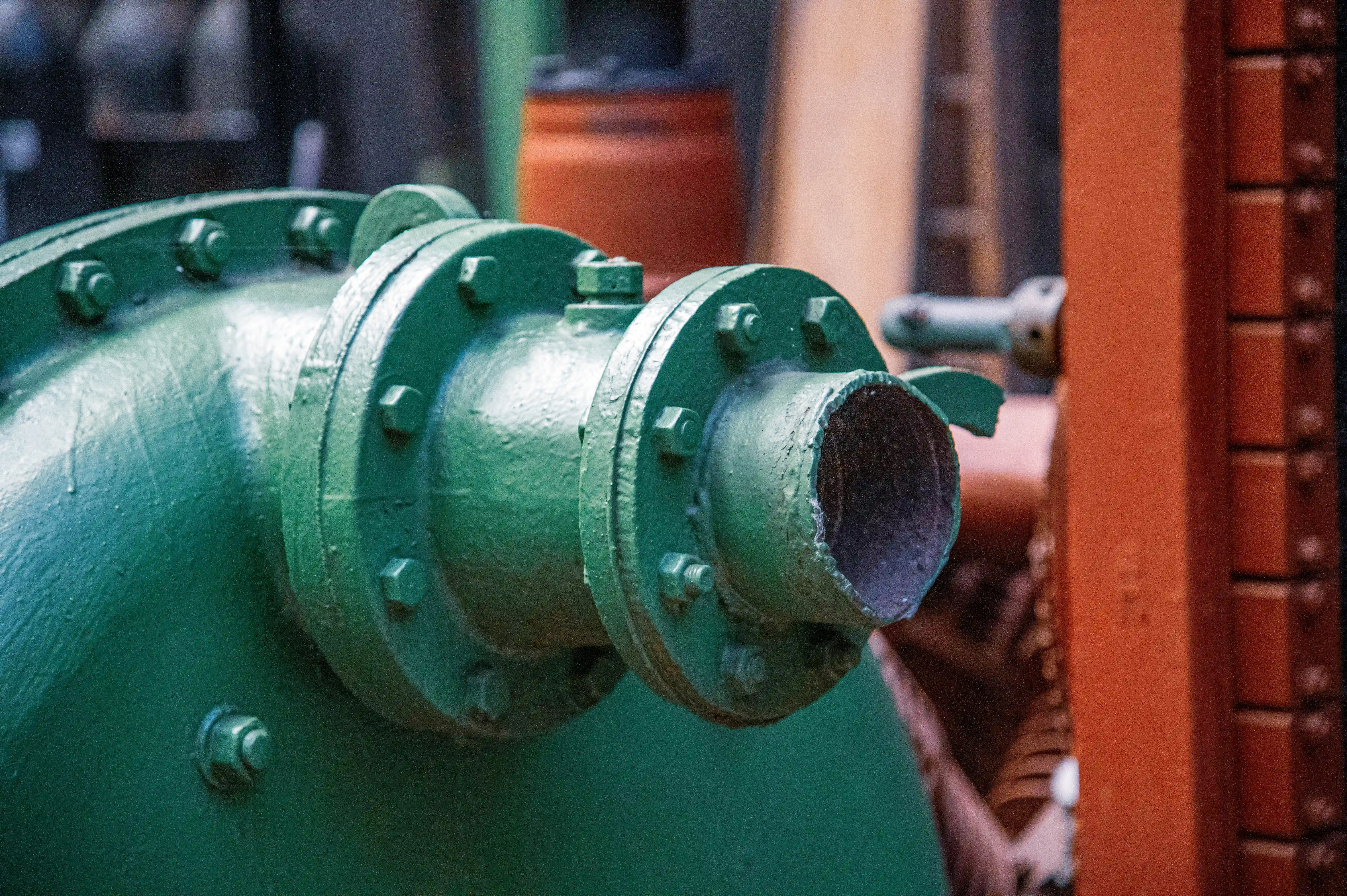
Close-up of a sturdy, green painted metal pipe joint with multiple bolts securing a flange. The end of a connecting pipe is visible and open.
Industrial Pipe Flange Detail
photo by
©www.mgaylard.co.uk.
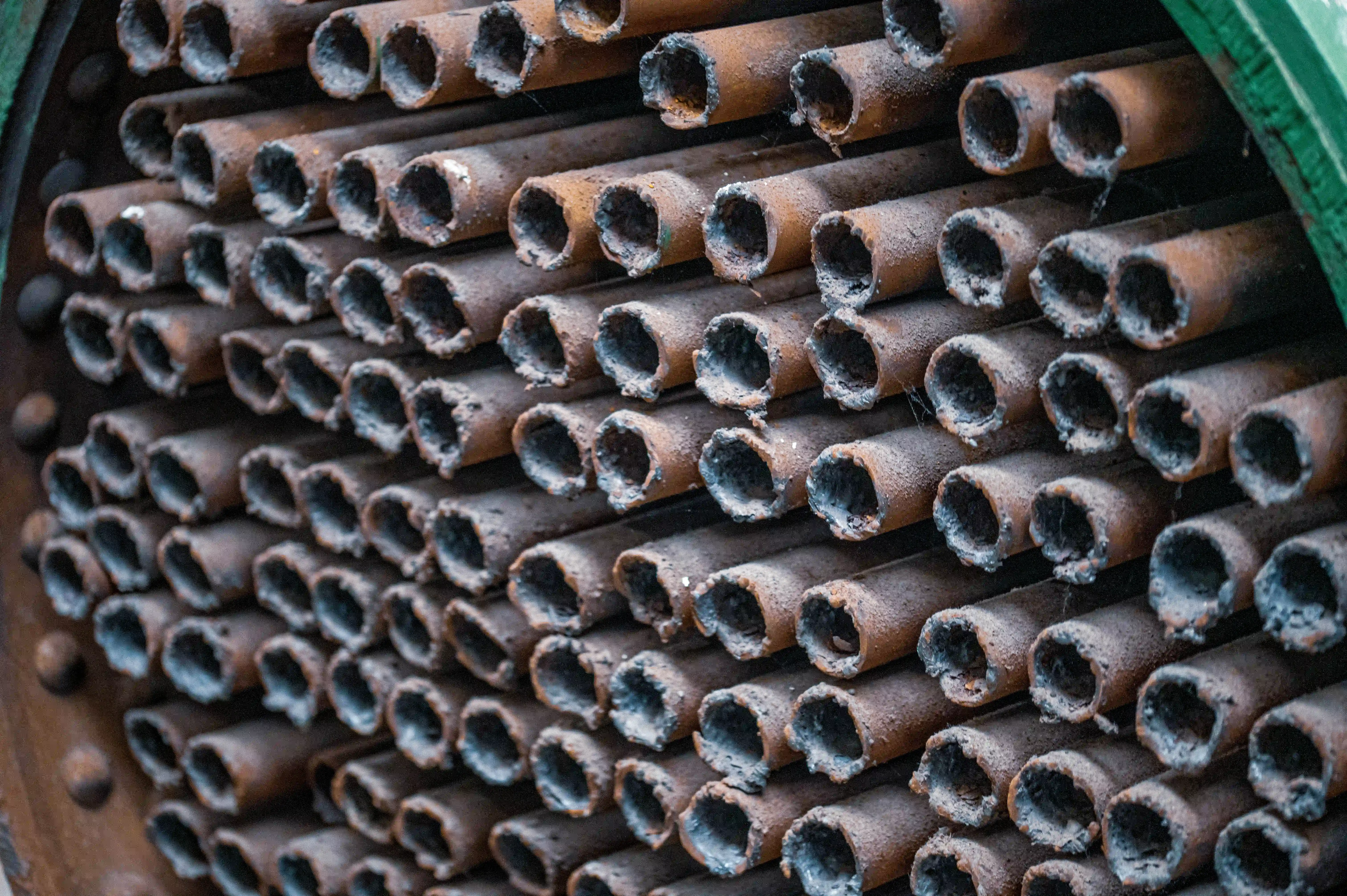
Close-up, eye-level shot of a densely packed bank of narrow, cylindrical metal tubes. The tubes are oriented horizontally and arranged in staggered rows, creating a repeating pattern. They are heavily textured with rust, appearing brown and orange, with some areas showing a greyish residue or soot accumulation around the open ends. The interiors of the tubes are dark. On the far right, a sliver of a dark green, metallic edge is visible, likely part of the boiler's casing. The lighting highlights the rough surface of the metal.
Corroded Boiler Tube
photo by
©www.mgaylard.co.uk.
Close-up view of vintage industrial machinery in a dimly lit setting, with prominent green painted components, red safety cages, and various numbered labels and gauges visible.
Vintage Industrial Compressors and Machinery
photo by
©www.mgaylard.co.uk.
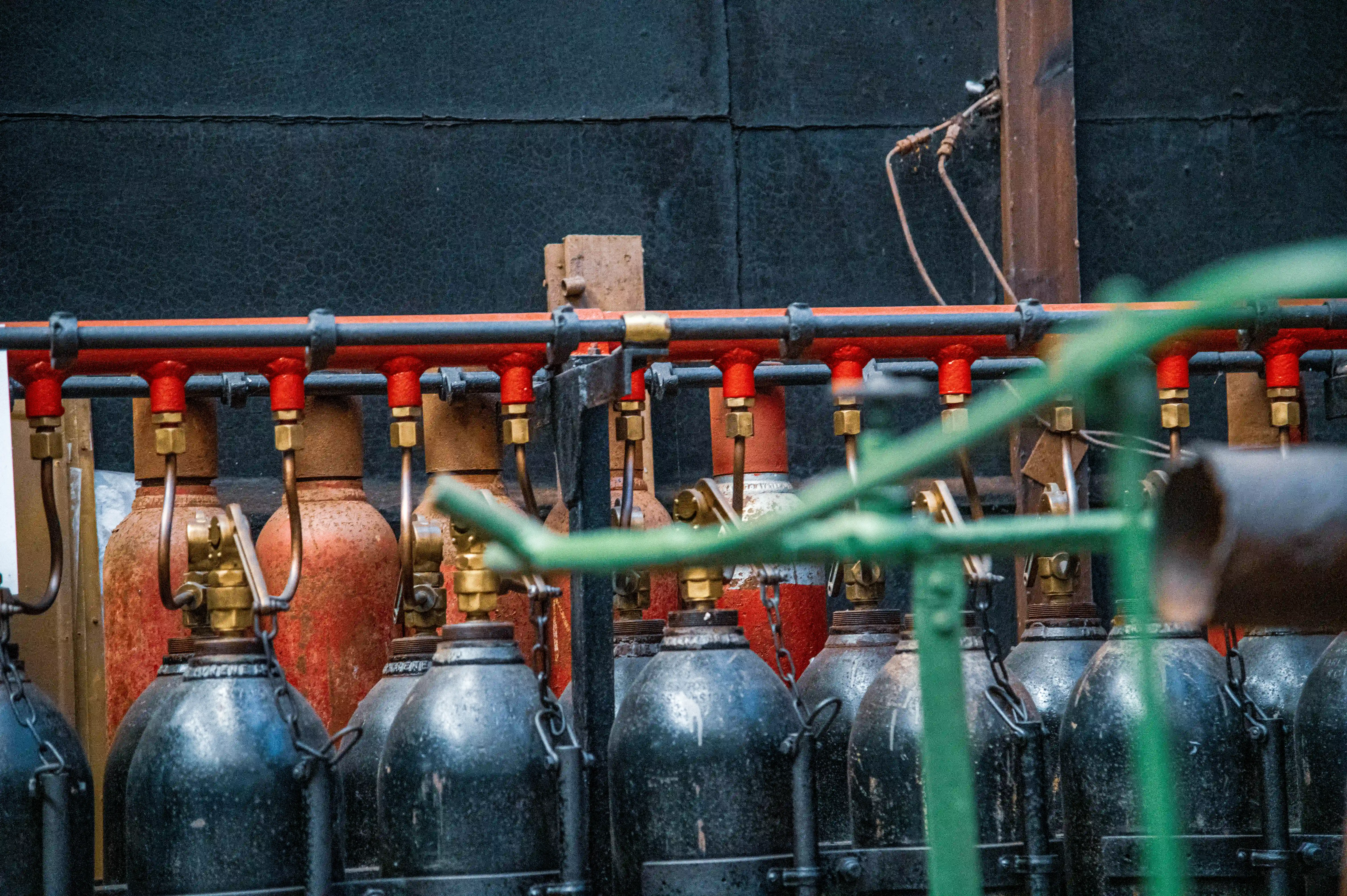
 Close-up view of multiple industrial gas cylinders connected to a red distribution manifold with brass fittings and valves, set against a dark, textured wall.
Industrial Gas Cylinders Connected to Manifold
photo by
©www.mgaylard.co.uk.
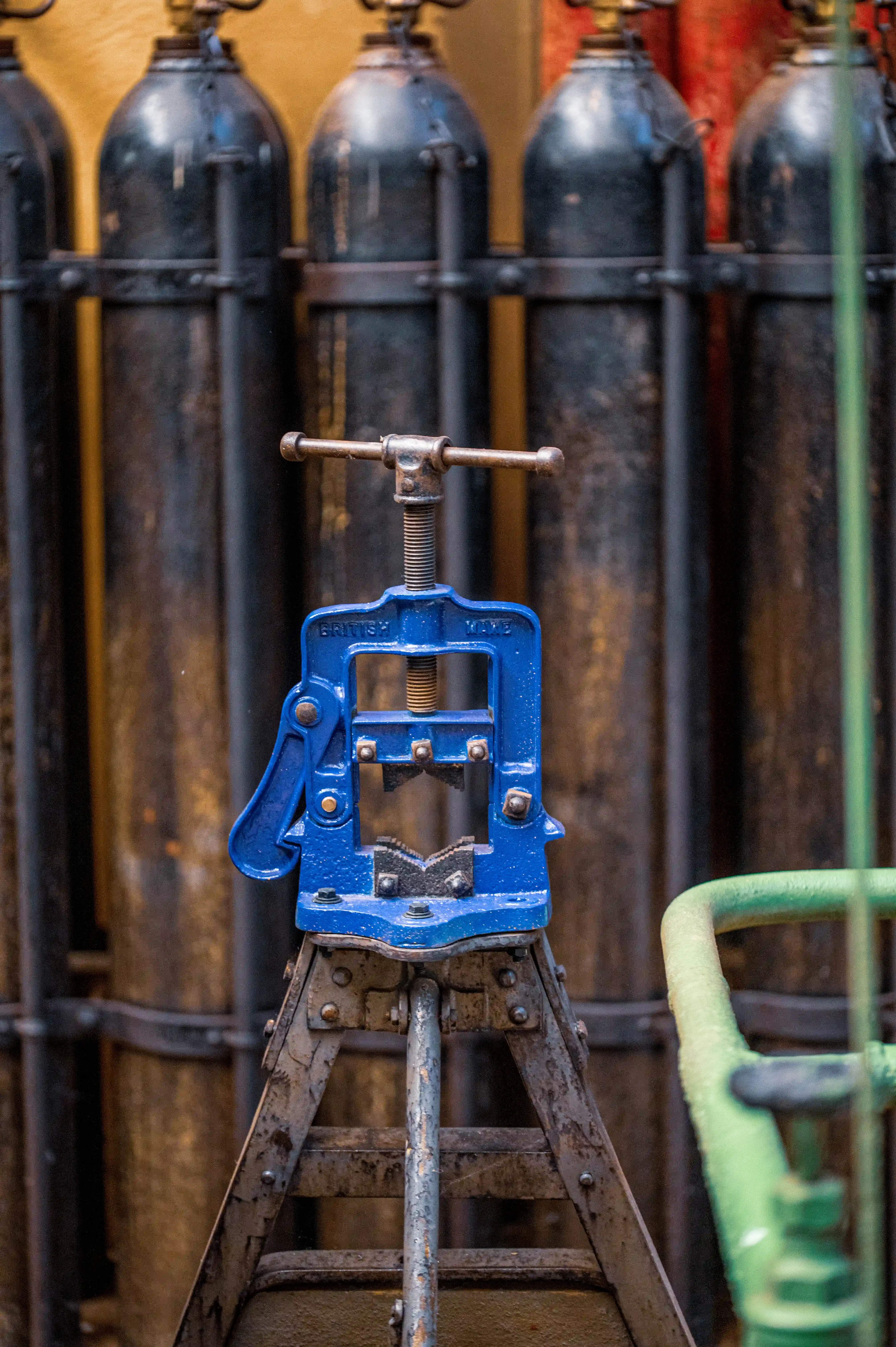
A close-up shot of a blue pipe vise on a metal stand, with out-of-focus industrial gas cylinders in the background.
Vintage Pipe Vise with Industrial Cylinders
photo by
©www.mgaylard.co.uk.
meta itemprop="encodingFormat" content="image/jpeg">
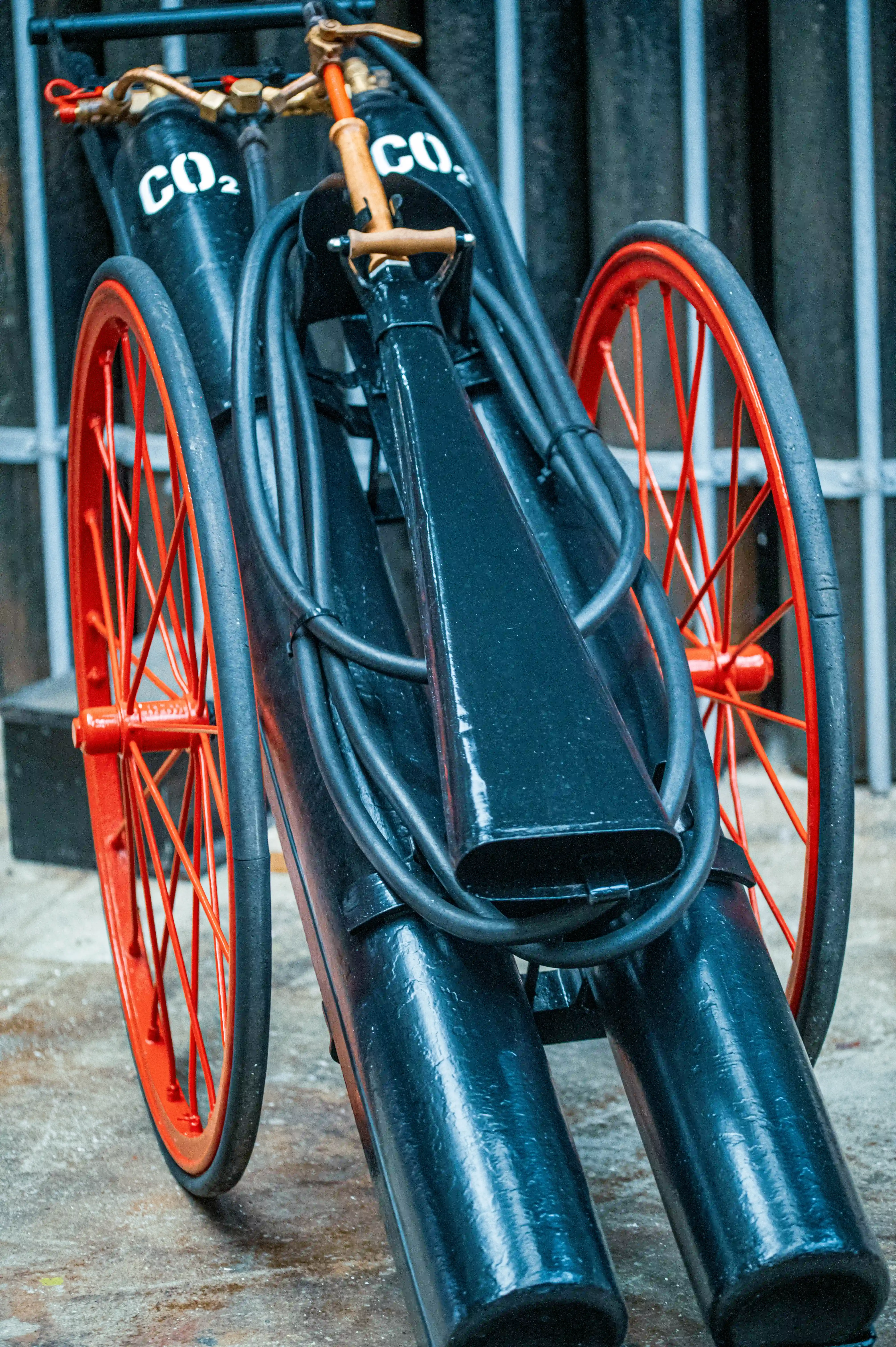
Close-up of a vintage fire extinguisher on red spoked wheels, with two black CO2 cylinders and coiled black hoses.
Antique CO2 Fire Extinguisher Apparatus
photo by
©www.mgaylard.co.uk.
meta itemprop="encodingFormat" content="image/jpeg">
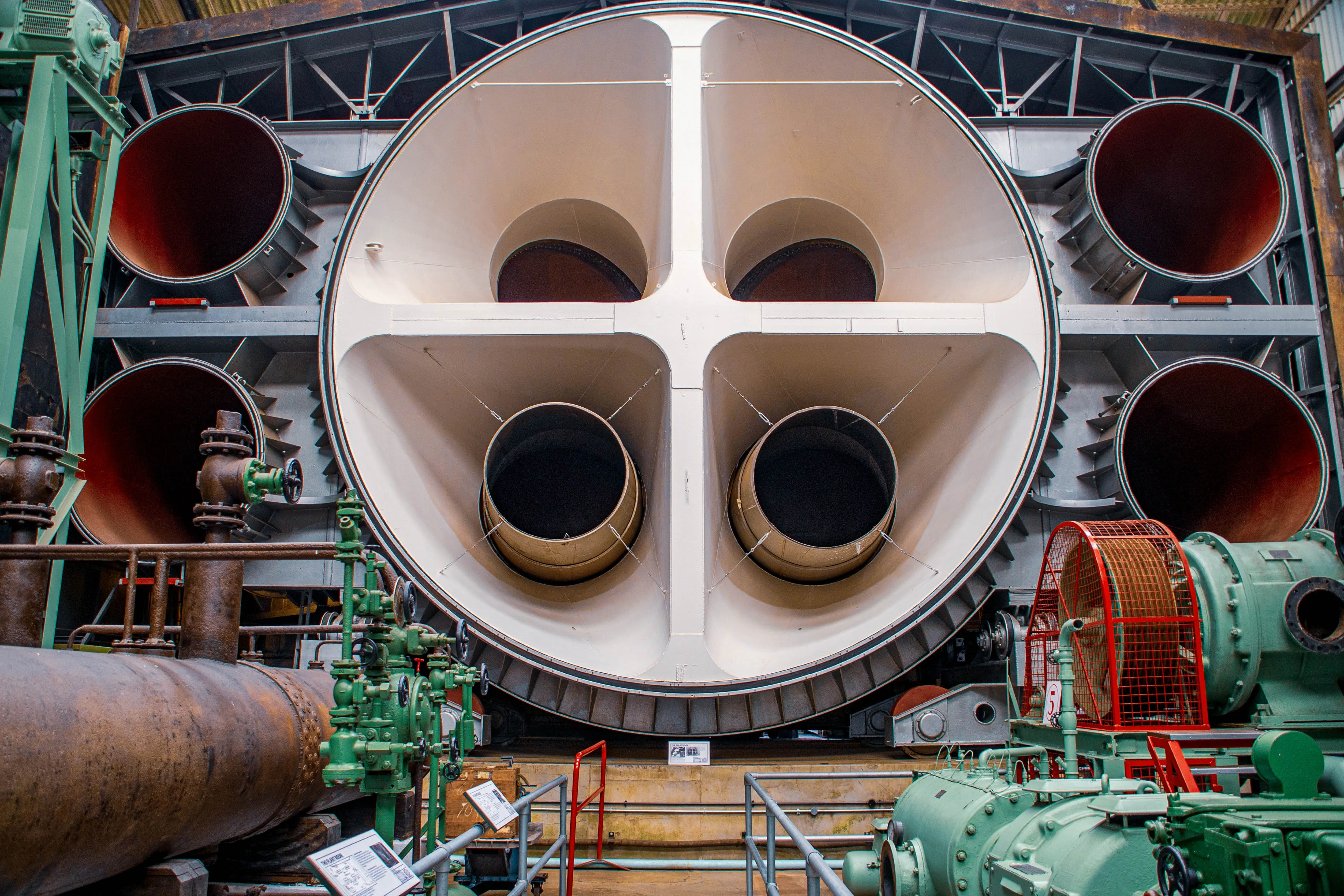
Close-up of a large, complex industrial wind tunnel. A wide, circular aperture dominates the centre, divided into four sections, each leading to a smaller circular opening. Surrounding this are large pipes, green industrial machinery, and metallic structural elements.
Industrial Wind Tunnel Machinery
photo by
©www.mgaylard.co.uk.
Close-up of a large, complex industrial wind tunnel. A wide, circular aperture dominates the centre, divided into four sections, each leading to a smaller circular opening. Surrounding this are large pipes, green industrial machinery, and metallic structural elements.
Industrial Wind Tunnel Machinery
photo by
©www.mgaylard.co.uk.
Close-up of a large, complex industrial wind tunnel. A wide, circular aperture dominates the centre, divided into four sections, each leading to a smaller circular opening. Surrounding this are large pipes, green industrial machinery, and metallic structural elements.
Industrial Wind Tunnel Machinery
photo by
©www.mgaylard.co.uk.
meta itemprop="encodingFormat" content="image/jpeg">
Close-up of a large, complex industrial wind tunnel. A wide, circular aperture dominates the centre, divided into four sections, each leading to a smaller circular opening. Surrounding this are large pipes, green industrial machinery, and metallic structural elements.
Industrial Wind Tunnel Machinery
photo by
©www.mgaylard.co.uk.
meta itemprop="encodingFormat" content="image/jpeg">
Close-up of a large, complex industrial wind tunnel. A wide, circular aperture dominates the centre, divided into four sections, each leading to a smaller circular opening. Surrounding this are large pipes, green industrial machinery, and metallic structural elements.
Industrial Wind Tunnel Machinery
photo by
©www.mgaylard.co.uk.
meta itemprop="encodingFormat" content="image/jpeg">

Brooklands Museum

Established: 1991 (as a museum)

Original Race Track Opened: 1907

Type: Aviation and motorsport museum

Focus: British aviation, motorsport, and engineering history

Collection Size: Over 100 historic aircraft, vehicles, and exhibits

Notable Features: Historic aircraft, racing cars, motorcycles, memorabilia, interactive exhibits, restoration workshops

Website:

Brooklands Museum is located on the site of the Brooklands race track, which was opened in 1907 as the world’s first purpose-built motor racing circuit. The track was the brainchild of Hugh Locke King, a wealthy landowner and motorsport enthusiast, who sought to create a venue for testing and racing the latest motor vehicles in a safe and controlled environment. Brooklands quickly became the heart of British motorsport, hosting legendary races, record-breaking attempts, and innovative engineering feats that shaped the history of motoring and aviation.

In addition to its motorsport heritage, Brooklands played a pivotal role in the development of British aviation. During World War I, the site was used for aircraft production and testing, and it later became a center for aviation innovation in the interwar and post-war periods. The Brooklands Aerodrome was a key location for the development and testing of aircraft, including iconic models such as the Vickers Vimy, which made the first non-stop transatlantic flight in 1919.

The Brooklands race track was closed in 1939 at the outbreak of World War II, but its legacy lived on through the establishment of Brooklands Museum in 1991. The museum was created to preserve and celebrate the rich history of the site, ensuring that the stories of its people, vehicles, and achievements would not be forgotten. Today, Brooklands Museum is a vibrant and dynamic heritage site that attracts visitors from around the world, offering a unique and immersive experience of British aviation and motorsport history.
References

Text generated by Mistral AI , Microsoft CoPilot , and AI Image Describer

Control Room, 

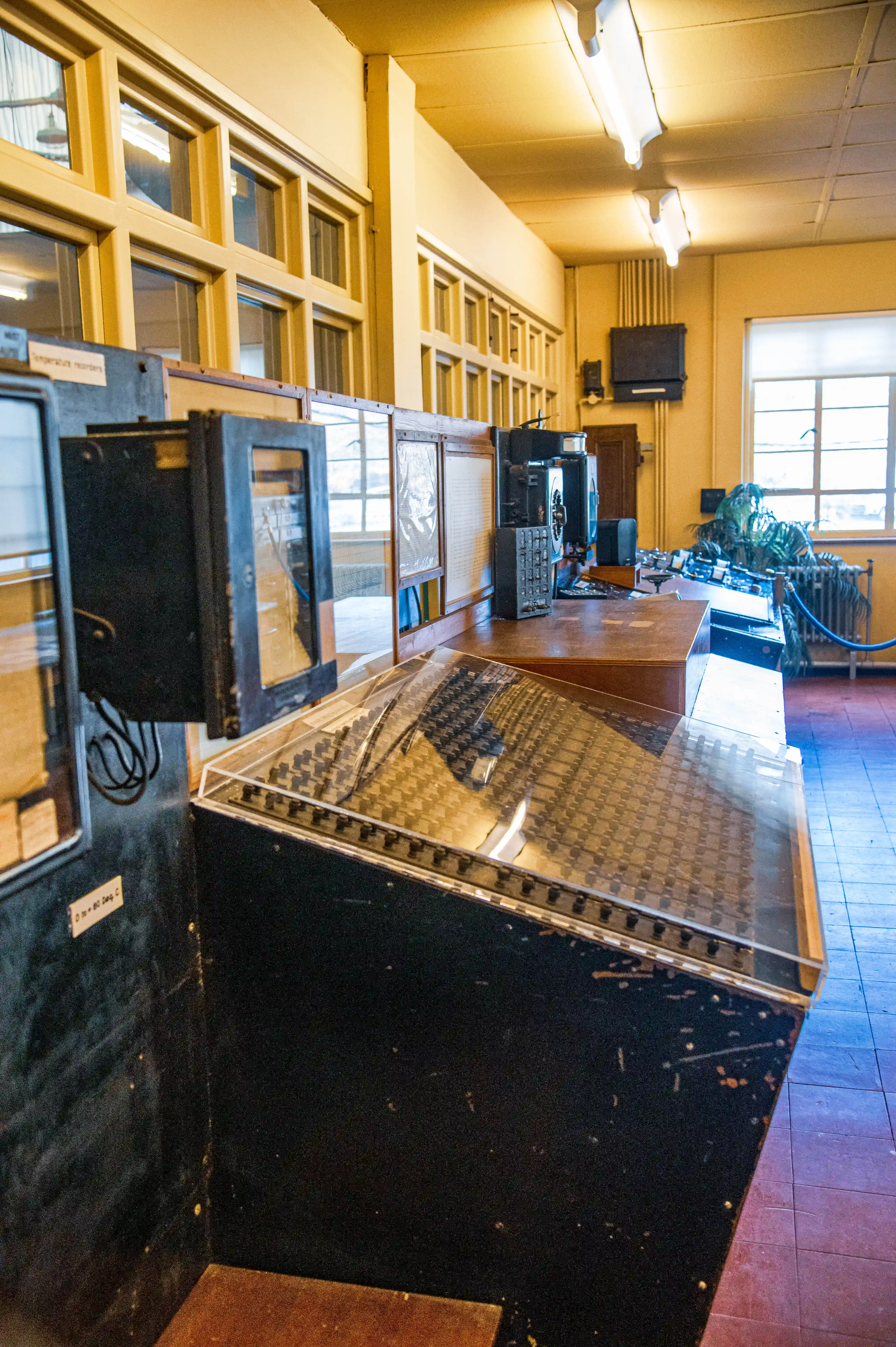
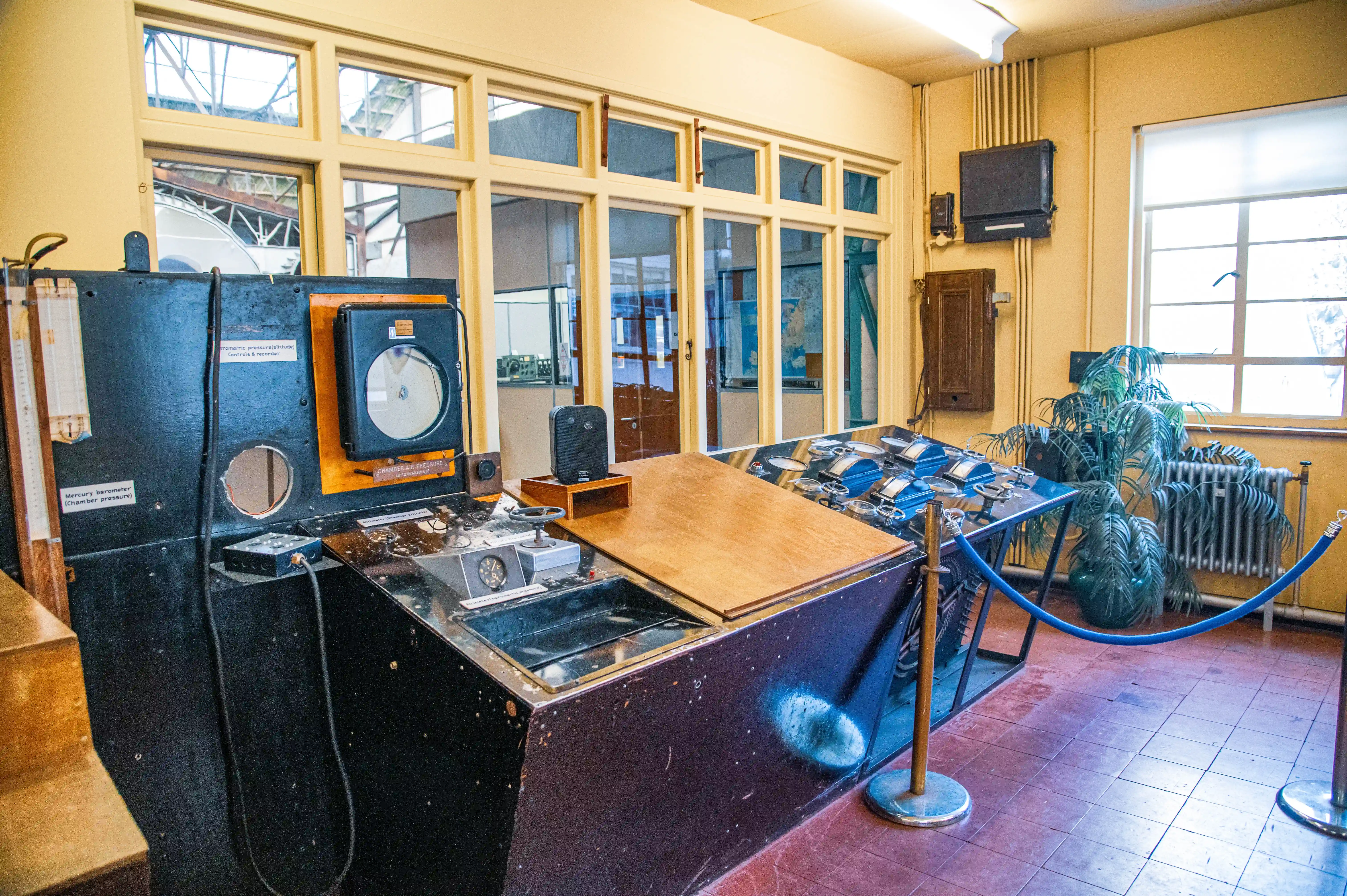
The Control Room at the Stratosphere Chamber in Brooklands Museum is a historically significant and technically advanced exhibit that offers visitors a unique glimpse into the world of early aviation research and high-altitude testing. Built in the 1930s, the control room was the nerve center of the Stratosphere Chamber, where engineers and researchers monitored and controlled experiments to simulate the extreme conditions of high-altitude flight. This room played a pivotal role in the development of aviation technology, particularly during the interwar years and World War II, when advancements in high-altitude flight and aircraft reliability were critical. Today, the control room has been preserved and restored as part of Brooklands Museum, allowing visitors to explore the history of aviation research and the ingenuity of early aerospace engineering.
A view inside a vintage control room featuring a large, dark-coloured console with a textured surface beneath a clear plastic cover. Several older electronic devices and wall-mounted recorders are visible, along with a bank of windows in the background.
Vintage Control Room Interior
photo by
©www.mgaylard.co.uk.
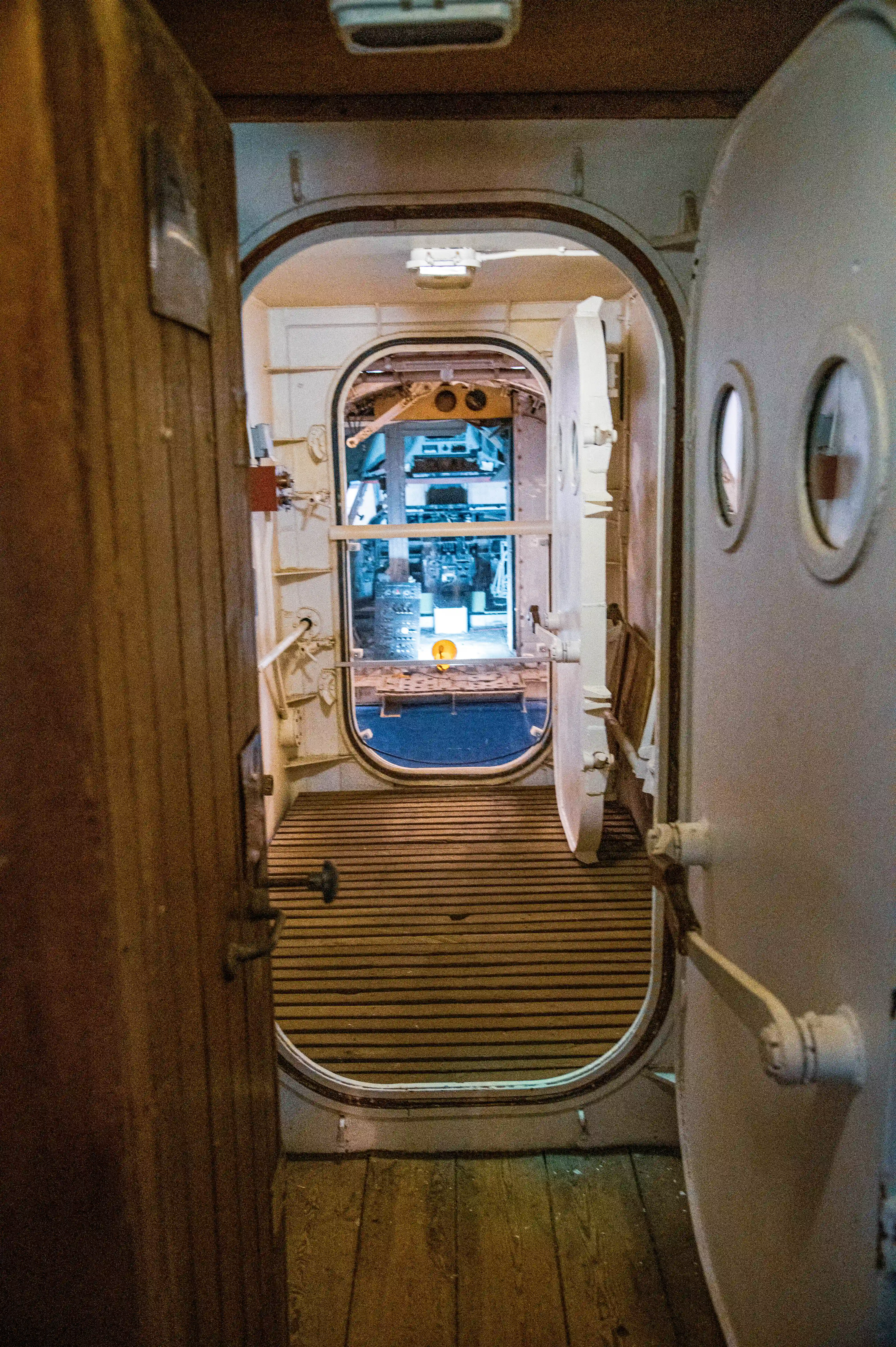
Interior view of a air-lock showing an open hatchway. The foreground features wooden flooring and a partially open wooden door on the left. Ahead, a curved metal doorway leads into a well-lit compartment with blue flooring and visible machinery.
Air-lock Compartment Entrance
photo by
©www.mgaylard.co.uk.
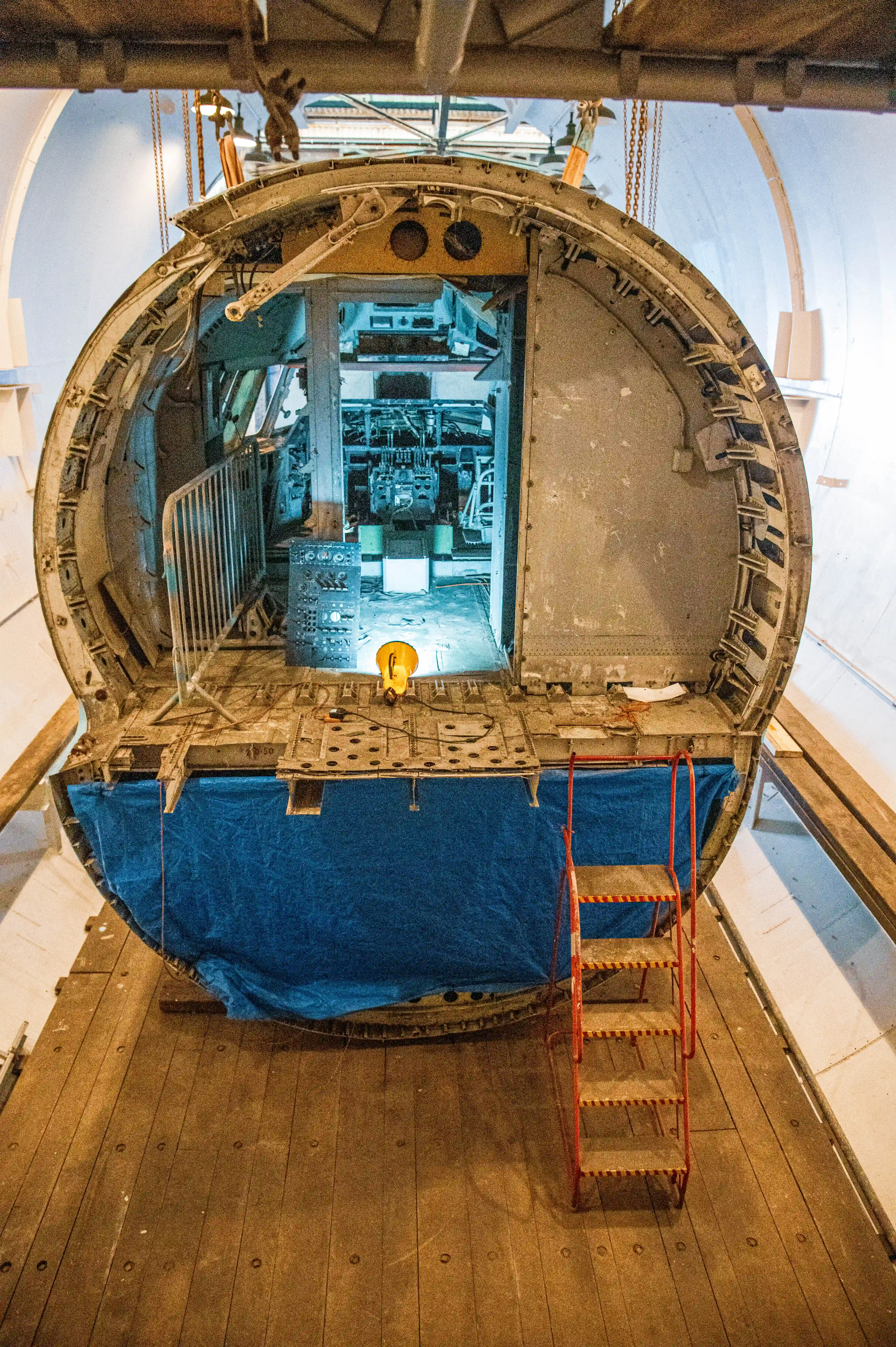
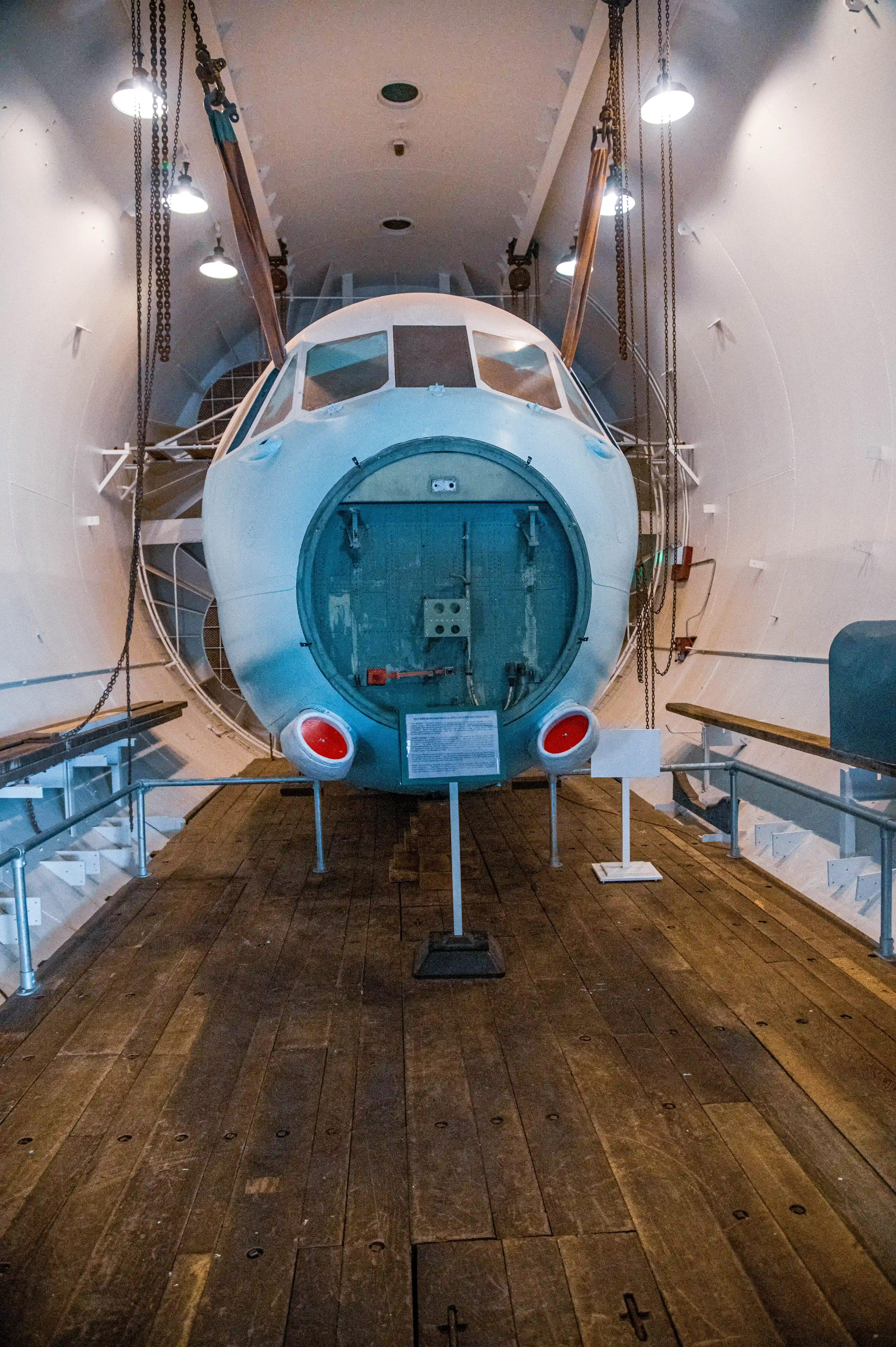
A view of the interior of an aircraft fuselage, showcasing the cockpit area with visible instrument panels, control yokes, and seating. The fuselage features metal framing, rivets, and a circular door opening, with a red ladder leading up to the entrance. The background includes hangar walls and lighting.
Stratosphere Chamber Airlock
photo by
©www.mgaylard.co.uk.
A view of the interior of an aircraft fuselage, showcasing the cockpit area with visible instrument panels, control yokes, and seating. The fuselage features metal framing, rivets, and a circular door opening, with a red ladder leading up to the entrance. The background includes hangar walls and lighting.
Stratosphere Chamber Airlock
photo by
©www.mgaylard.co.uk.
A view of the interior of an aircraft fuselage, showcasing the cockpit area with visible instrument panels, control yokes, and seating. The fuselage features metal framing, rivets, and a circular door opening, with a red ladder leading up to the entrance. The background includes hangar walls and lighting.
Stratosphere Chamber Airlock
photo by
©www.mgaylard.co.uk.
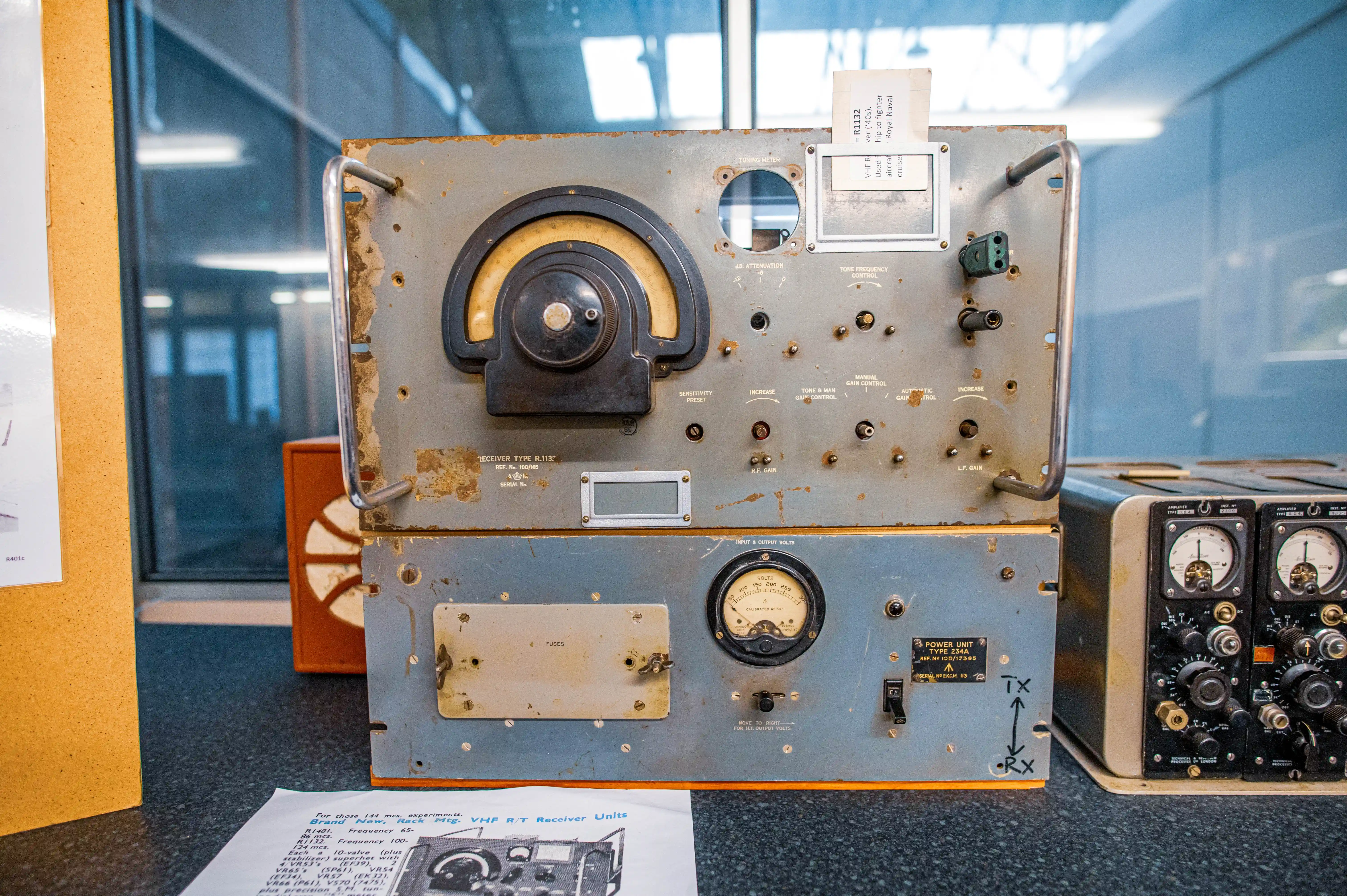
Two vintage radio receiver units are displayed side-by-side. The top unit has a large tuning dial and numerous smaller control knobs. The bottom unit features a large VU meter and a fused power switch. Both units appear to be constructed of metal with a grey finish and show signs of age.
Vintage Radio Receiver and Power Unit Display
photo by
©www.mgaylard.co.uk.
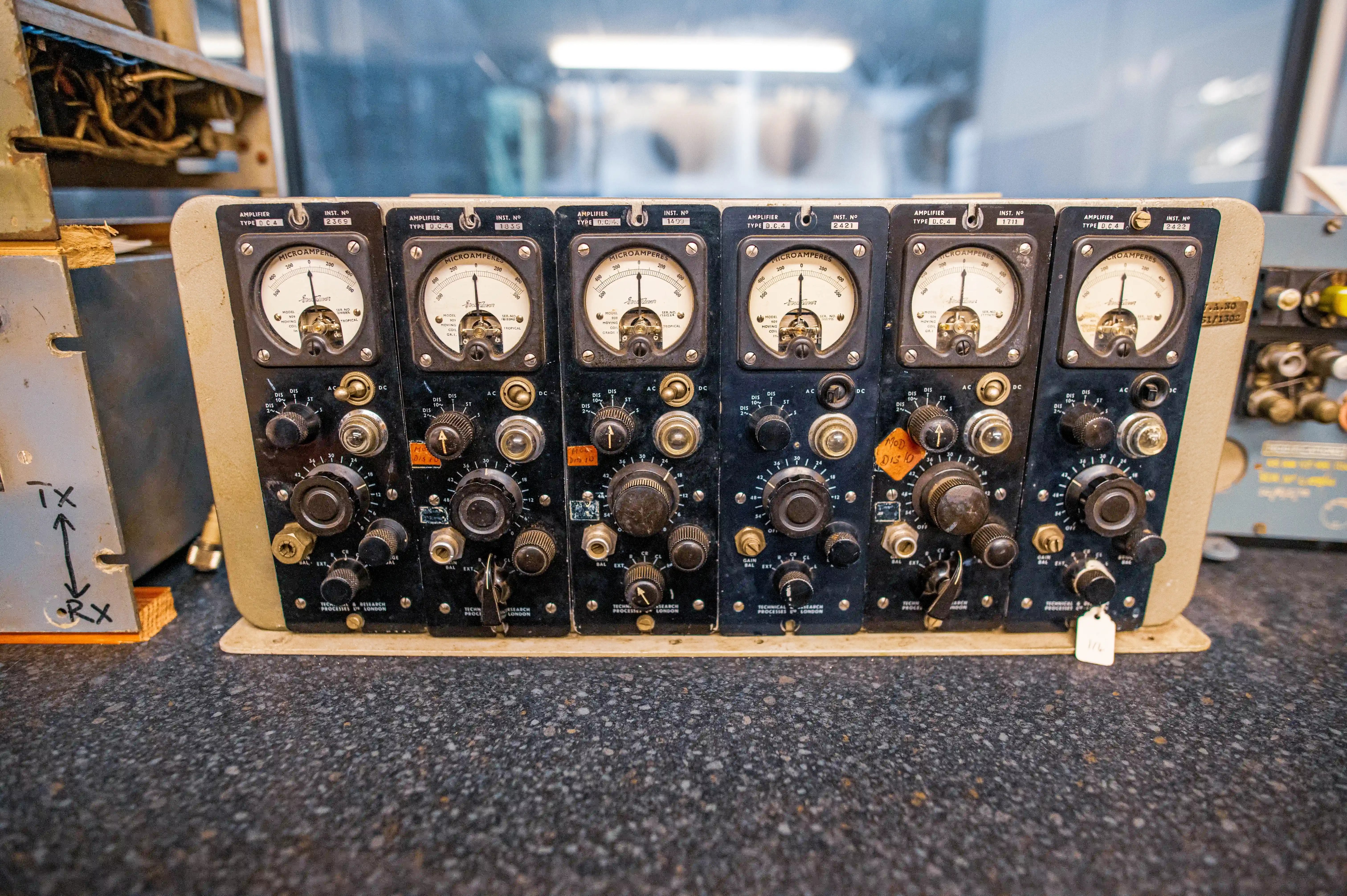
A close-up frontal view of a row of six vintage electrical amplifier units. Each unit features a central analogue microammeter displaying readings from 0 to 500, a type designation of AMPLIFIER TYPE D.C.4, and an INST. NO. serial number. Below the meters are arrays of black rotary knobs, toggle switches, and circular dials with various settings. Some units have small orange labels with handwritten text such as MOD. DIS. 10. To the far left, a separate metal unit displays handwritten TX with an upward arrow and RX with a downward arrow. The equipment sits on a dark, speckled surface, with blurred laboratory equipment visible in the background.
Stratosphere Chamber Control Room
photo by
©www.mgaylard.co.uk.
A vintage grey aviation control box with numerous circular, multi-pin connectors in different colours, a yellow knob labelled PRESSURE SUPPLY, and handwritten modifications.
Stratosphere Chamber Control Room
photo by
©www.mgaylard.co.uk.
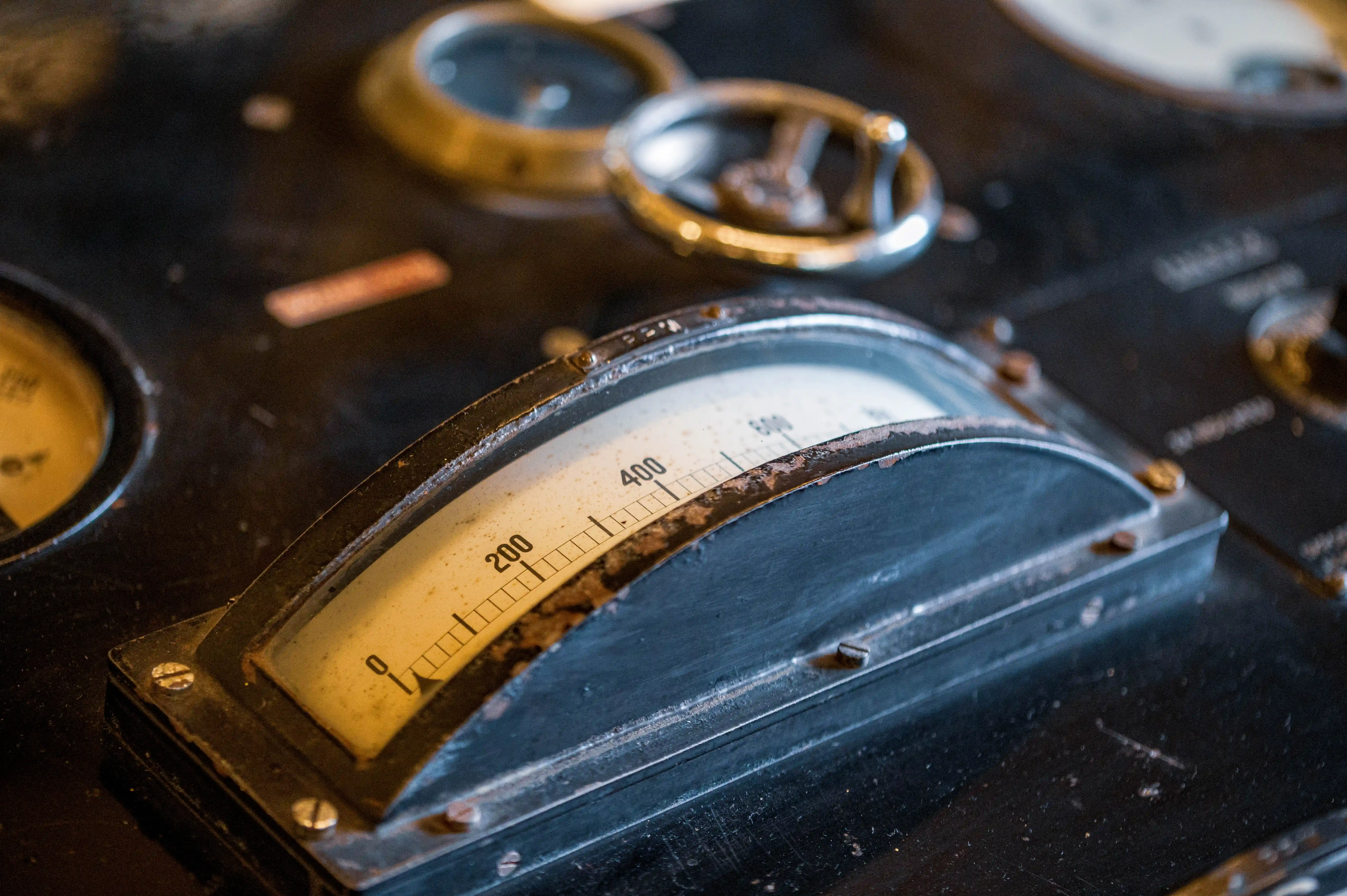
Close-up of a vintage analogue meter with a white face and black markings, showing a scale from 0 to 600. The meter is mounted on a dark, weathered control panel.
title3
photo by
©www.mgaylard.co.uk.
Two vintage radio receiver units are displayed side-by-side. The top unit has a large tuning dial and numerous smaller control knobs. The bottom unit features a large VU meter and a fused power switch. Both units appear to be constructed of metal with a grey finish and show signs of age.
Stratosphere Chamber Control Room
photo by
©www.mgaylard.co.uk.
A view inside a vintage control room featuring a large, dark-coloured console with a textured surface beneath a clear plastic cover. Several older electronic devices and wall-mounted recorders are visible, along with a bank of windows in the background.
Vintage Control Room Interior
photo by
©www.mgaylard.co.uk.
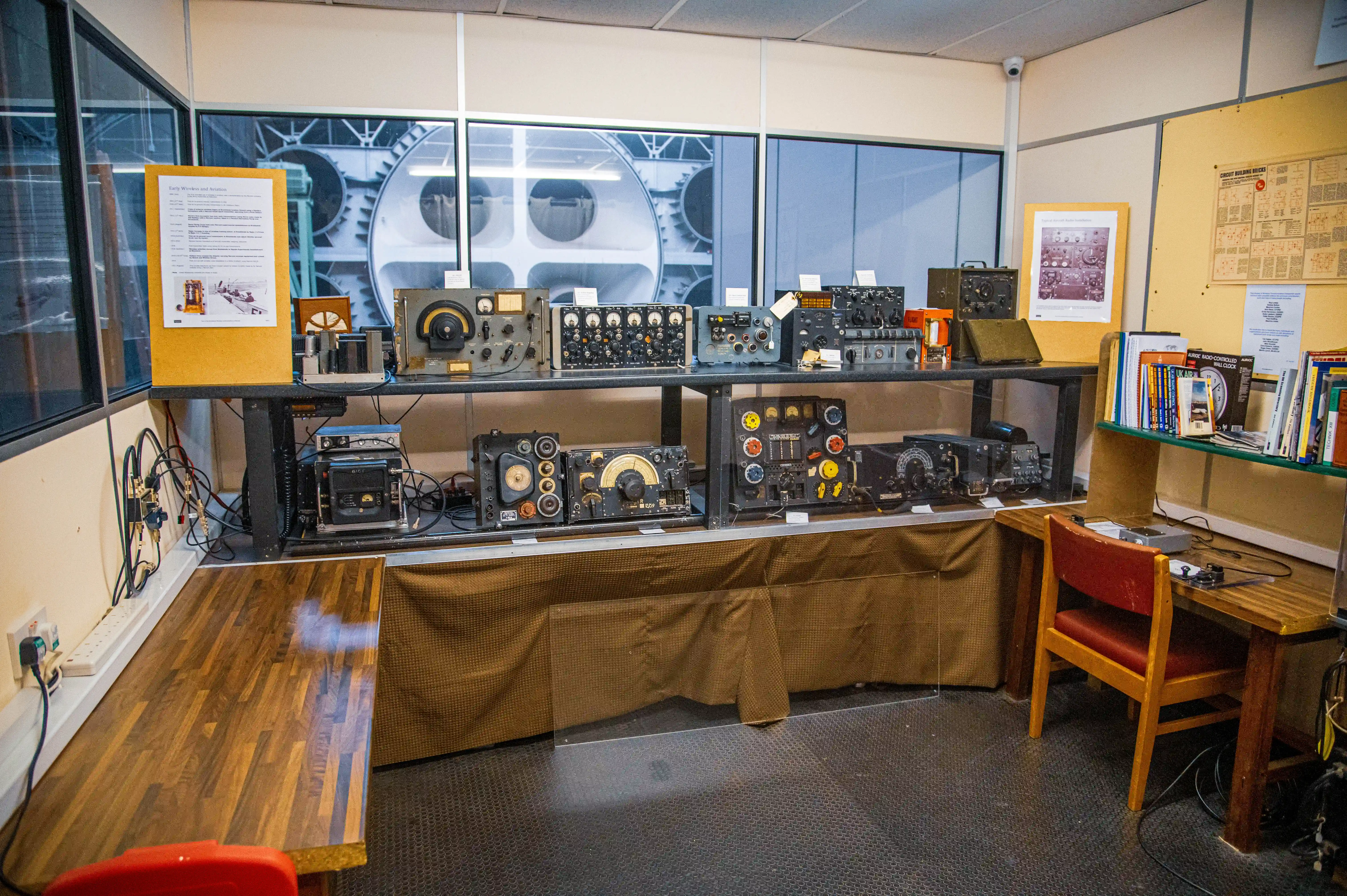
A museum display of vintage radio equipment, featuring numerous analogue devices with dials and knobs on shelves, behind a protective barrier. A large cogwheel is visible through a window in the background. A wooden desk with books and a chair is on the right.
Exhibition of Vintage Radio and Aviation Technology
photo by
©www.mgaylard.co.uk.
A museum display of vintage radio equipment, featuring numerous analogue devices with dials and knobs on shelves, behind a protective barrier. A large cogwheel is visible through a window in the background. A wooden desk with books and a chair is on the right.
Exhibition of Vintage Radio and Aviation Technology
photo by
©www.mgaylard.co.uk.
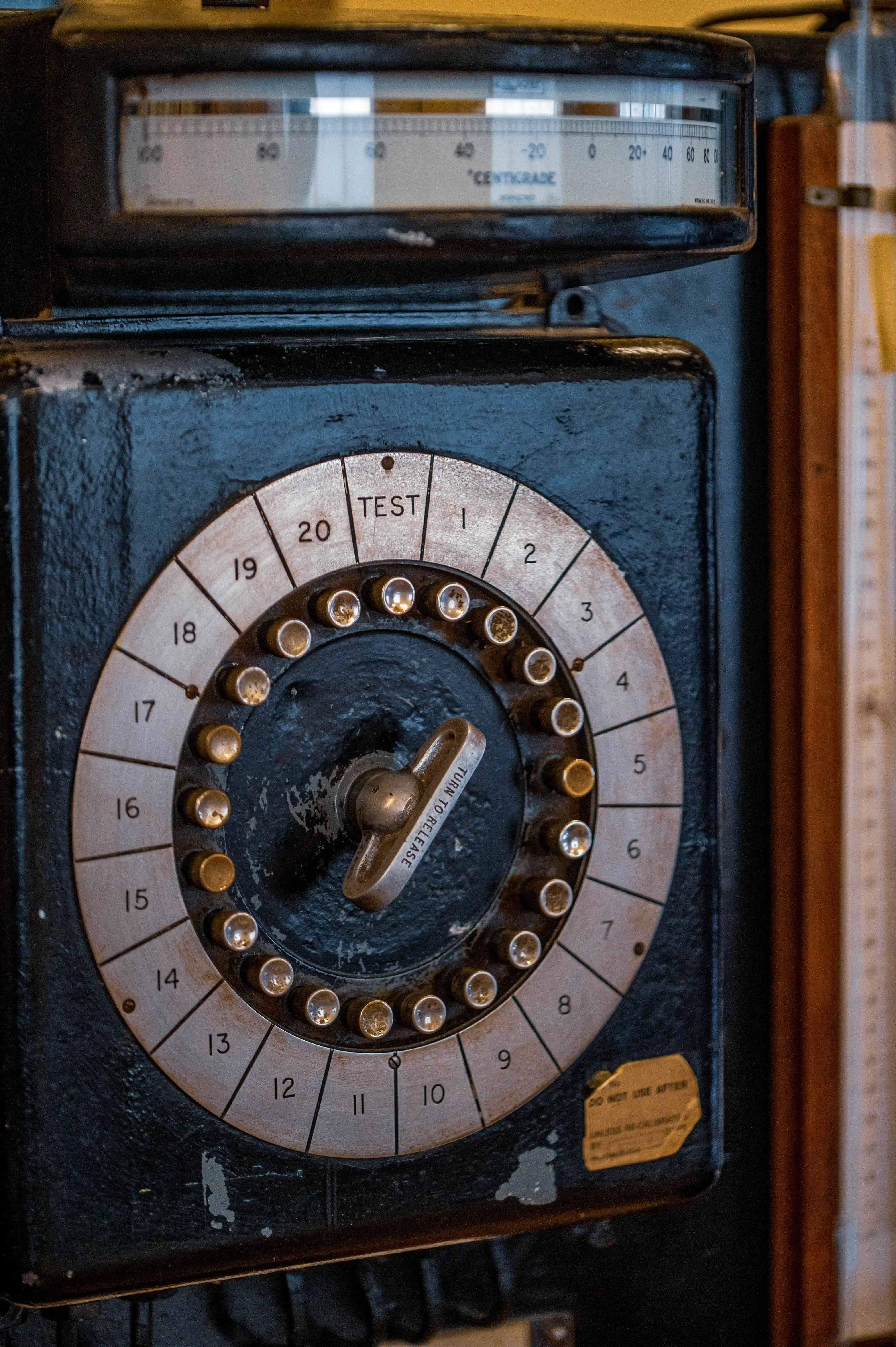
Close-up of a vintage black time clock. A circular dial with numbers 1-20, a TEST setting, and a metal handle labelled TURN TO RELEASE is central. Above, a thermometer scale reads CENTIGRADE from -20 to 100. A yellow caution sticker is on the lower right.
Vintage Time Clock and Thermometer
photo by
©www.mgaylard.co.uk.
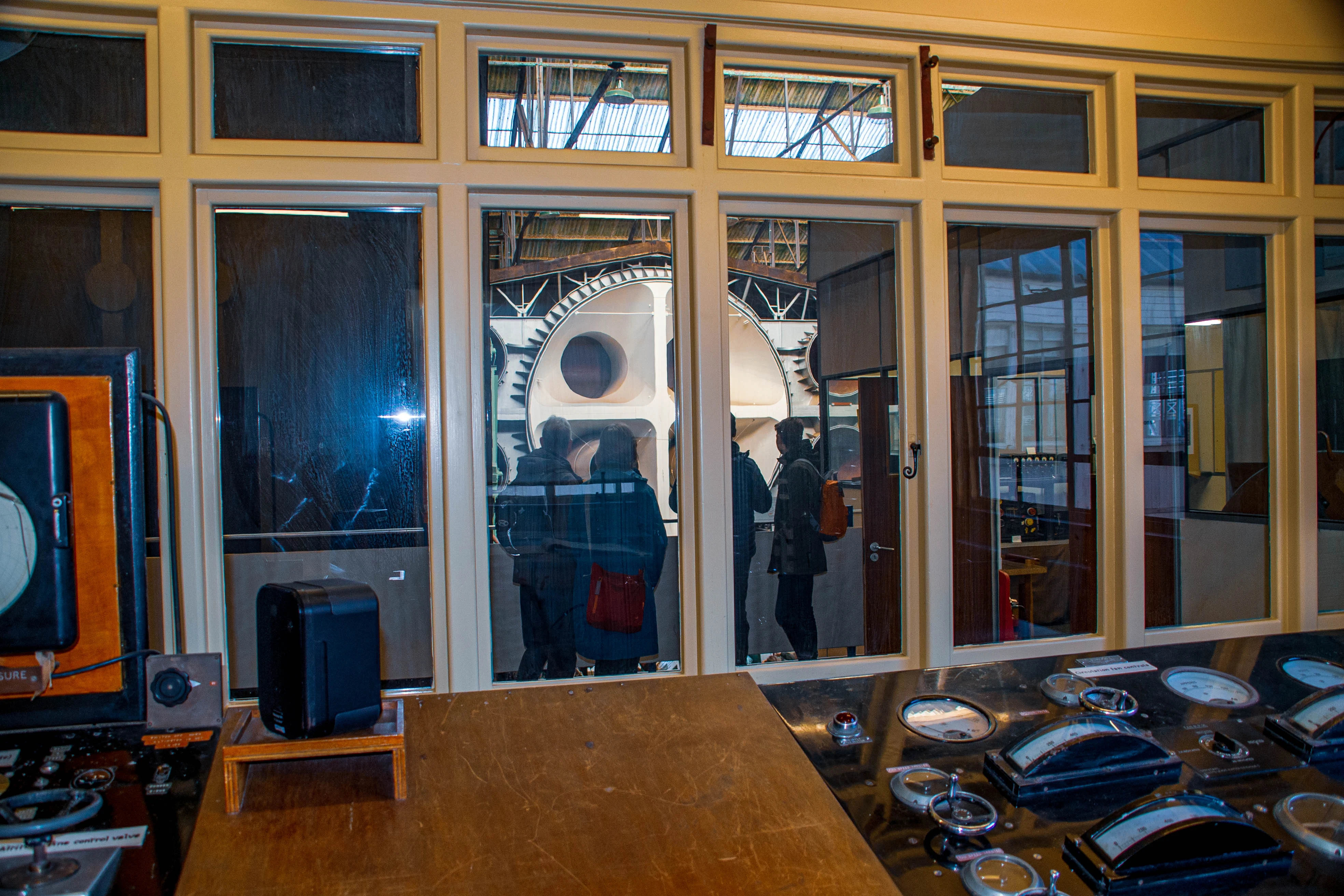
View from inside a control room with a panel of gauges and levers, looking out through large windows to an industrial space with large machinery and several people observing.
Vintage Engine Room Control Station with Visitors
photo by
©www.mgaylard.co.uk.
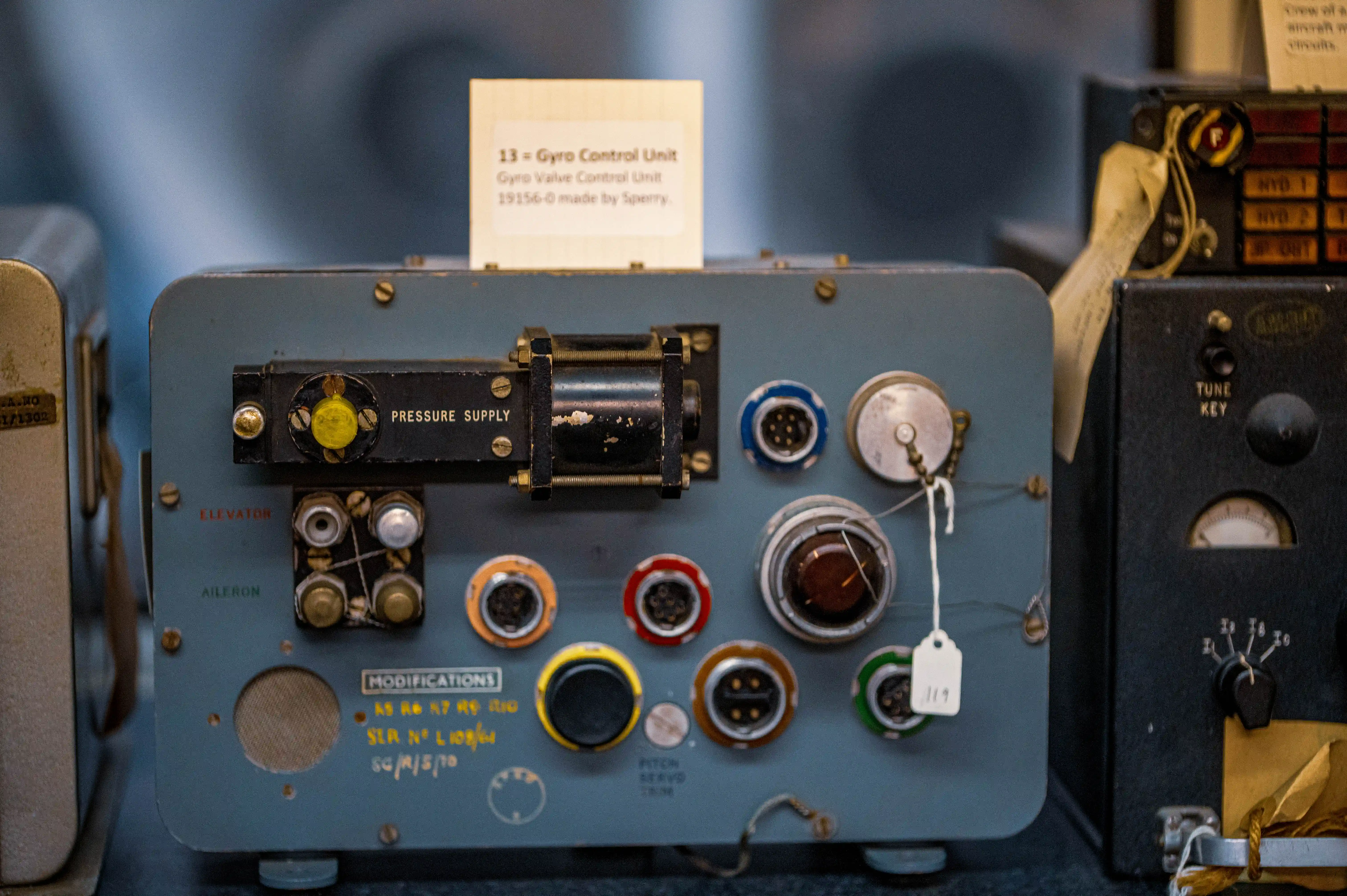
A vintage grey aircraft gyro control unit with various connectors, dials, and labels, including PRESSURE SUPPLY, ELEVATOR, AILERON, and PITCH SERVO. A card identifies it as a Gyro Control Unit made by Sperry.
Vintage Sperry Gyro Control Unit - Aircraft Instrumentation
photo by
©www.mgaylard.co.uk.
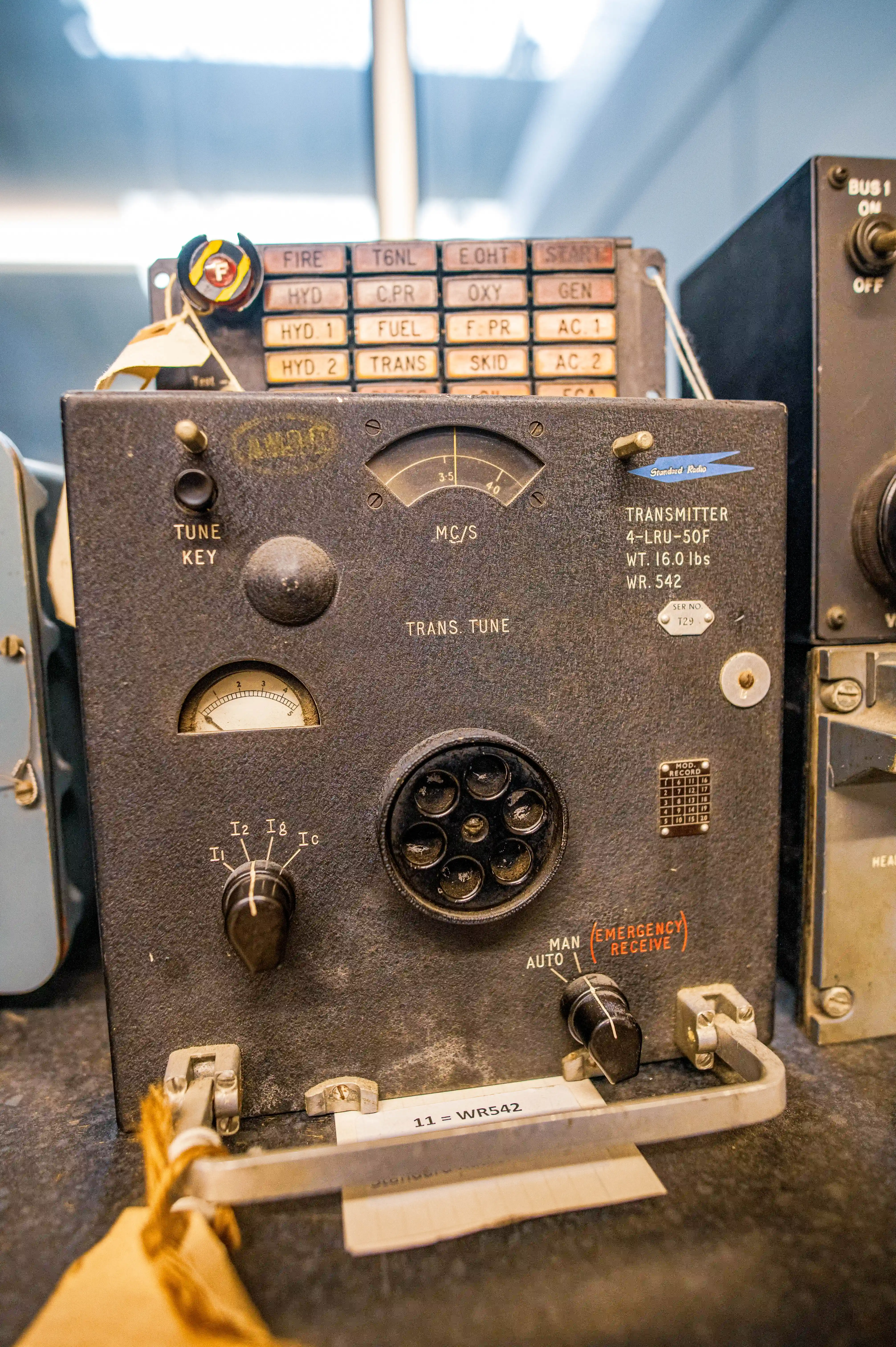
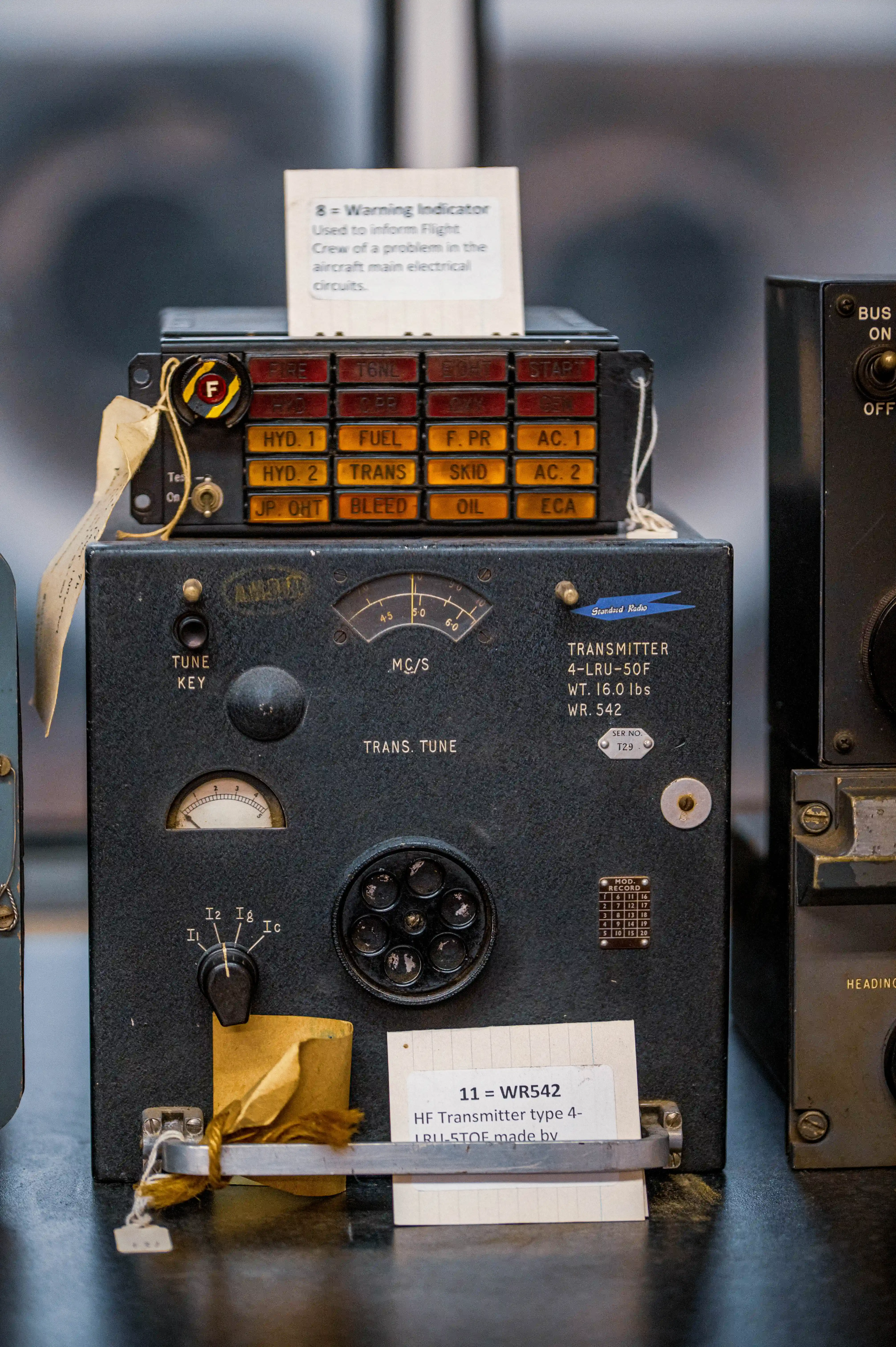
A detailed shot of vintage aircraft electrical warning indicators and an HF transmitter, showing multiple labels and dials on the devices.
Stratosphere Chamber Control Room
photo by
©www.mgaylard.co.uk.
meta itemprop="encodingFormat" content="image/jpeg">
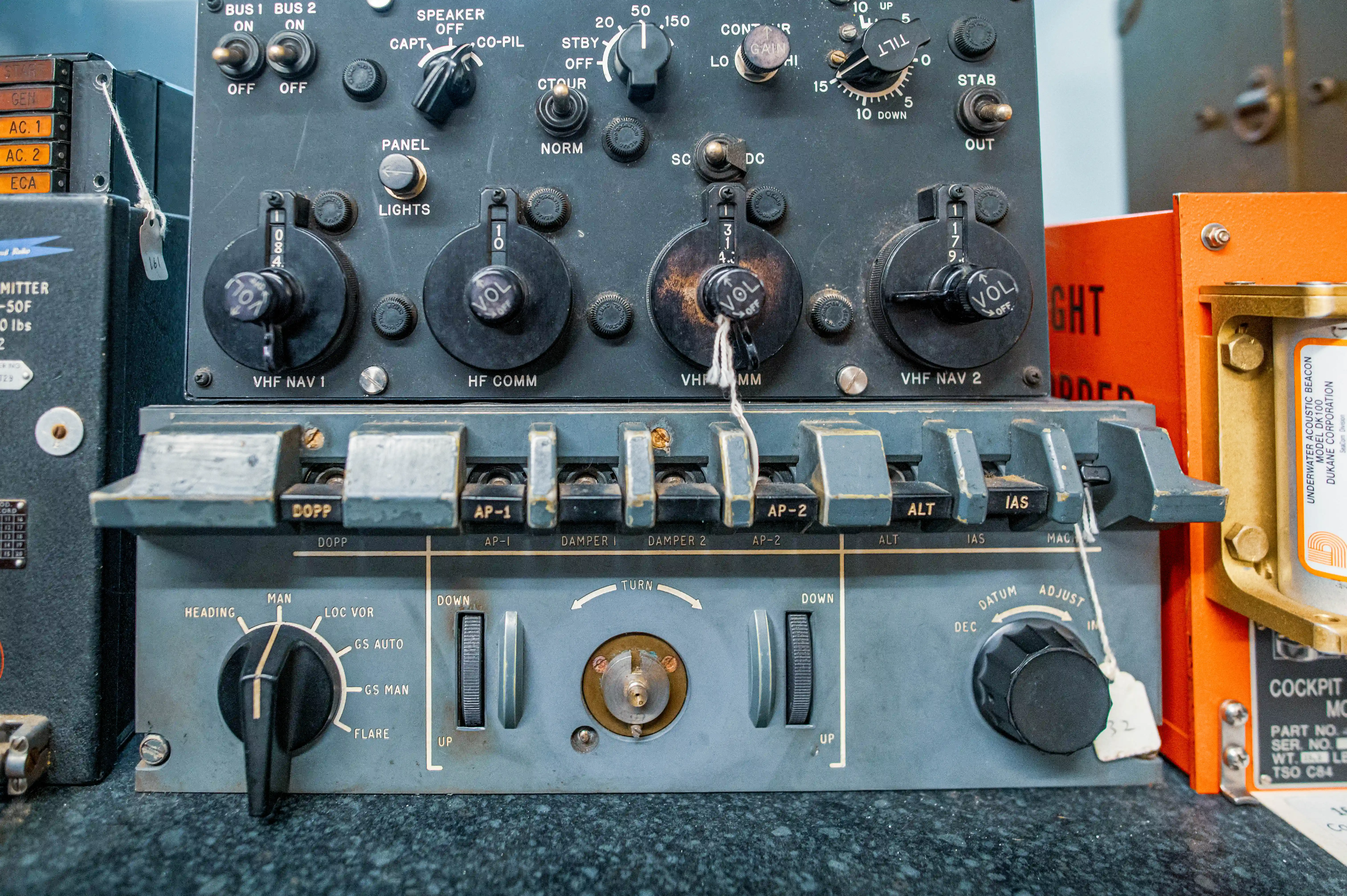
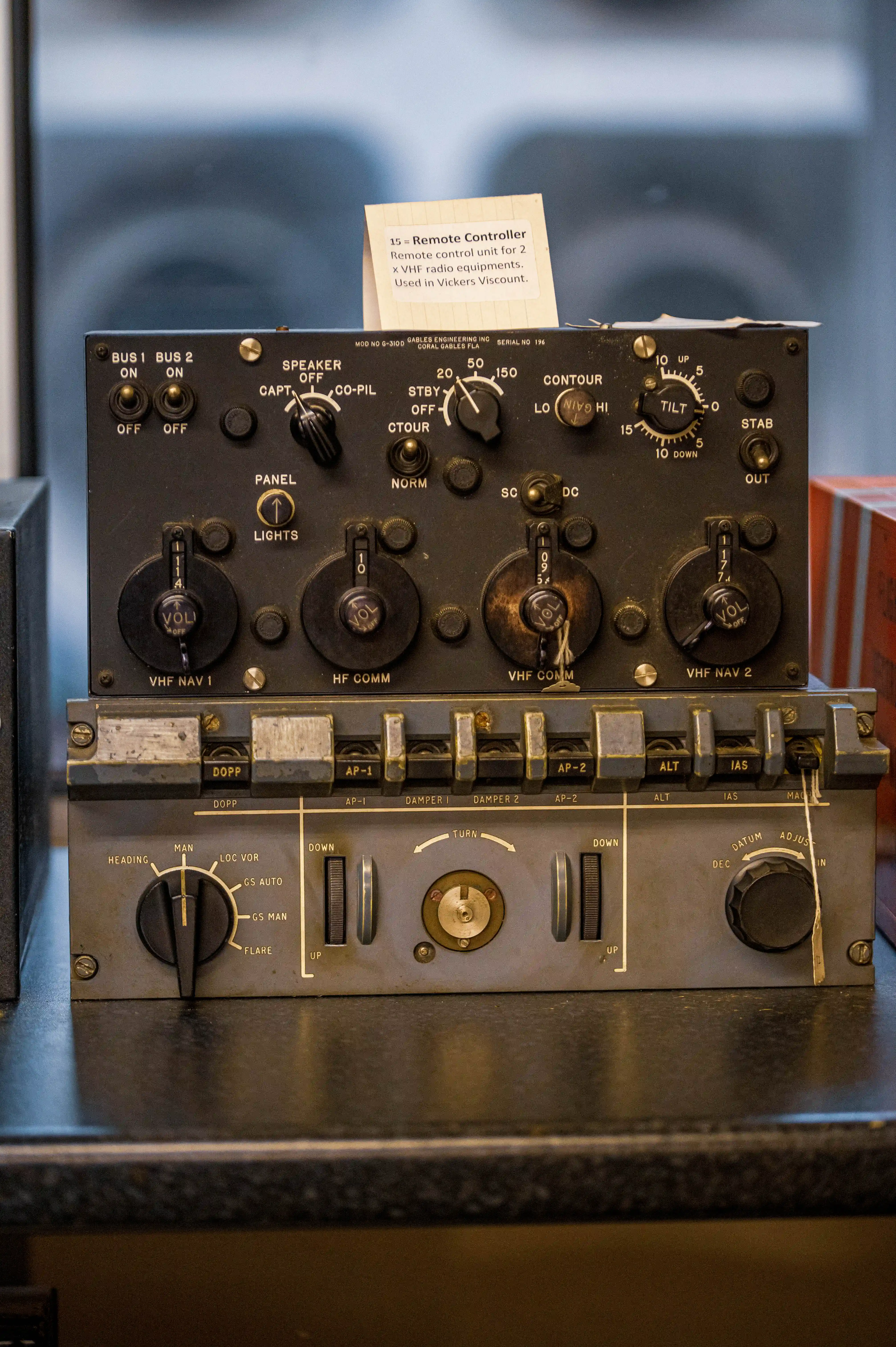
A detailed view of an old aircraft radio control panel. The panel is dark grey and covered in various controls, including rotary dials with numbers and labels like «VHF NAV 1,» «HF COMM,» and «VHF NAV 2.» Toggle switches and push buttons are also visible, along with indicators such as «BUS 1,» «BUS 2,» «SPEAKER,» «STBY,» and «ONTOUR.» A handwritten yellow label is attached to the top, stating its purpose and connection to a Vickers Viscount aircraft. The lower section of the image reveals another panel with more controls, including a large rotary dial labelled «HEADING» and smaller switches and dials.
Stratosphere Chamber Control Room
photo by
©www.mgaylard.co.uk.
meta itemprop="encodingFormat" content="image/jpeg">
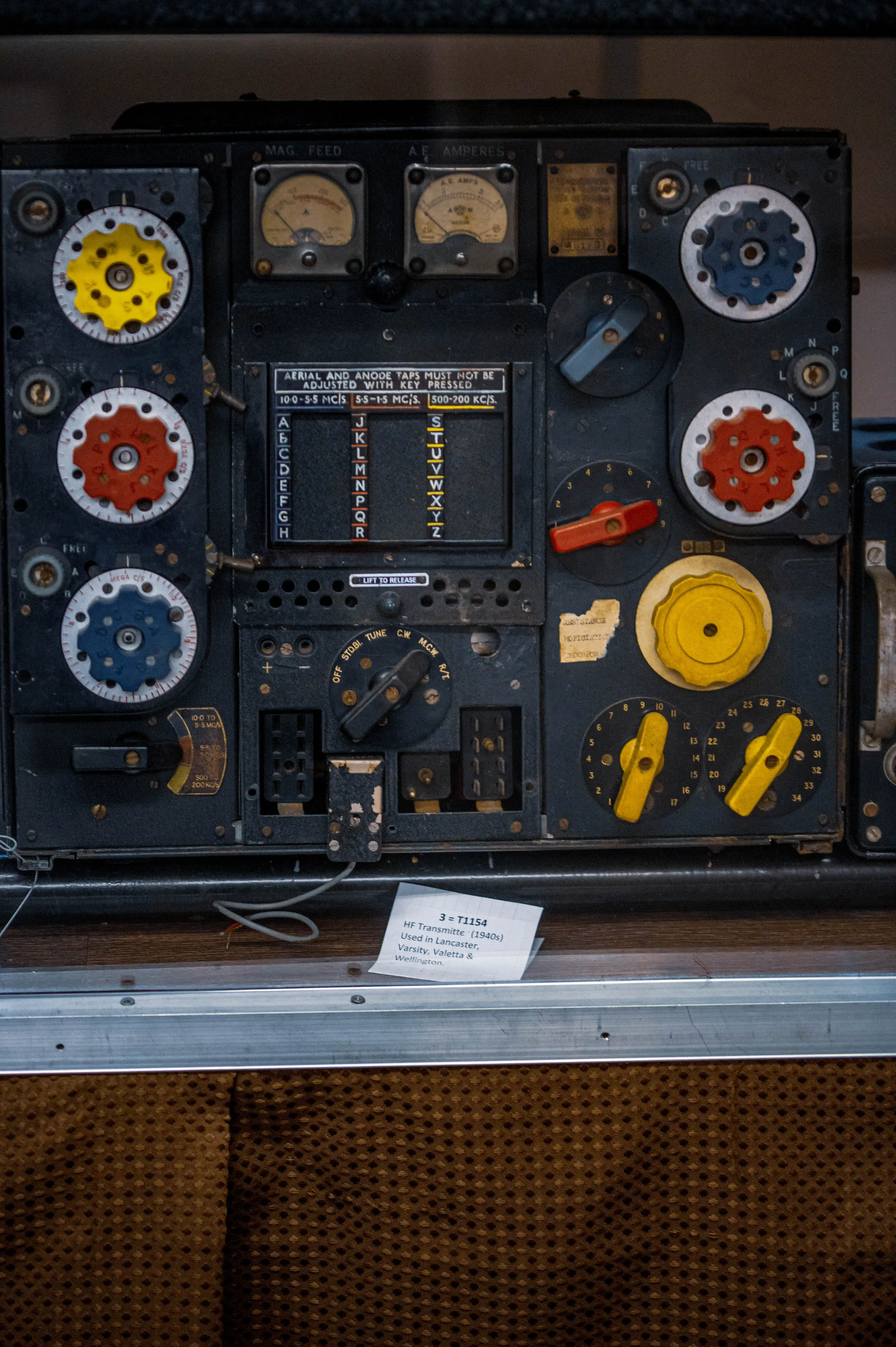
A vintage aircraft radio control panel from the 1940s, featuring analog dials, switches, and knobs in a black metal housing. The panel includes color-coded controls (yellow, red, and blue), frequency meters, and labeled switches for tuning and adjusting radio settings. A handwritten note identifies the panel as a 'Type T1154 HF Transmitter' used in aircraft like the Lancaster, Varsity, Valetta, and Wellington.
Voices from the Skies: The Type T1154 HF Transmitter Radio Pane
photo by
©www.mgaylard.co.uk.
meta itemprop="encodingFormat" content="image/jpeg">

Control Room

Built: 1930s

Original Use: Control and monitoring center for high-altitude testing in the Stratosphere Chamber

Type: Historic control room and museum exhibit

Notable Features: Original control panels, historic instruments, restored to original appearance, interactive exhibits

Website:

The Control Room at the Stratosphere Chamber was built in the 1930s as the nerve center of the Stratosphere Chamber at Brooklands, a facility designed to simulate the extreme conditions of high-altitude flight. The control room was where engineers, researchers, and technicians monitored and controlled experiments to test aircraft components, instruments, and life-support systems under conditions that mimicked the upper atmosphere. This was critical for advancing aviation technology, as aircraft began to fly at higher altitudes where low temperatures, low air pressure, and reduced oxygen levels could affect performance and reliability.

During the interwar years, the control room played a key role in the development of high-altitude flight. Researchers used the Stratosphere Chamber to test and refine a variety of aircraft systems, ensuring they could withstand the rigors of high-altitude operations. The control room’s advanced instrumentation and monitoring systems allowed for precise control of the chamber’s conditions, enabling accurate and repeatable experiments.

In World War II, the control room and Stratosphere Chamber became even more vital to the British aviation industry. The facility was used to test and improve the performance of aircraft used in the war effort, including bombers, fighters, and reconnaissance planes. The contributions of the control room to aviation research helped enhance the effectiveness of British aircraft and support the Allied war effort.

After World War II, the control room continued to be used for aviation research and testing, though its role evolved as new technologies and methods were developed. By the 1950s and 1960s, the control room had fallen into disuse, but with the establishment of Brooklands Museum in 1991, it was preserved and restored as a museum exhibit. Today, the control room stands as a testament to the innovation and ingenuity of early aviation research and a symbol of Brooklands’ contributions to the history of flight.

Notice

Text generated by Mistral AI , Microsoft CoPilot , and AI Image Describer
To the top
Powered by w3.css. The images are all stored on link to www.gaylard.co.uk Photostream on Flickr   This website is hosted by link to 123Reg Web Hosting