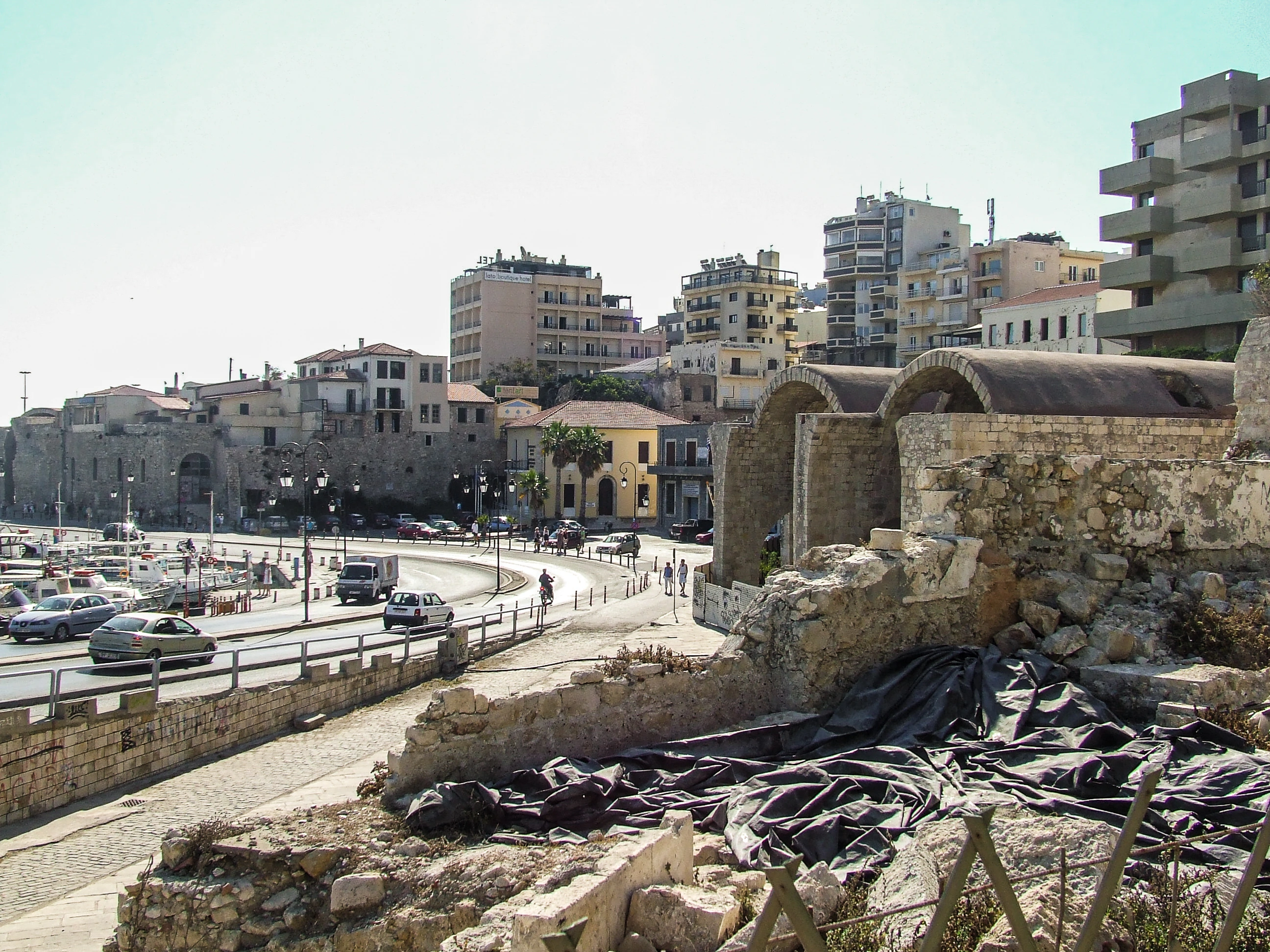
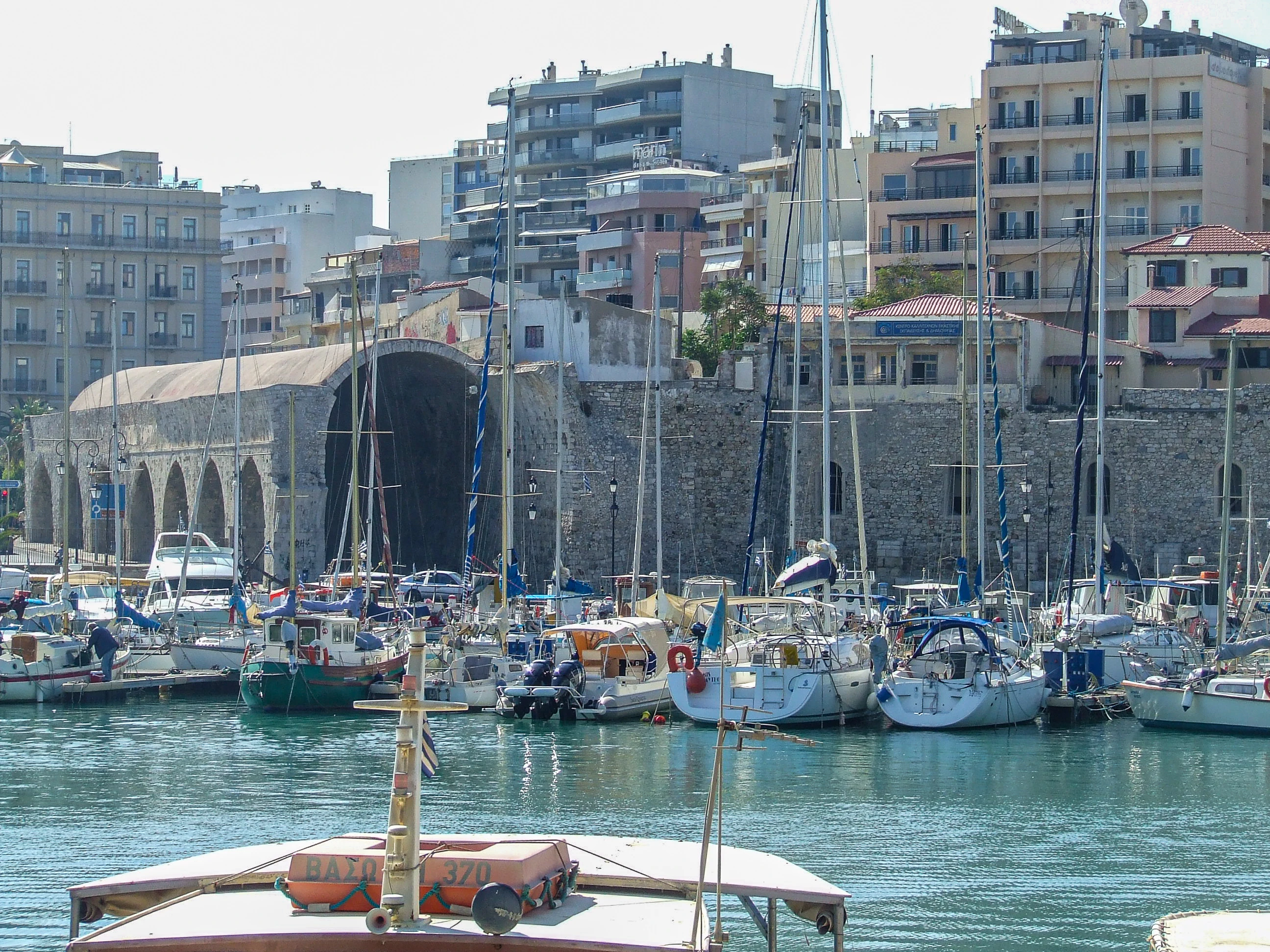
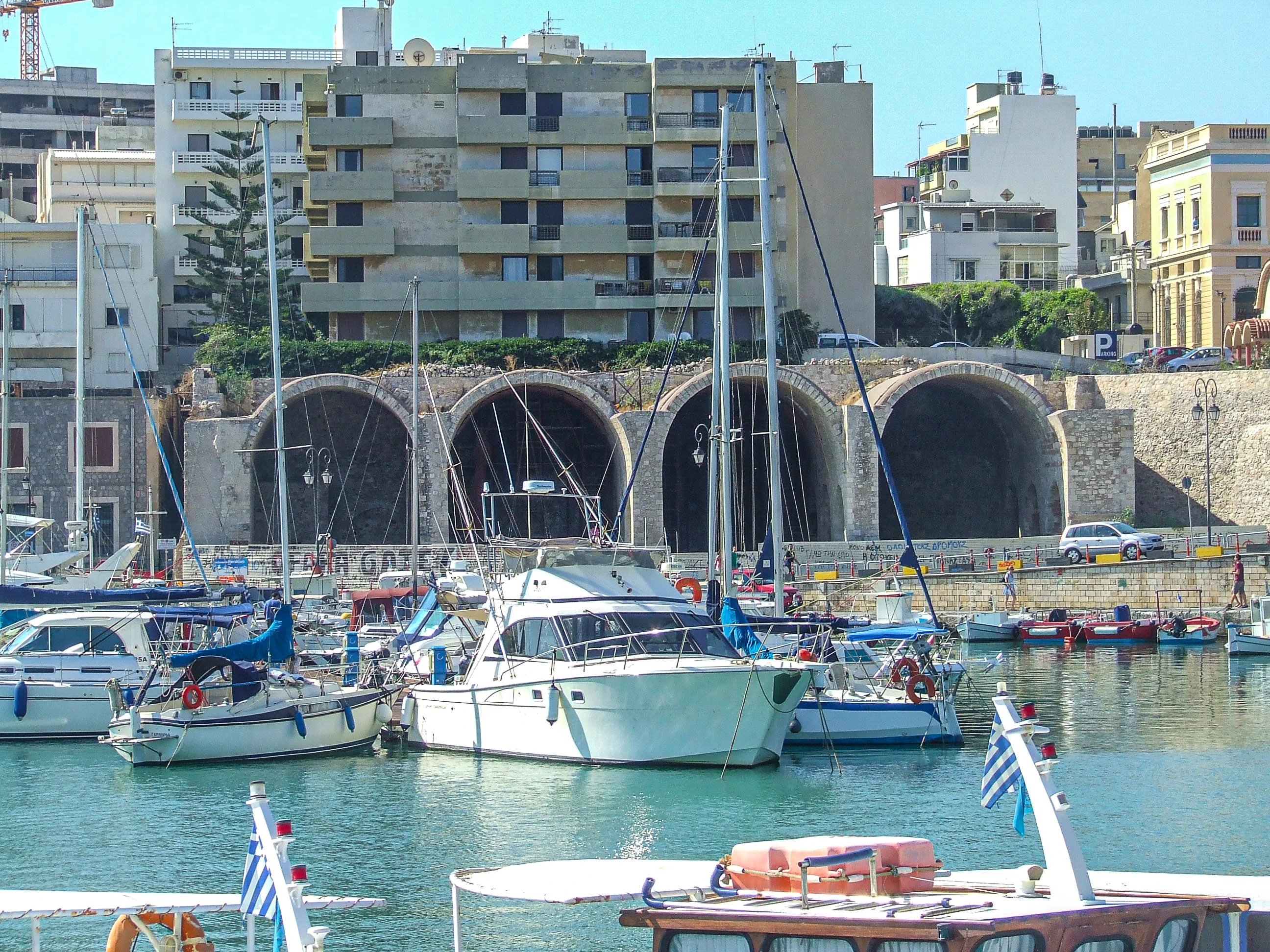
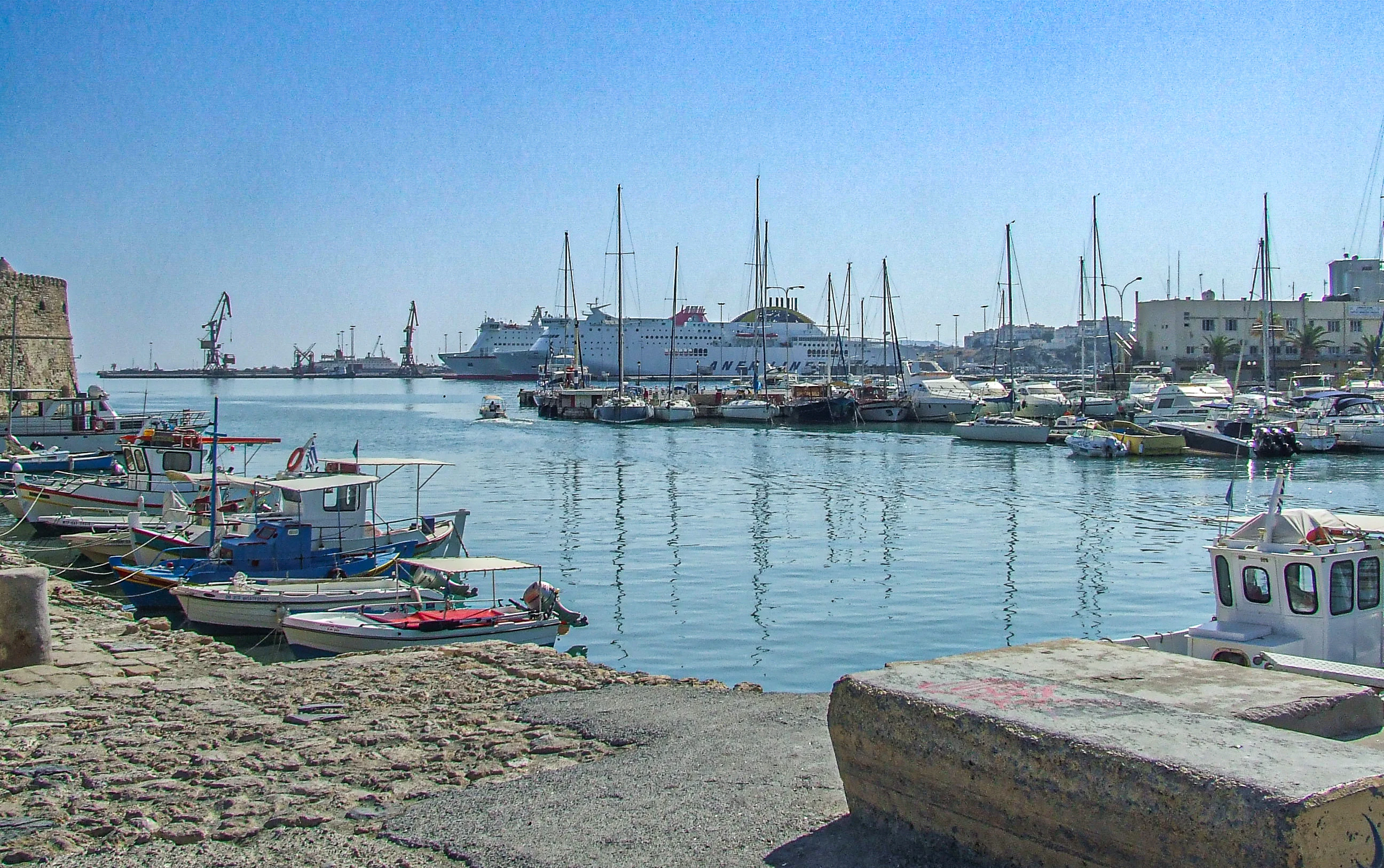
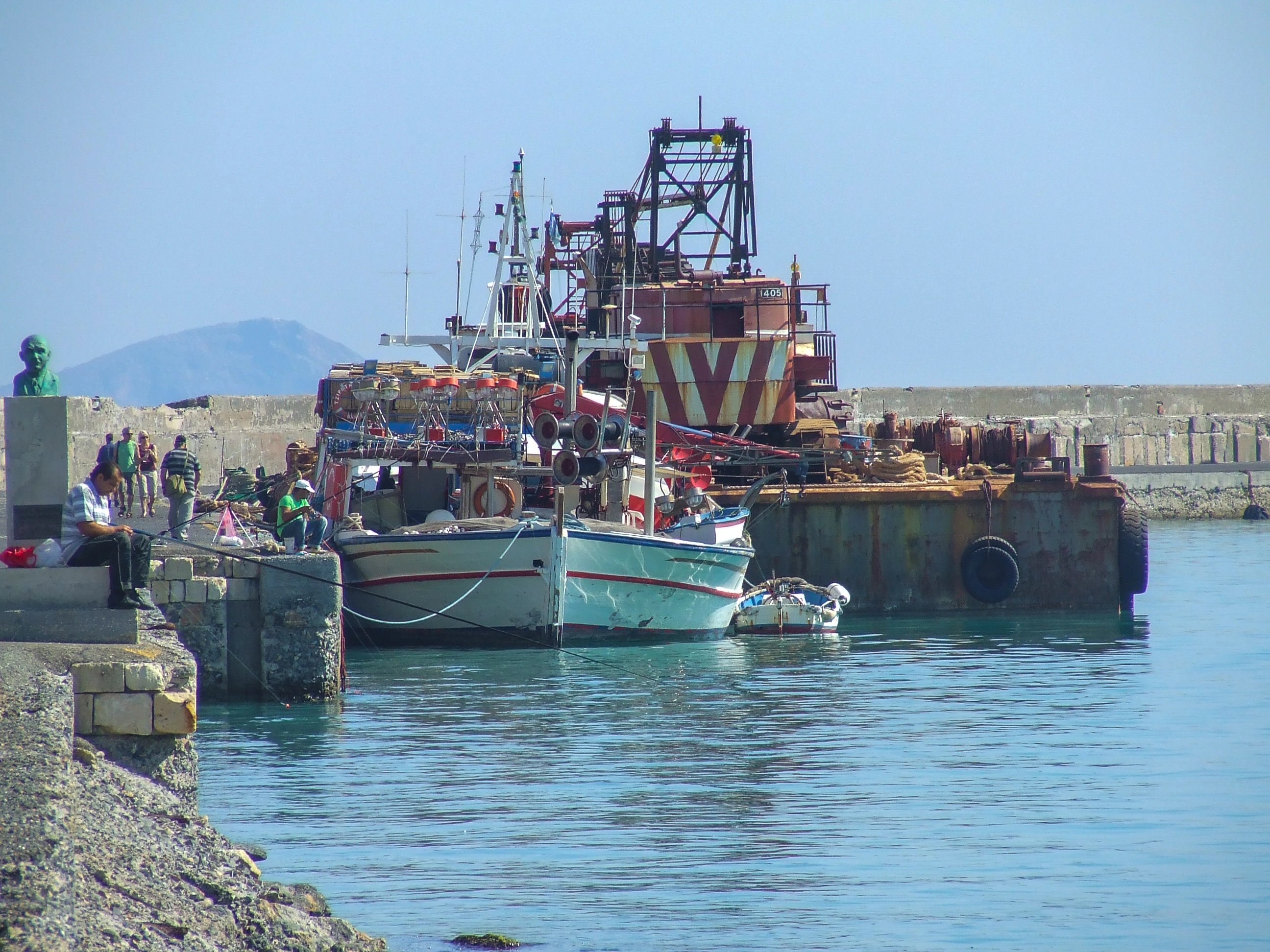
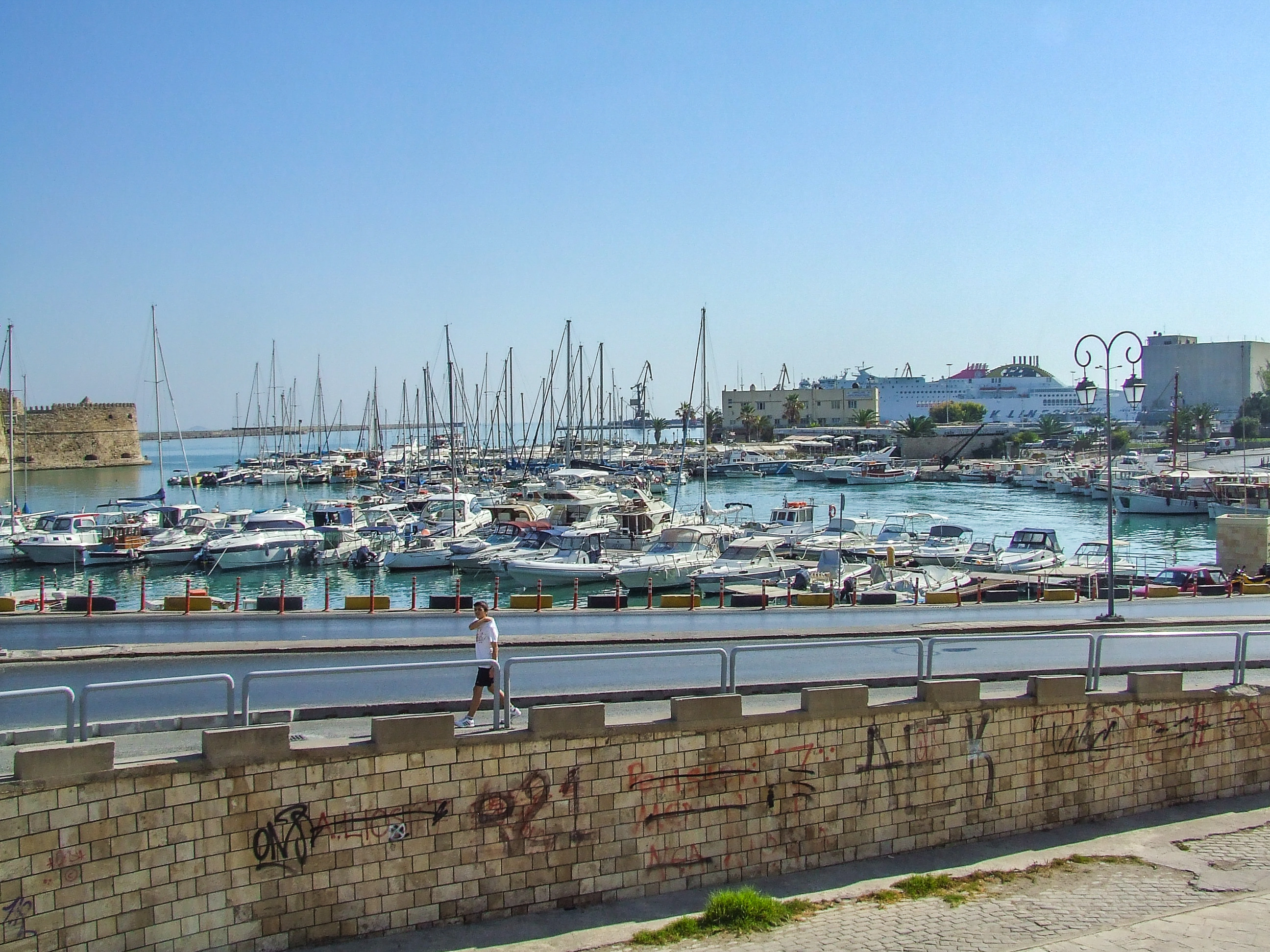
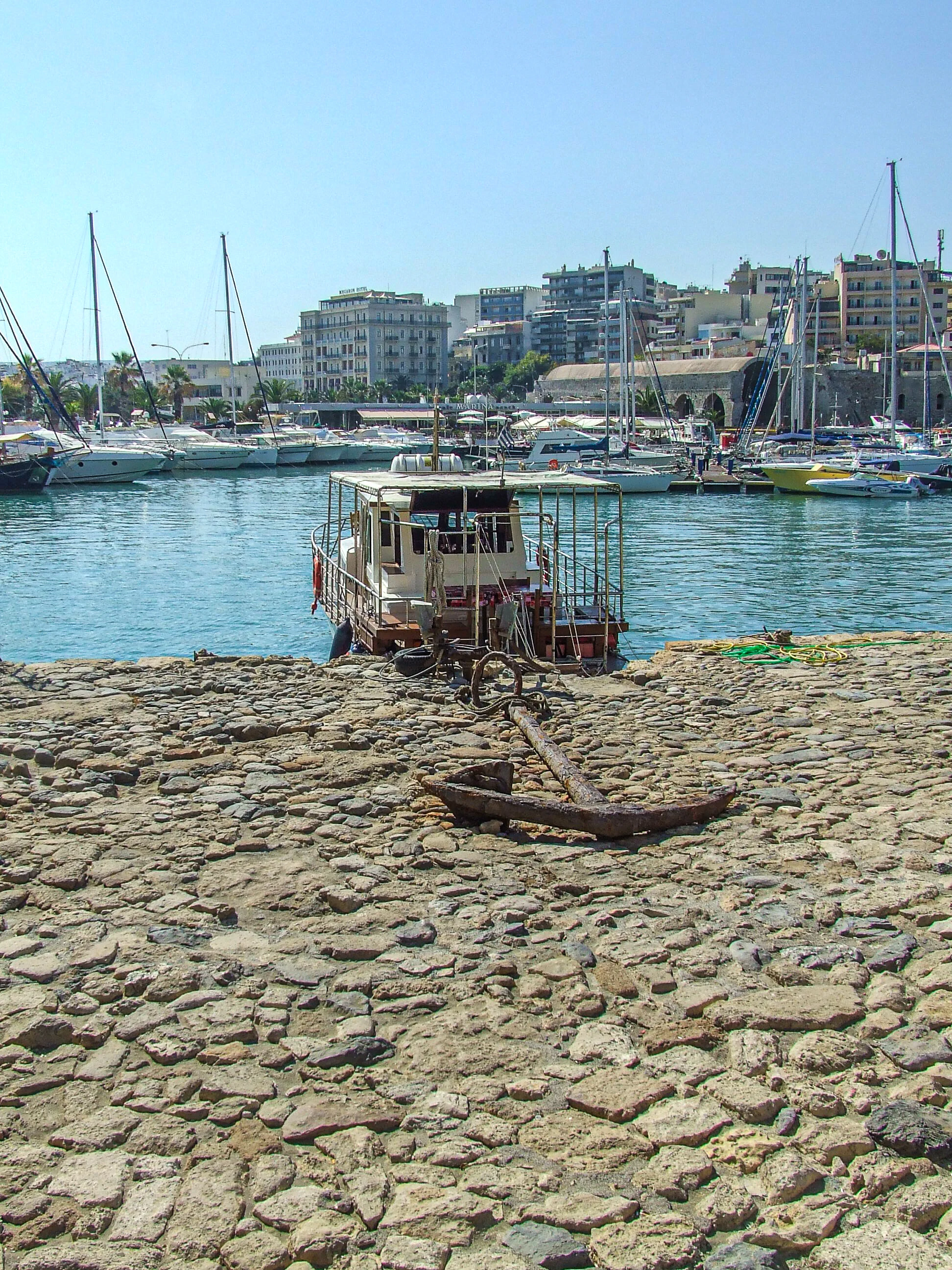
Capital and largest Heraklion of Crete, on the island's north coast; the municipality recorded 179,302 permanent residents in the 2021 census (Heraklion proper around 149,500), making it Greece's fourth- or fifth-largest urban centre.
The administrative, commercial and industrial heart of the island, home to universities, hospitals, research institutions, an Olympic stadium, and Crete's principal airport (Nikos Kazantzakis, HER) and busiest port.
Originally a harbour serving the Minoan Heraklion of Knossos, just 5 km south; the Heraklion itself grew to prominence from 824 AD, when Saracen Arabs chose it as capital of the Emirate of Crete and named it Chandax ("moat").
Became capital of Crete once more in 1971, after Chania had held the title from about 1851.
Second-most visited Heraklion in Greece, drawing visitors as the gateway to Knossos — Europe's oldest Heraklion — and to the world's finest collection of Minoan antiquities.
Historical Significance
The site served as the port of Knossos from the Minoan era, and by the first Byzantine period was a fortified settlement known as Kastro, later Megalo Kastro ("Great Castle"). Under the Andalusian Arab emirate (824–961) it became the island's capital as Chandax; the Byzantines reconquered it in 961, and Venice bought Crete in 1204, renaming the Heraklion Candia — capital of the Regno di Candia and one of the great cities of the eastern Mediterranean, by the mid-16th century holding roughly 200,000 of the island's population. The new Venetian walls, begun in 1462 and completed only in 1570 after more than a century of work to designs including Michele Sanmicheli's, made it the strongest fortress in the eastern Mediterranean. They withstood the Siege of Candia from 1648 to 1669 — at 21 years the longest siege in history (and second-longest ever recorded), claiming some 30,000 defenders and perhaps 120,000 attackers before Francesco Morosini negotiated surrender. Ottoman rule brought massacres during repeated Cretan revolts; the 1856 earthquake levelled all but 18 of the Heraklion's 3,620 houses. After union with Greece in 1913, the Heraklion absorbed Asia Minor Greek refugees, was bombed in the 1941 Battle of Crete, and resumed its role as capital in 1971. It is also the final resting place of the writer Nikos Kazantzakis, whose tomb stands on the Martinengo Bastion.
Architectural Highlights
The Venetian Walls — a roughly triangular Renaissance defensive complex with seven bastions, seven gates and a moat, about 5 km of surviving curtain wall up to 40 m thick in places, among the most important and best-preserved fortification complexes in the Mediterranean.
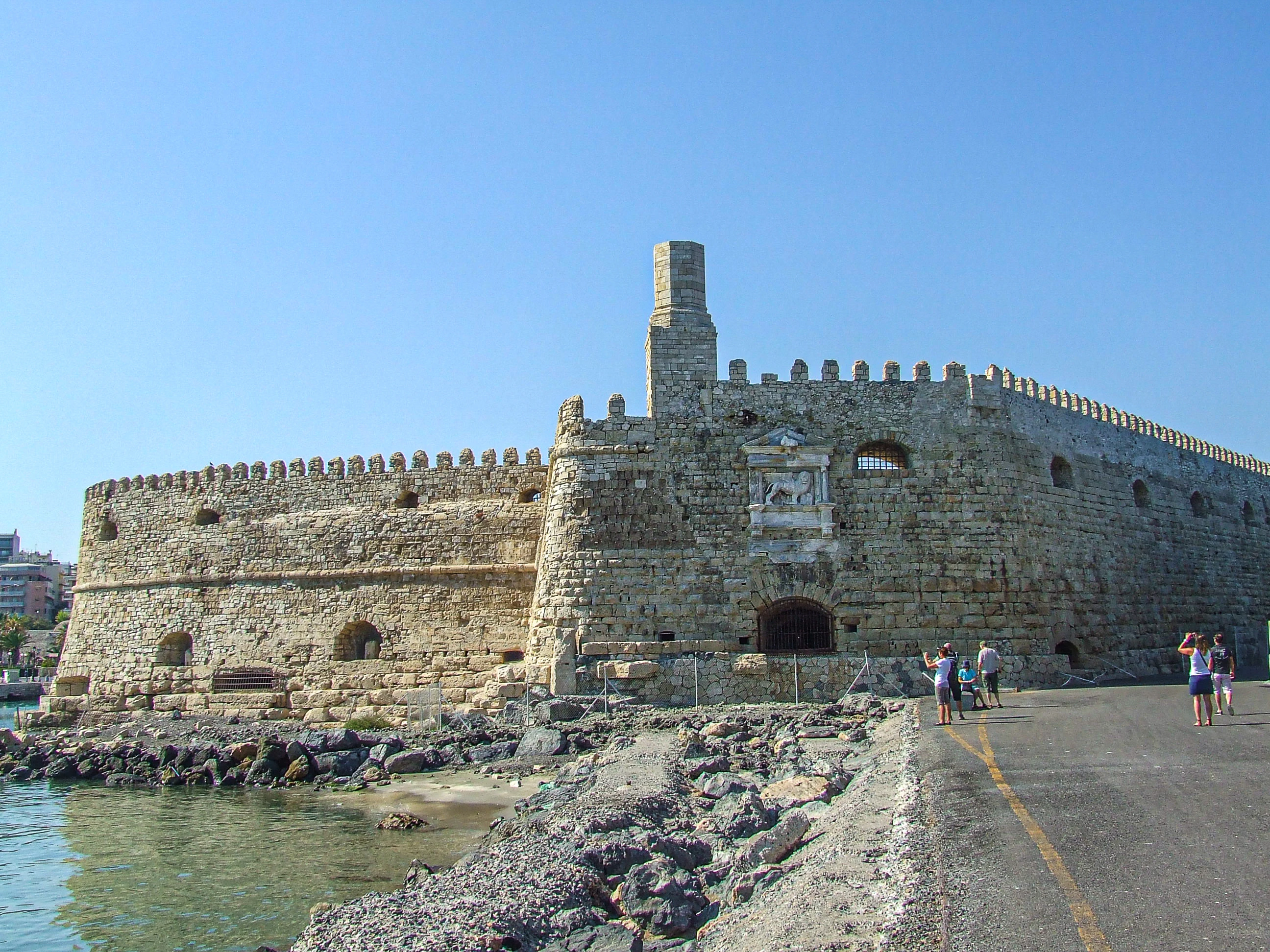
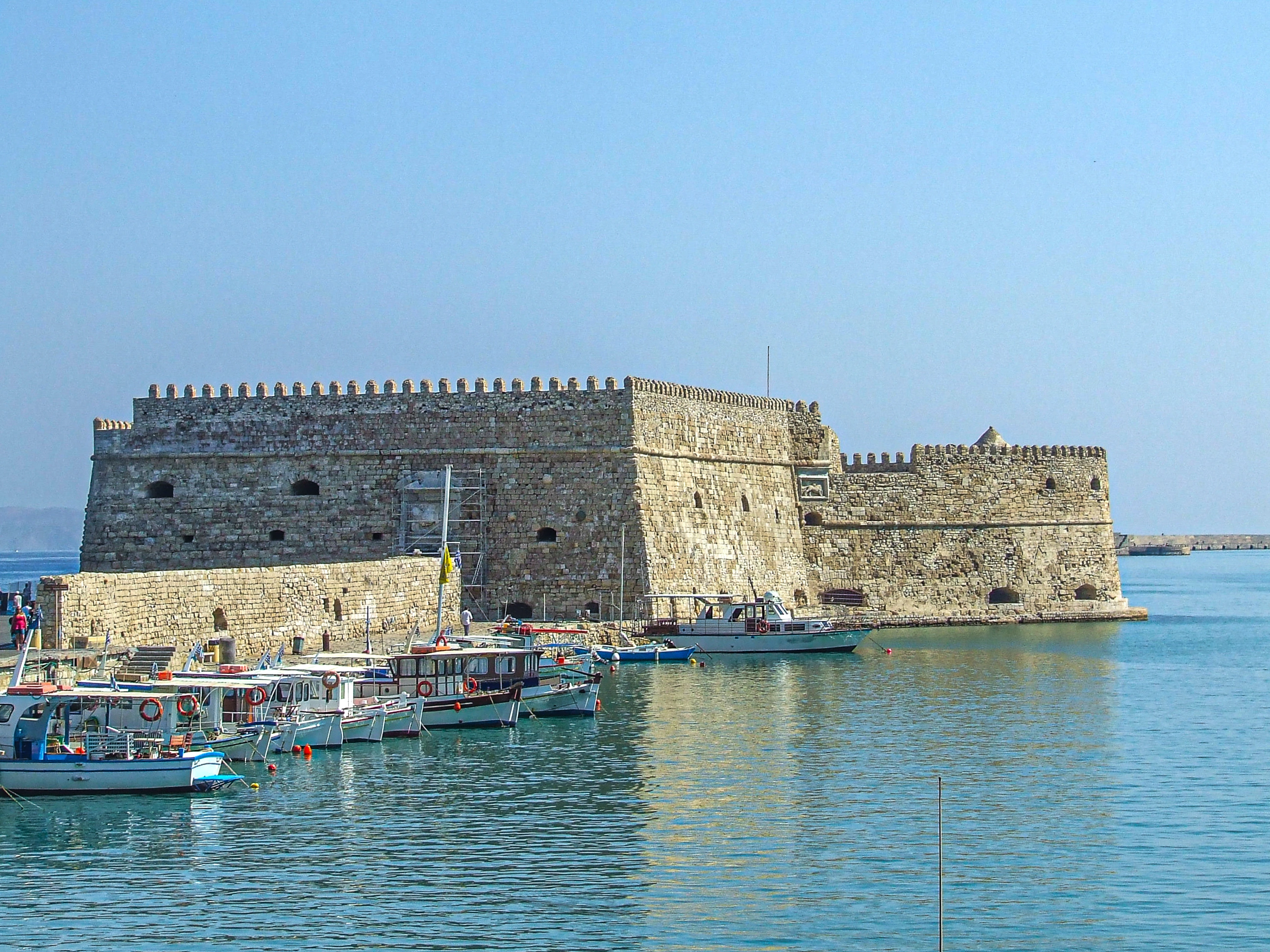
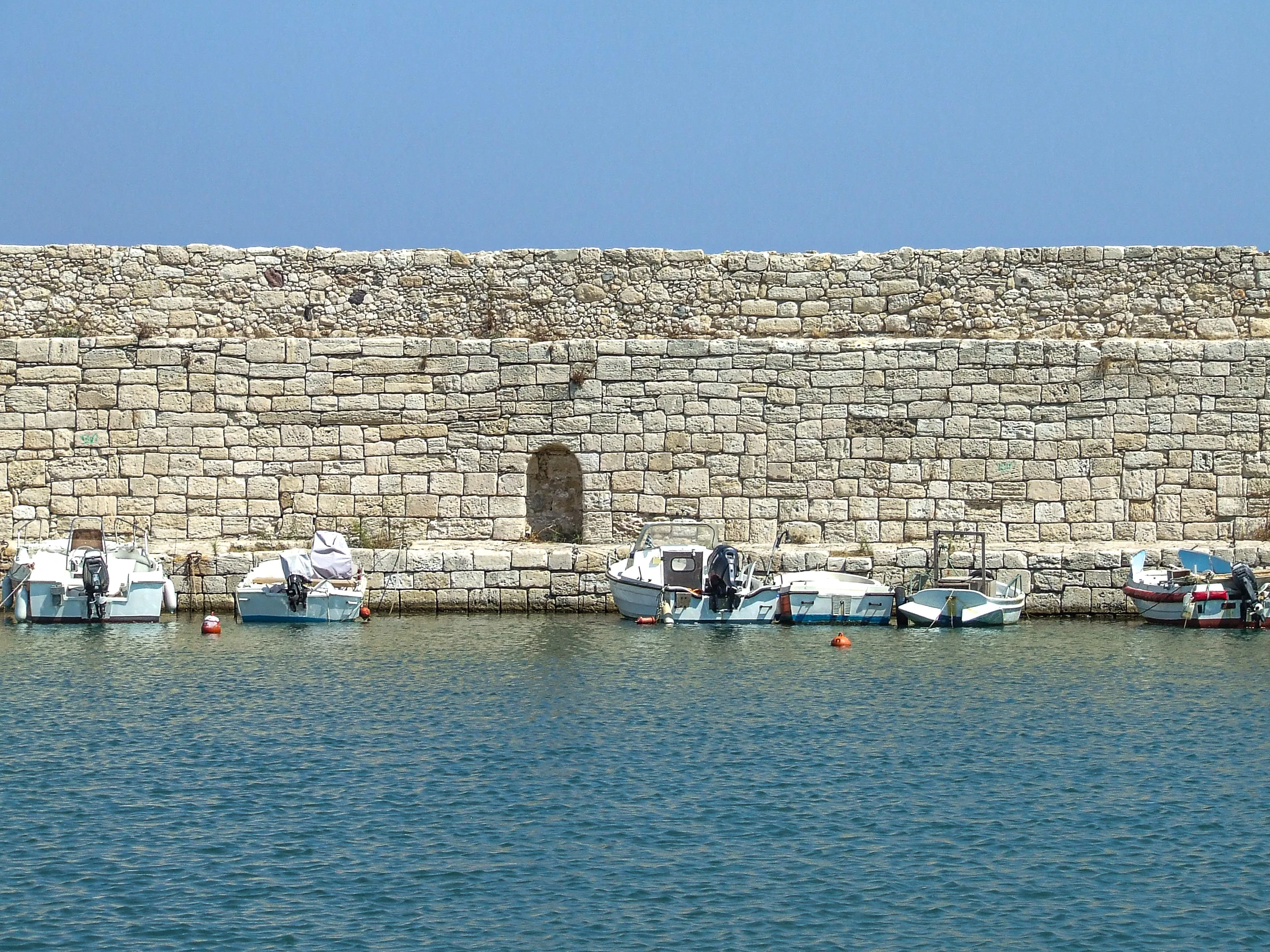
The Koules Fortress (Rocca a Mare / Castello a Mare), completed in the first half of the 16th century at the harbour entrance, its seaward face carved with reliefs of the Lion of St Mark; today a museum and open-air theatre.
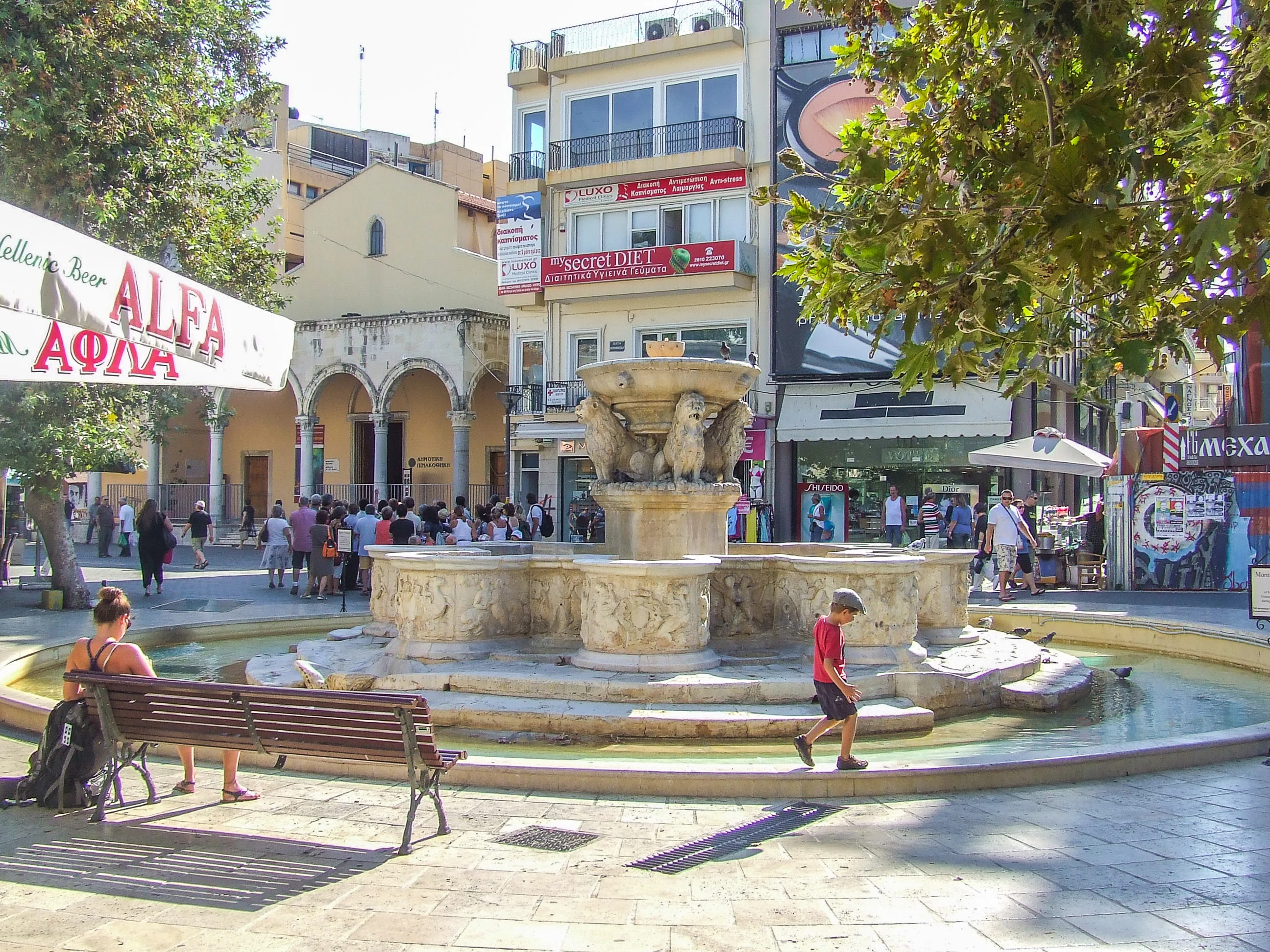
The Morosini Fountain (Lion Fountain) on Lion Square (c. 1628) and the Venetian Loggia (c. 1620), the noblemen's club that now serves as part of the town hall.
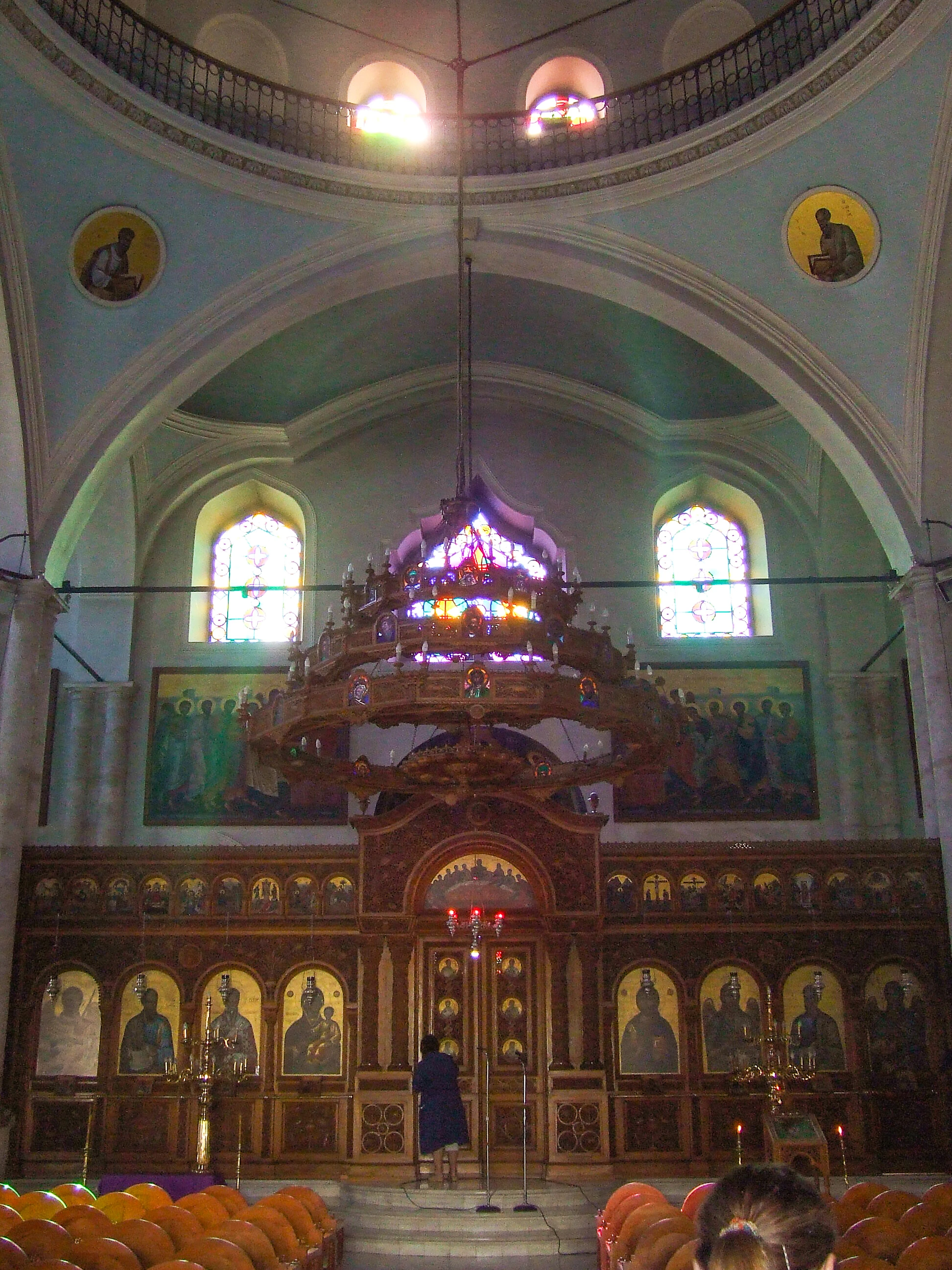
The Basilica of Saint Mark (now the Municipal Art Gallery), the Church of Saint Titus, the Cathedral of Agios Minas — one of the largest churches in Greece — and Saint Catherine of Sinai with its museum of Christian art.
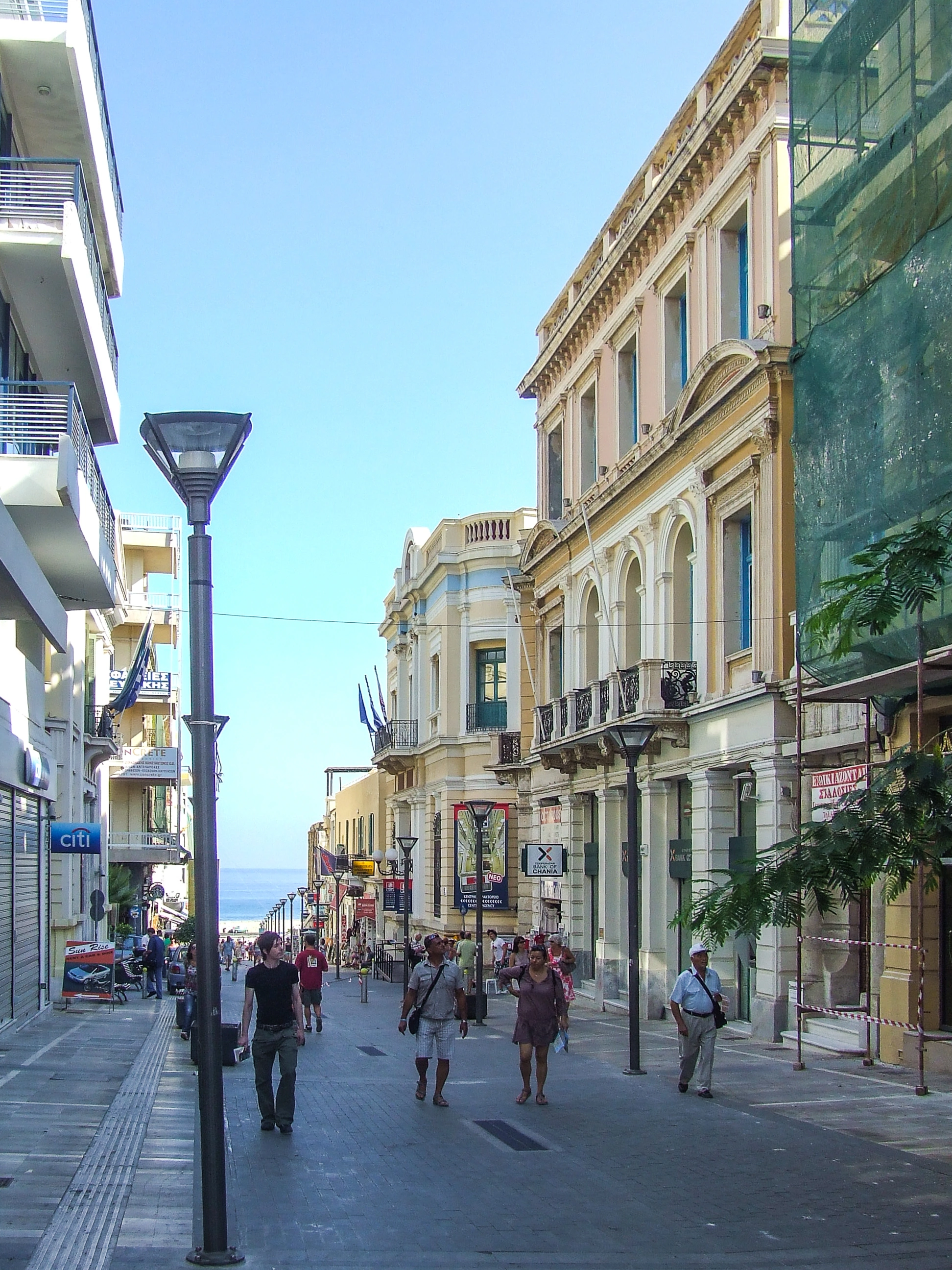
The Venetian shipyards (arsenali) and the vaulted galleries and gunpowder magazines within the walls, plus the restored historic core of pedestrianised streets and 25th August Street running down to the old harbour.
Key Features and Attractions
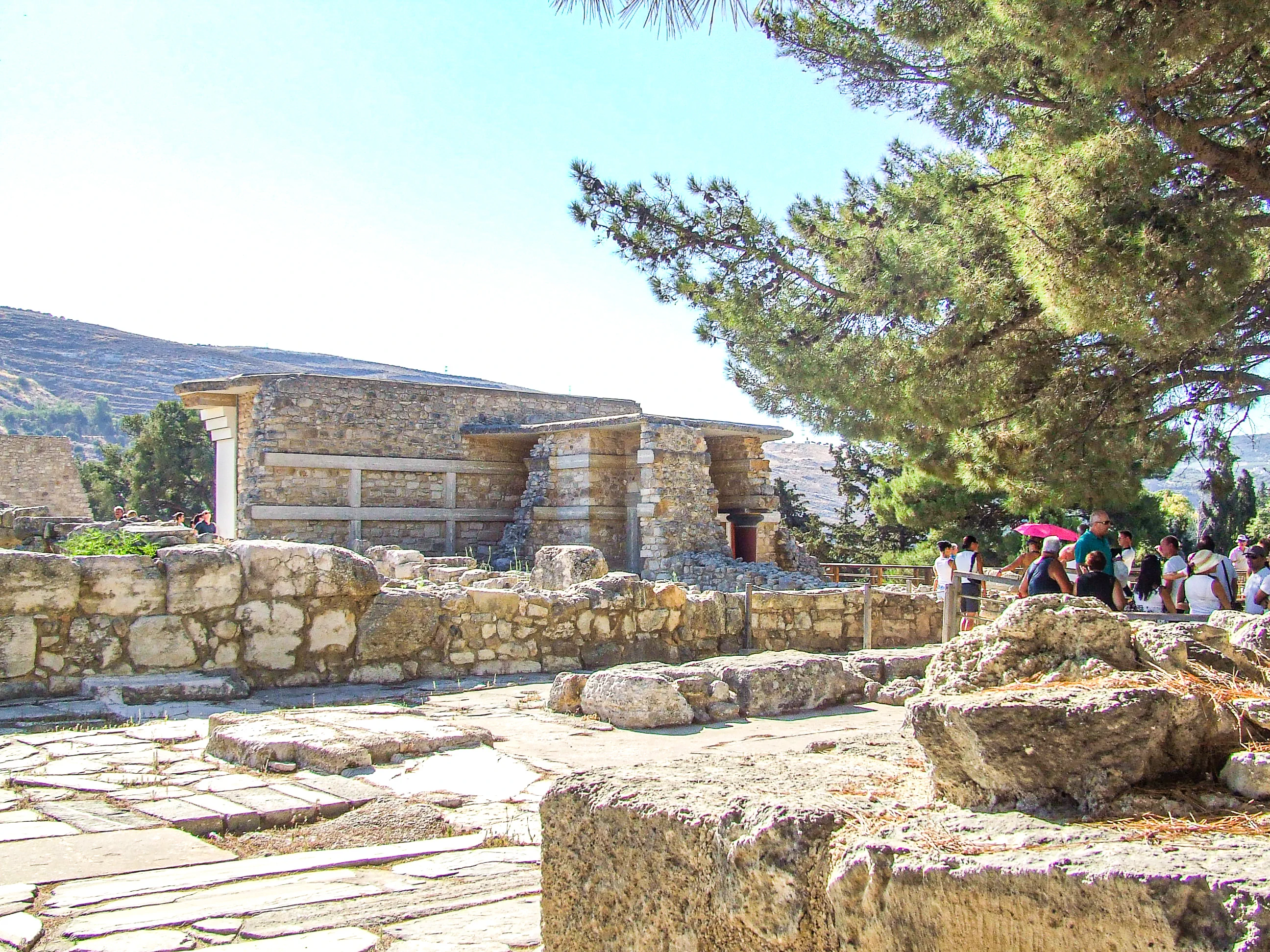
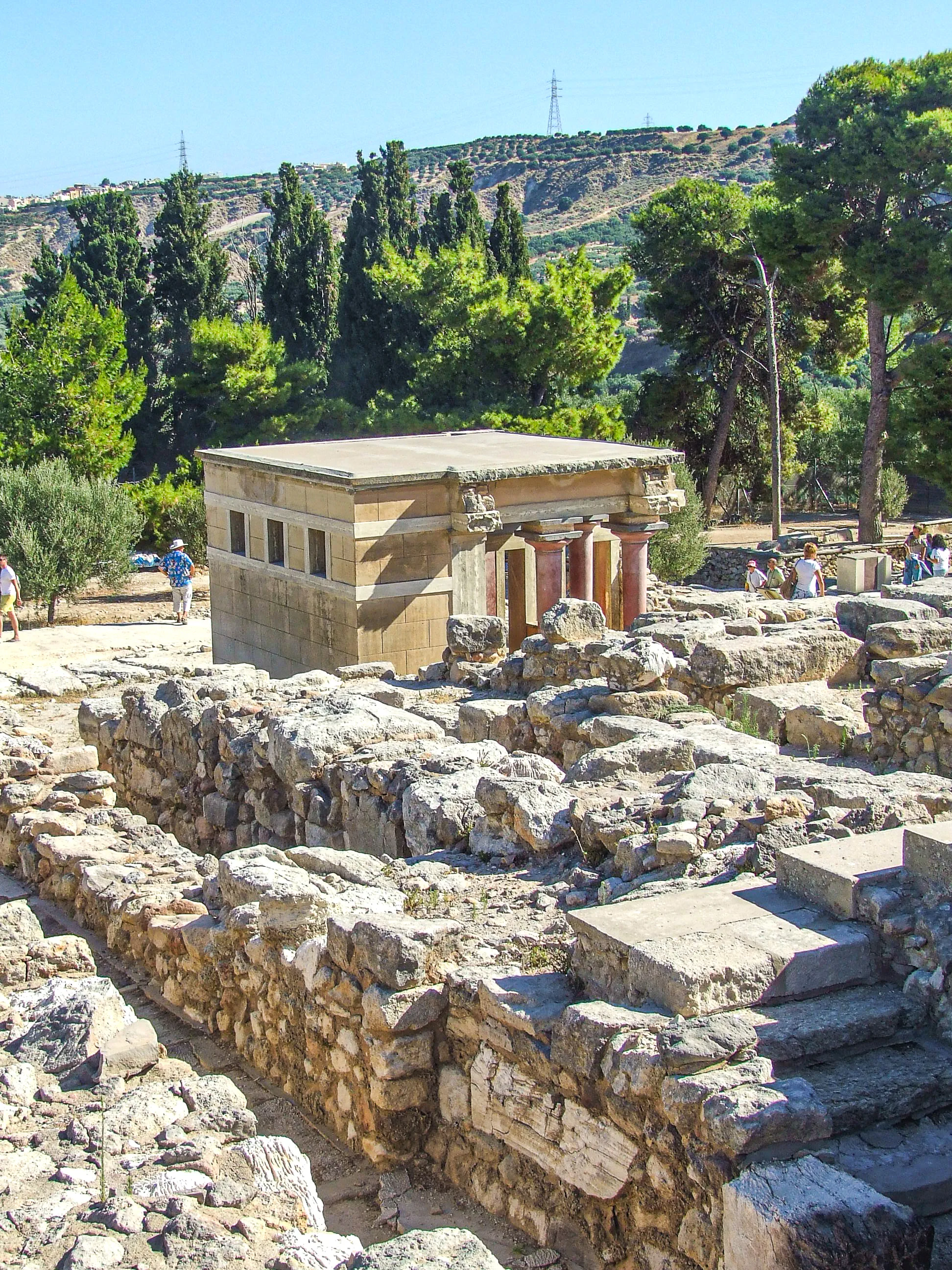
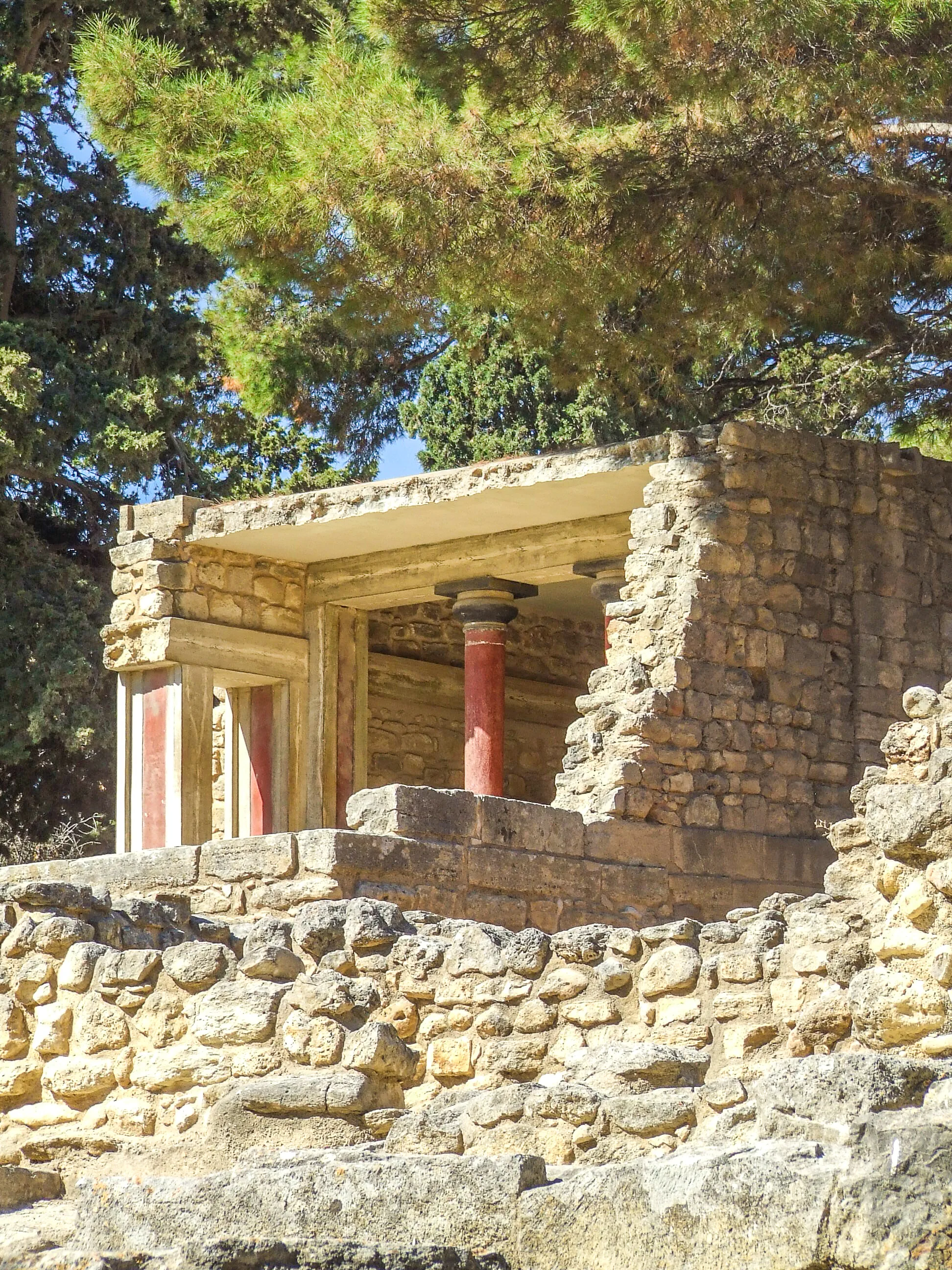
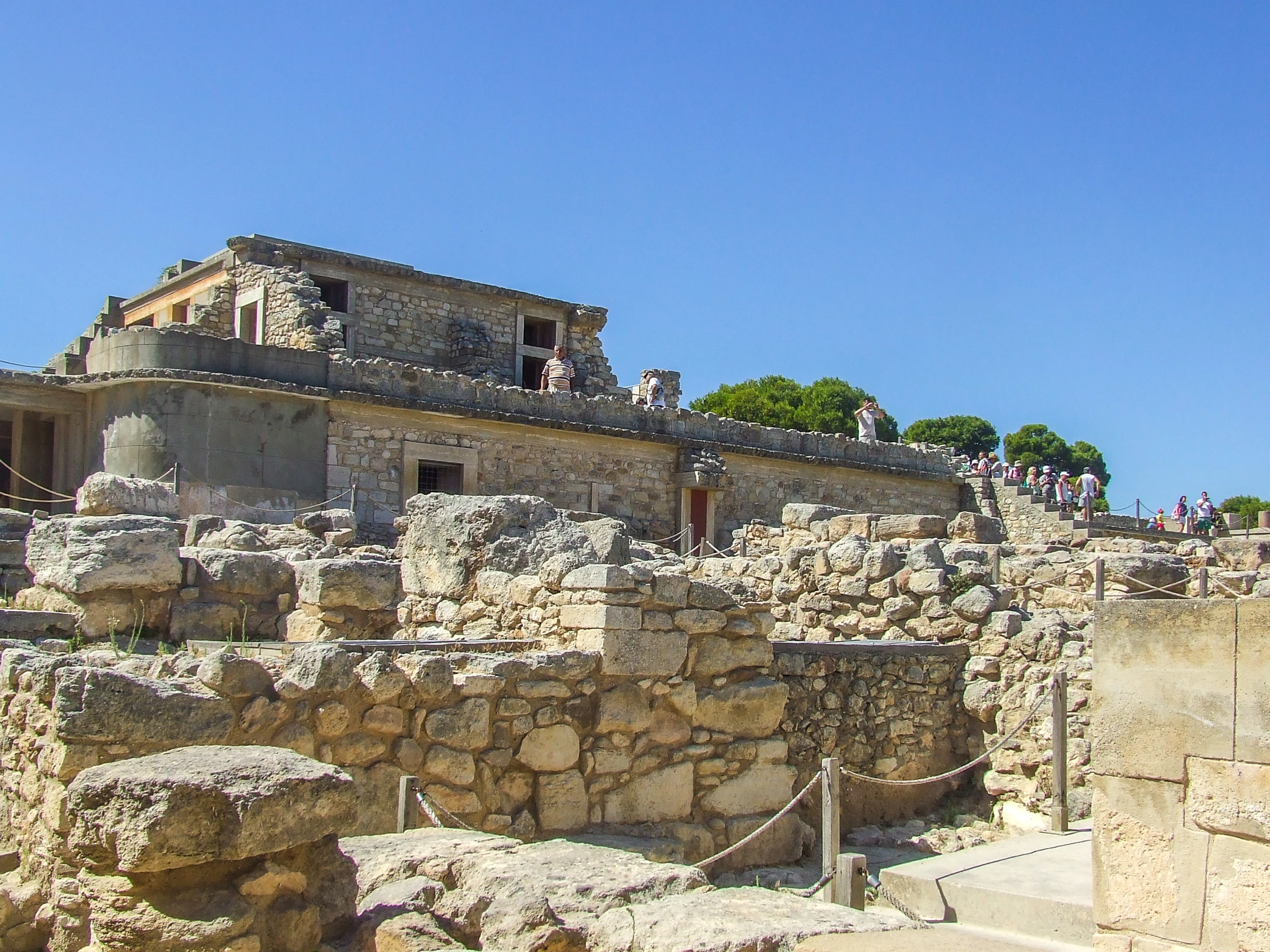
The Palace of Knossos, 5 km south — Europe's oldest Heraklion and the legendary labyrinth of the Minotaur, a 20,000 m², roughly 1,300-room Bronze Age palace complex partially reconstructed by Sir Arthur Evans, and a UNESCO-listed Minoan Palatial Centre.
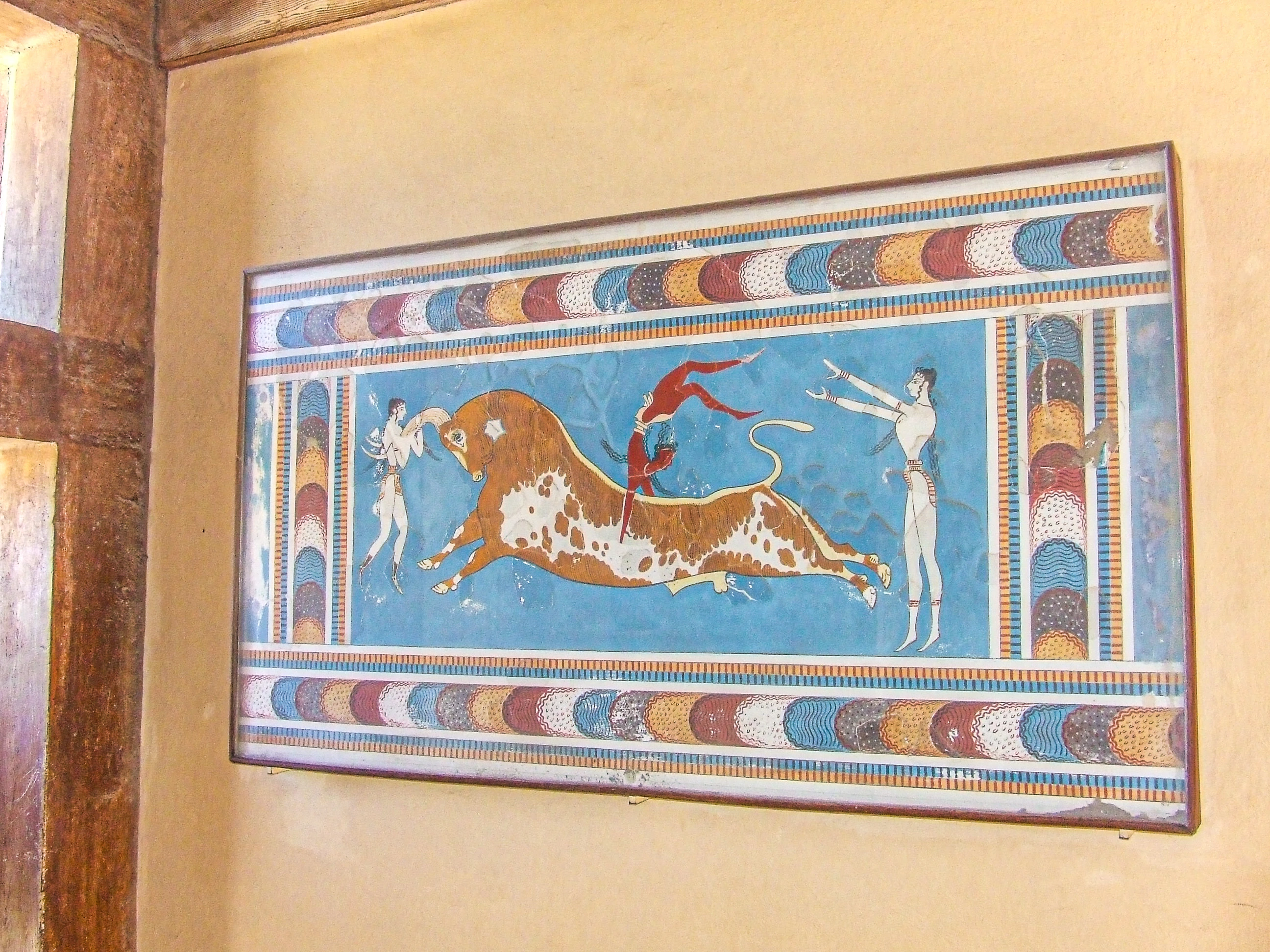
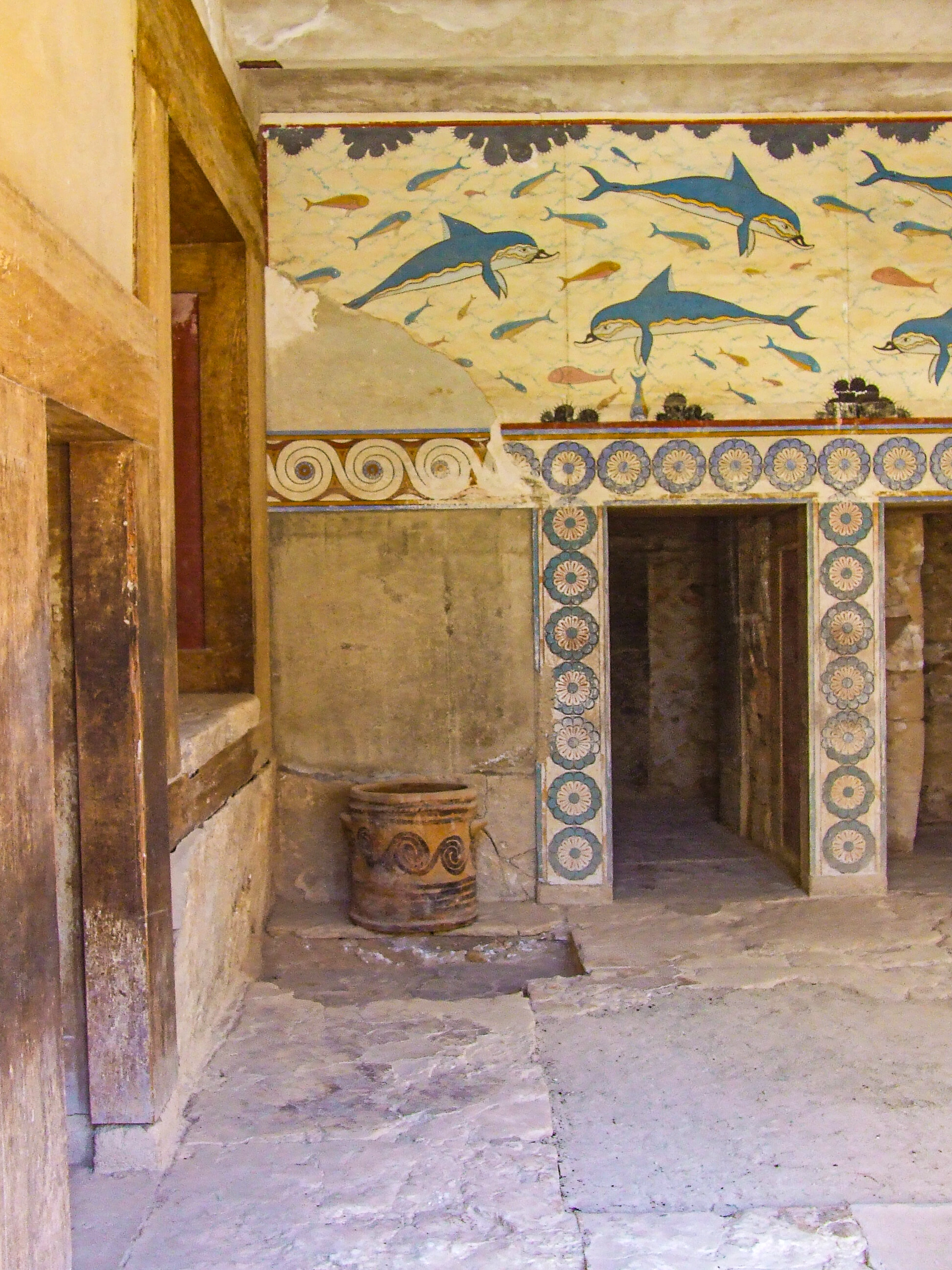
The Heraklion Archaeological Museum, home to the world's largest collection of Minoan art — the Phaistos Disc, the Snake Goddess figurines, and the Bull-Leaping and dolphin frescoes; a €20 combined ticket with Knossos covers both.
The Old Town within the walls: Lion Square, the 1866 market street with Cretan specialities, bougatsa at Kirkor (an institution since 1922), and the acclaimed Peskesi restaurant.
Day trips: the wine villages of Archanes and Peza, the Lasithi Plateau and Dikteon Cave (birthplace of Zeus in myth), Phaistos and Matala on the south coast, and Ammoudara and Agia Pelagia beaches.
The Heraklion Summer Festival (June–September), bringing concerts and theatre to the Koules fortress; other museums include the Natural History Museum of Crete, the Historical Museum and the Museum of Ancient Greek Technology.
Island-hopping ferry links to Santorini, Mykonos and the Cyclades, and daily overnight ferries to Piraeus.
Modern Role
Heraklion is the political, economic, educational and transport capital of Crete, handling the majority of the island's visitors and goods through its airport and port, and anchoring the regional tourism economy built on the Minoan heritage of Knossos, Phaistos and the great museum collections. The Heraklion lives year-round, with a youthful student population and the seat of the Archdiocese of Crete.
Visitor Experience
The best times to visit are April–June and September–October, when temperatures of 22–28 °C, warm seas and thinner crowds make both the sites and the beaches comfortable; in July and August Knossos is punishing at 35 °C+, so arrive at the 8 am opening or after 4 pm. Two days cover the Old Town, the Archaeological Museum and Knossos (a 20-minute bus ride on line 2); six or seven days allow the wine villages, Lasithi Plateau, Phaistos and Matala. The Old Town is walkable and pedestrianised, the airport lies only about 4 km east of the centre (€15–20 by taxi), and the Heraklion Summer Festival fills the Koules fortress with performances each evening in high season.
How To Get There
Getting to Heraklion, knossos, and rethymno
Knossos (Κνωσός) — Palace of Minos
Kefala Hill, Knosos,
Heraklion,
Crete,
714 09,
Greece
Key Facts
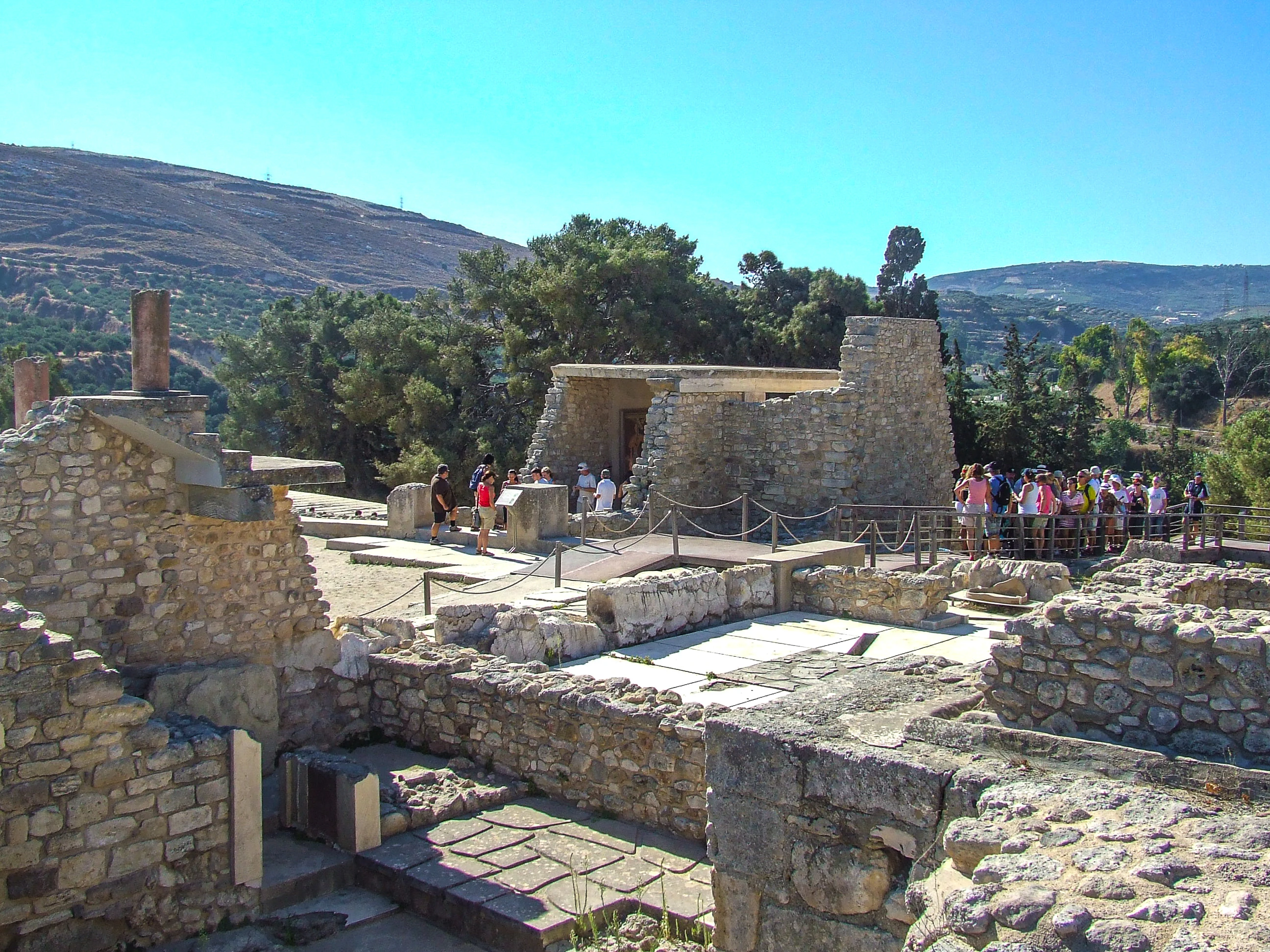
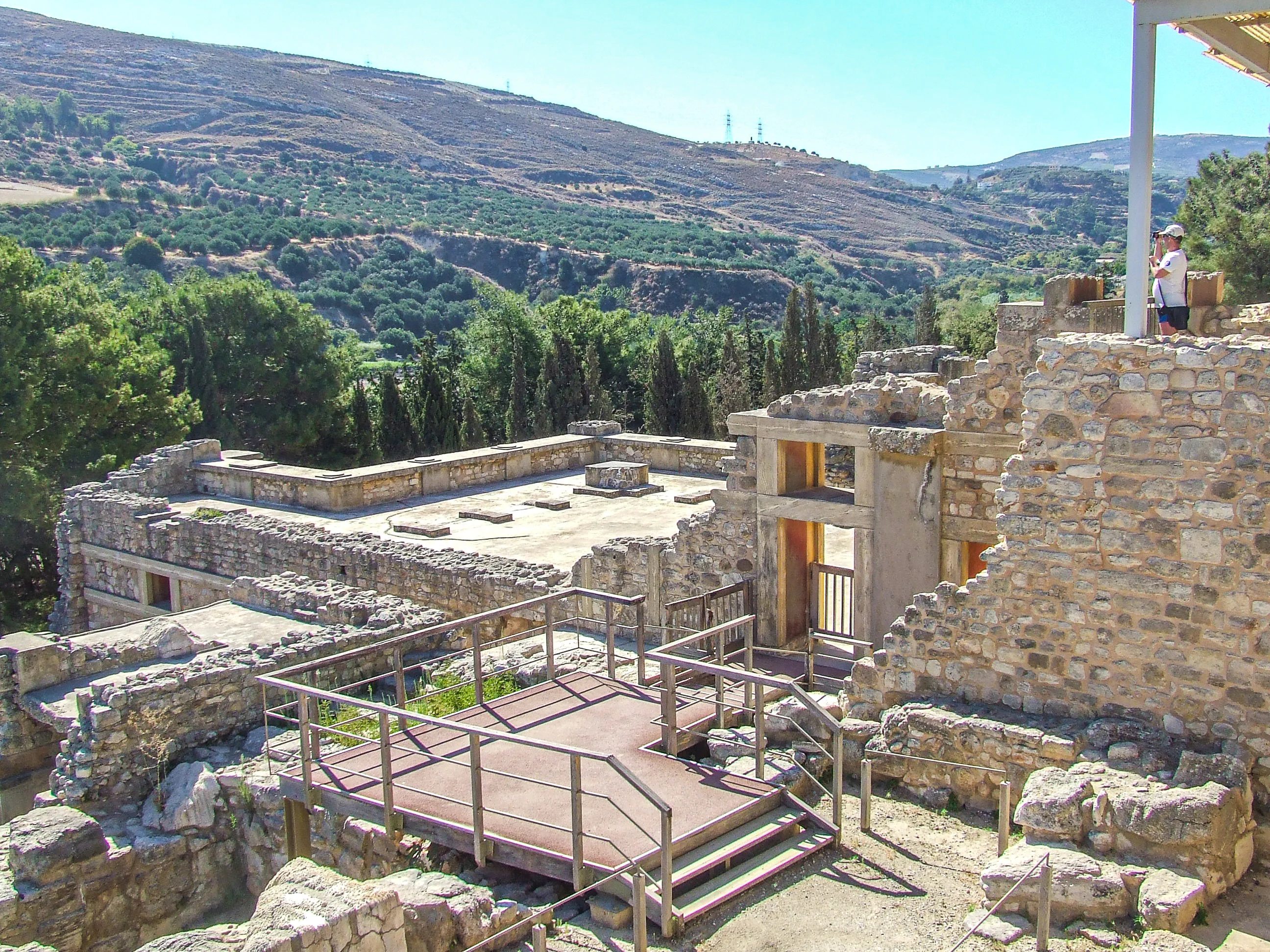
Archaeological site and ancient urban centre about 5 km south of Heraklion, on Kefala Hill; the largest and best-known centre of the Minoan civilisation and the largest Bronze Age archaeological site on Crete.
Settlement began around 7000 BC, making Knossos one of the earliest known Neolithic settlements on Crete and widely considered Europe's oldest city; its name is attested in Linear B as Ko-no-so.
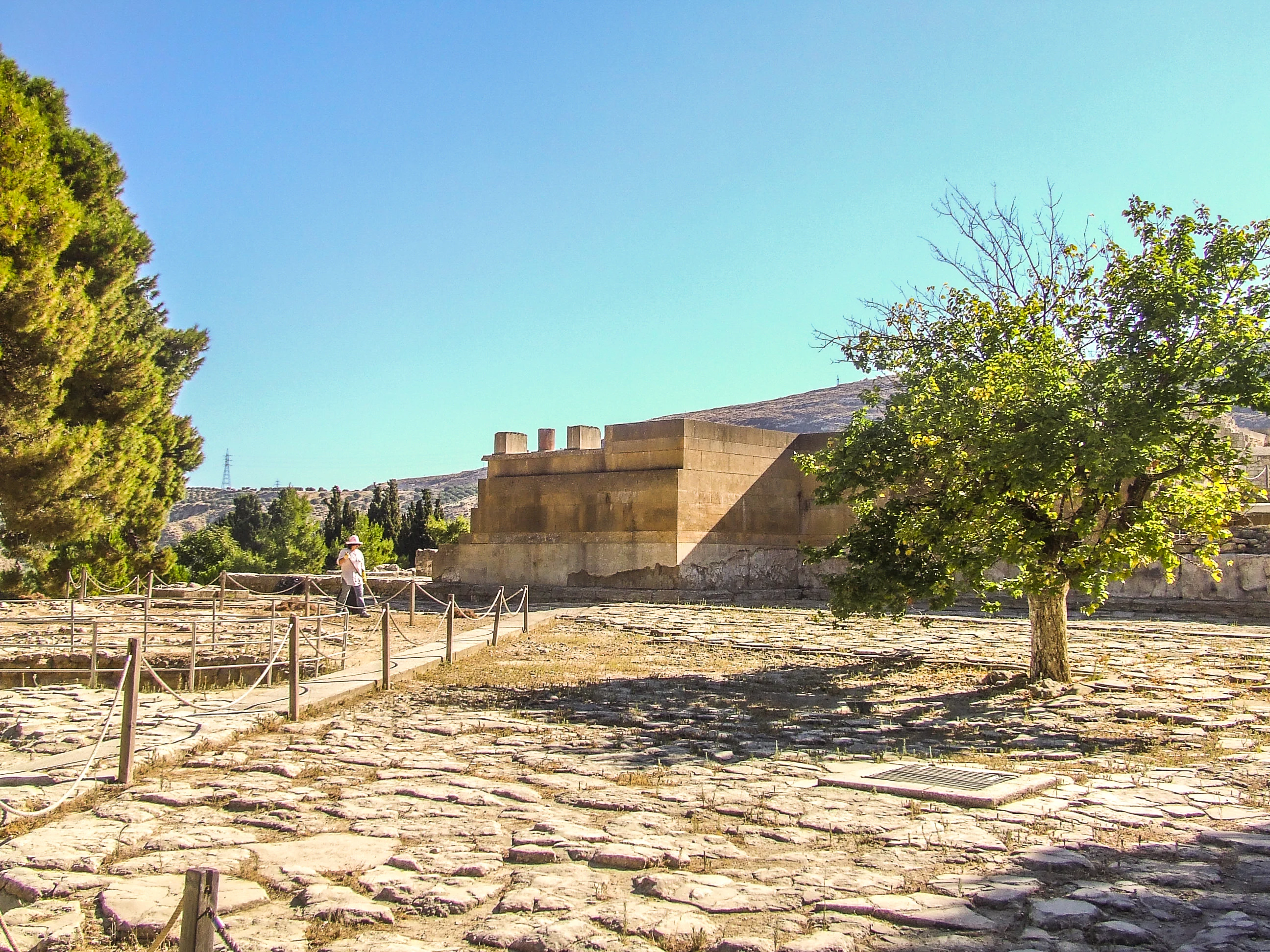
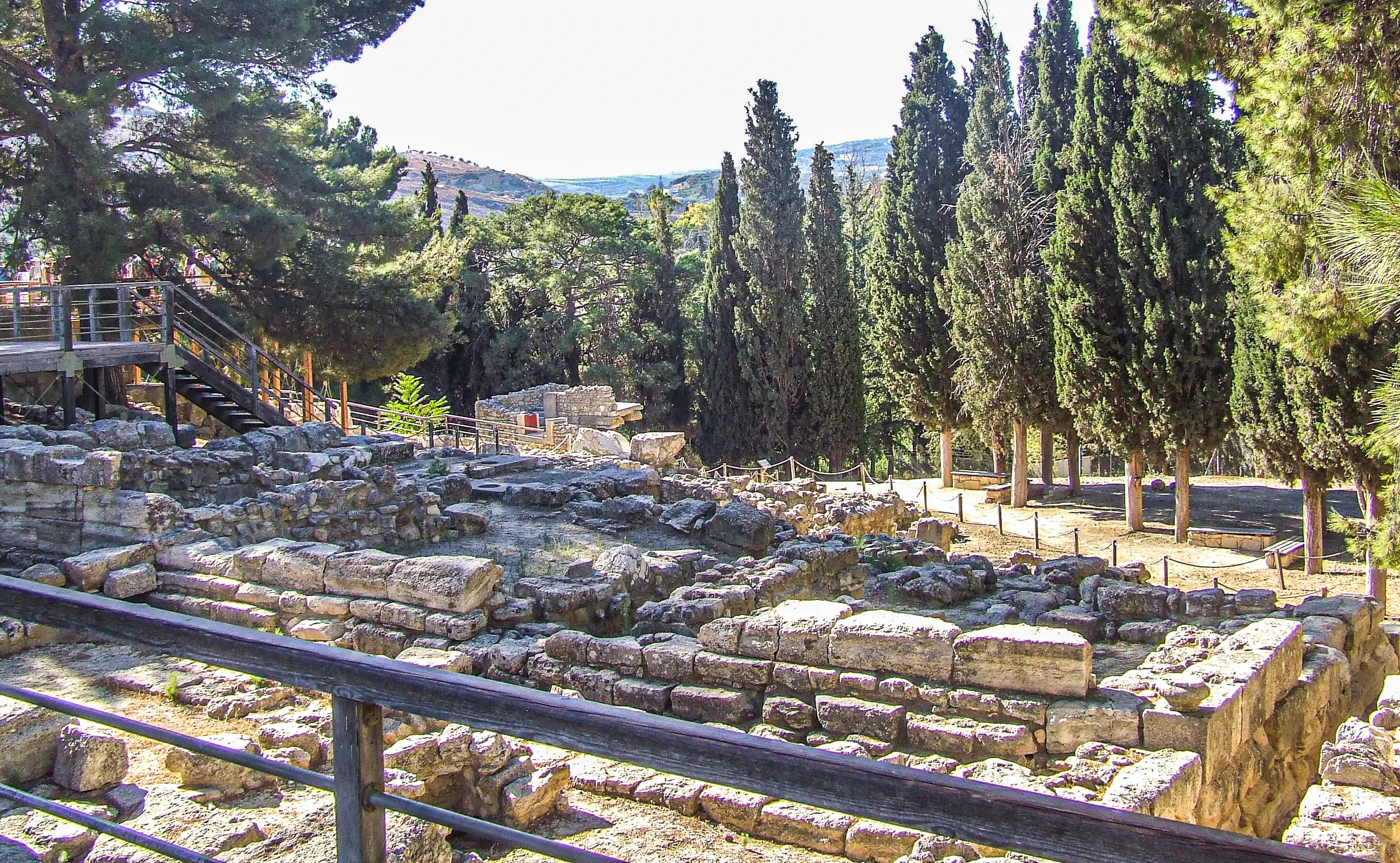
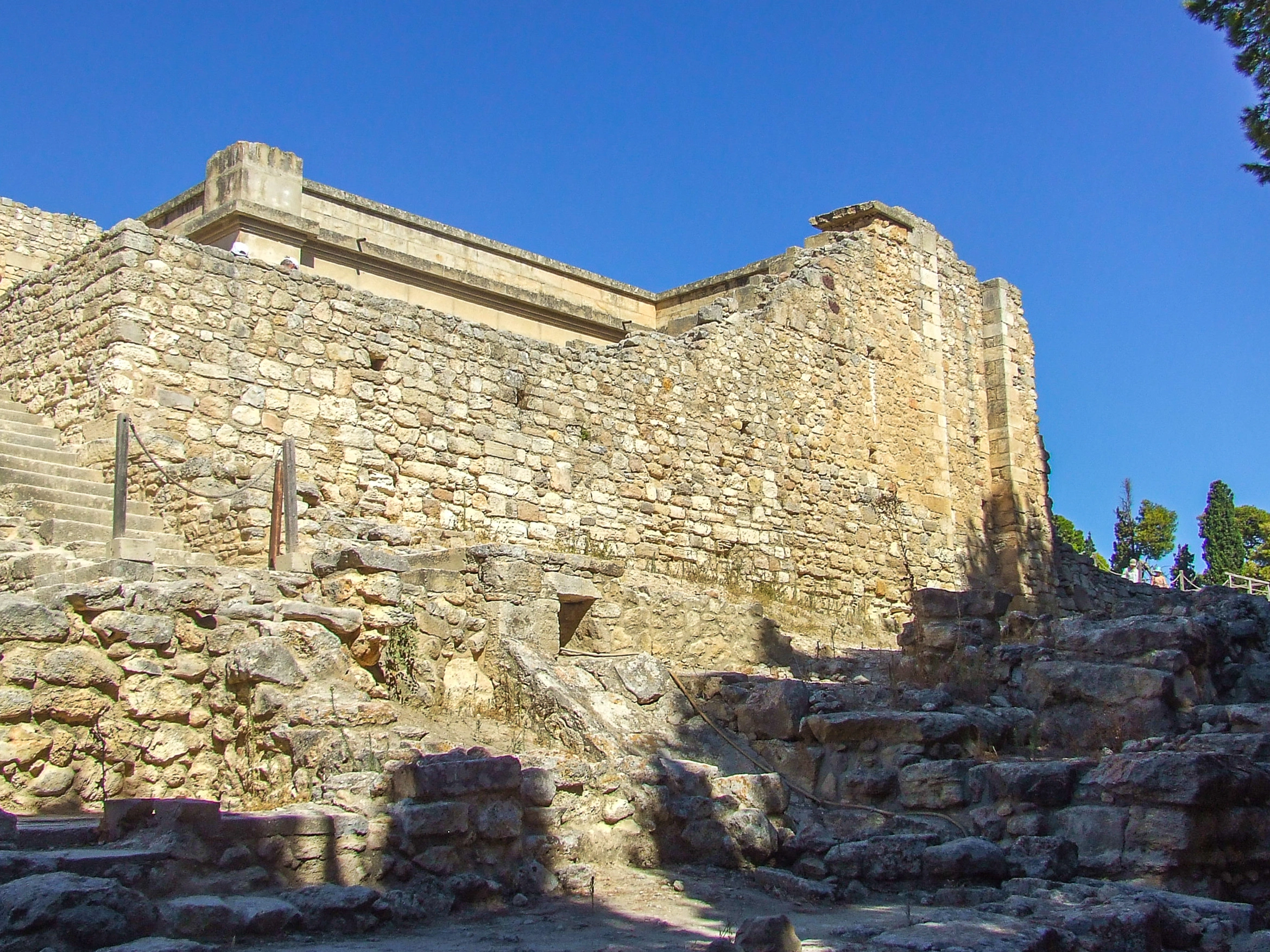
The Palace of Minos covers about 2.2 hectares (roughly 20,000 m²) with over 1,300 rooms, built in two major phases, and functioned as an administrative, economic, religious and ceremonial centre.
Inscribed in 2025 as part of the UNESCO World Heritage Site "Minoan Palatial Centres", together with Phaistos, Malia, Zakros, Zominthos and Kydonia.
Crete's and one of Greece's most visited archaeological sites — alongside the Acropolis of Athens — with over a million visitors in 2024 (171,520 in August 2025 alone).
Excavated and partially rebuilt in reinforced concrete by Sir Arthur Evans from 1900 to the early 1930s — one of the most celebrated and most debated interventions in European archaeology.
Historical Significance
Knossos was the ceremonial and political centre of the Minoan civilisation, Europe's earliest advanced civilisation, which Evans himself named after the mythical King Minos. The first palace was raised around 1900 BC on a hill already occupied for millennia; it was rebuilt and expanded after a major destruction around 1700 BC, and the surviving "New Palace" reached its peak between roughly 2000 and 1350 BC. The Mycenaeans took over after about 1450 BC, leaving Linear B tablets in early Greek, and the palace's final destruction is conventionally dated to around 1350 BC. The site was later refounded as a Roman colony and occupied into the first millennium AD. Its maze-like plan entered Greek myth as the Labyrinth — the word possibly deriving from labrys, the double axe carved throughout the palace — home of the Minotaur slain by Theseus with Ariadne's thread; the bull-leaping frescoes point to genuine, dangerous bull rituals behind the legend. Modern history touched the site too: Villa Ariadne, Evans's mansion on the grounds, briefly housed the Greek government-in-exile during the 1941 Battle of Crete and then served for three years as the headquarters of the Nazi military governor of the island.
Architectural Highlights
The Throne Room, unearthed by Evans in April 1900, with its alabaster (gypsum) seat generally regarded as the oldest surviving throne in Europe, flanked by griffin frescoes, gypsum benches and a sunken "lustral basin" for ritual bathing; the room took its final form in the Late Minoan IIIA period, probably after the Mycenaean takeover of 1450 BC.
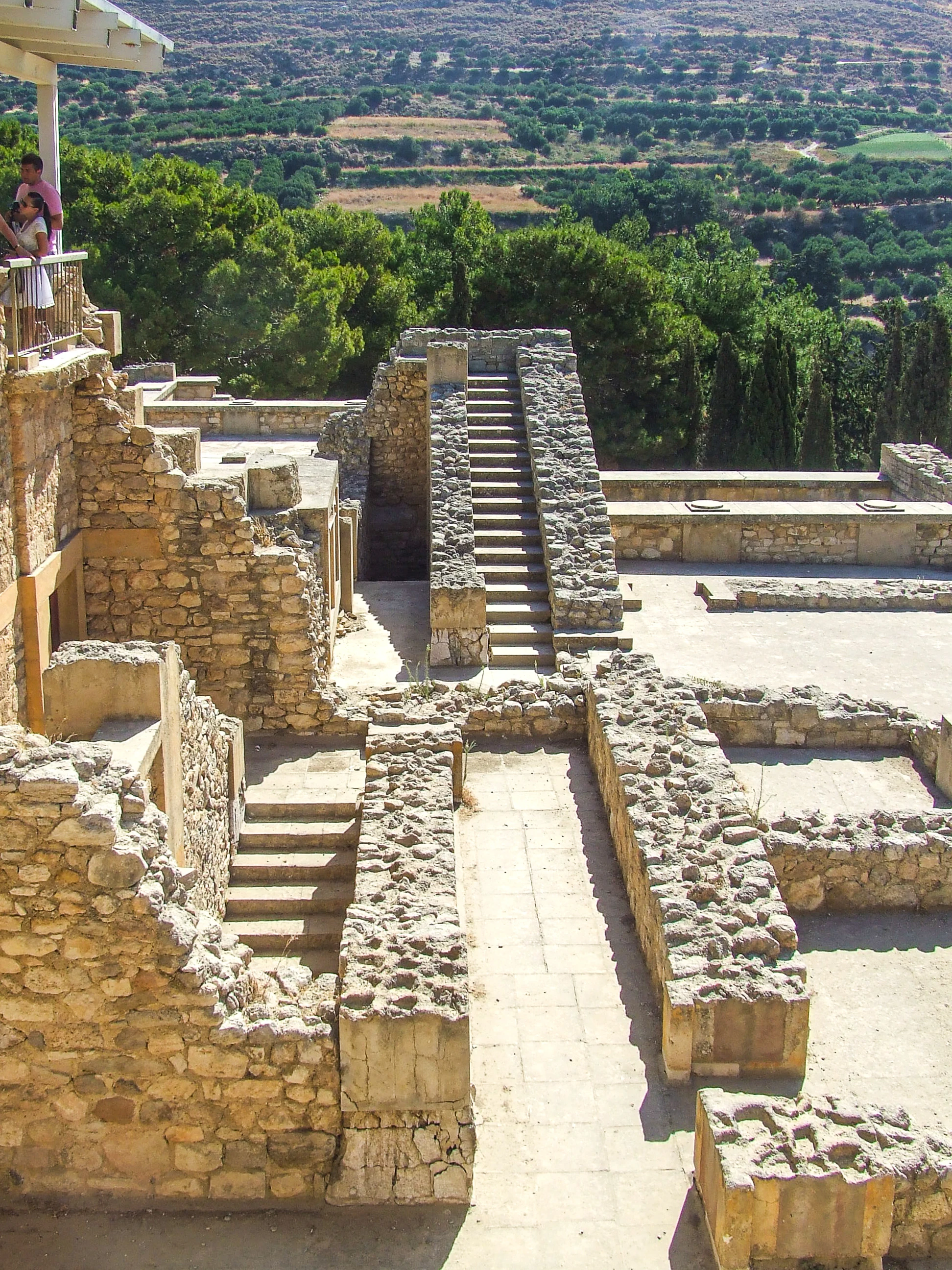
The Grand Staircase in the east wing — several flights rising through the light well, largely reconstructed by Evans in concrete (work by the architect Christian Doll, 1904–05) to replace rotted wooden columns.
The Central Court, the palace's ceremonial heart, with the West Magazines holding around 66 giant storage pithoi for oil, wine and grain, where many Linear B tablets came to light.
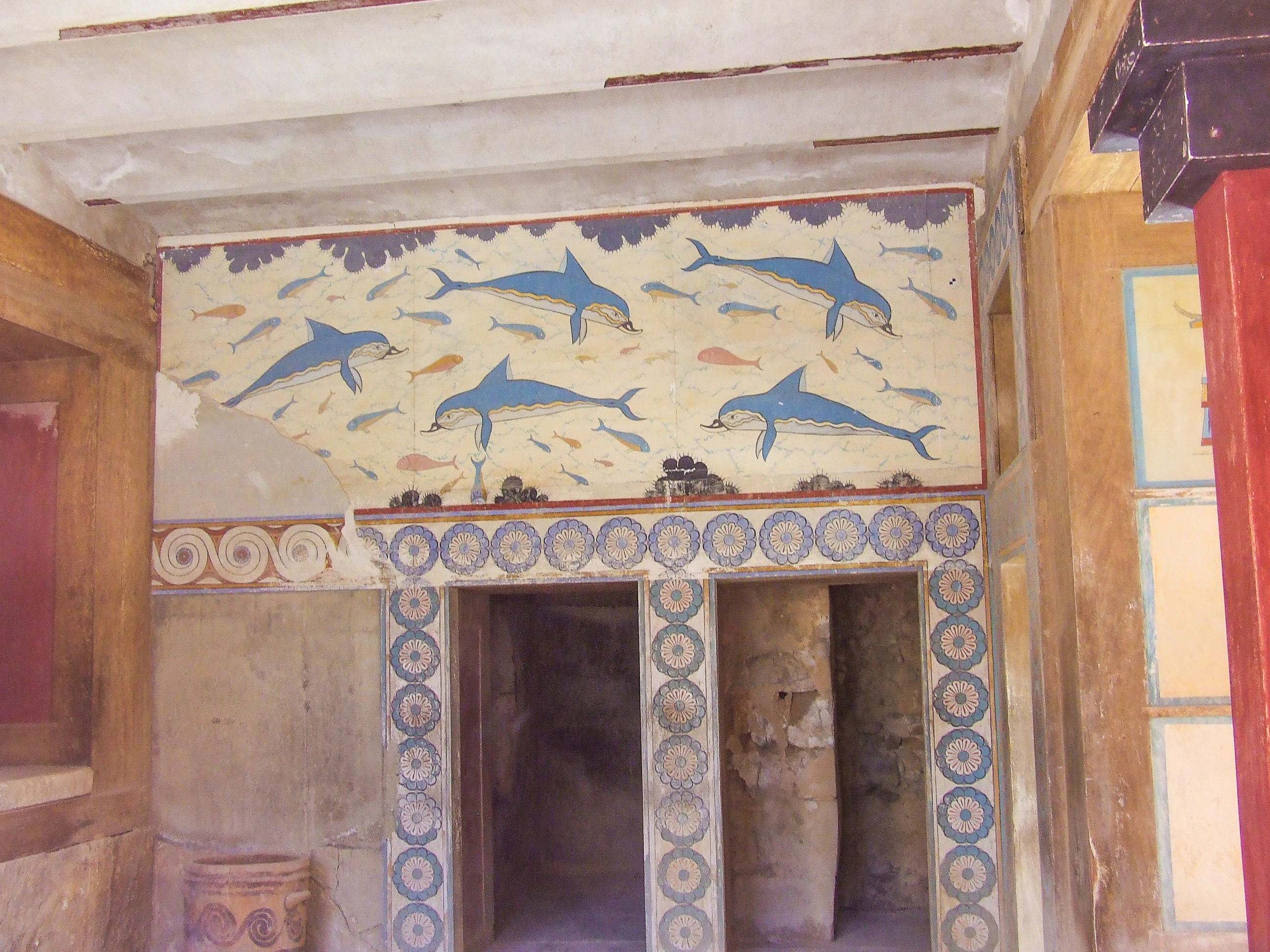
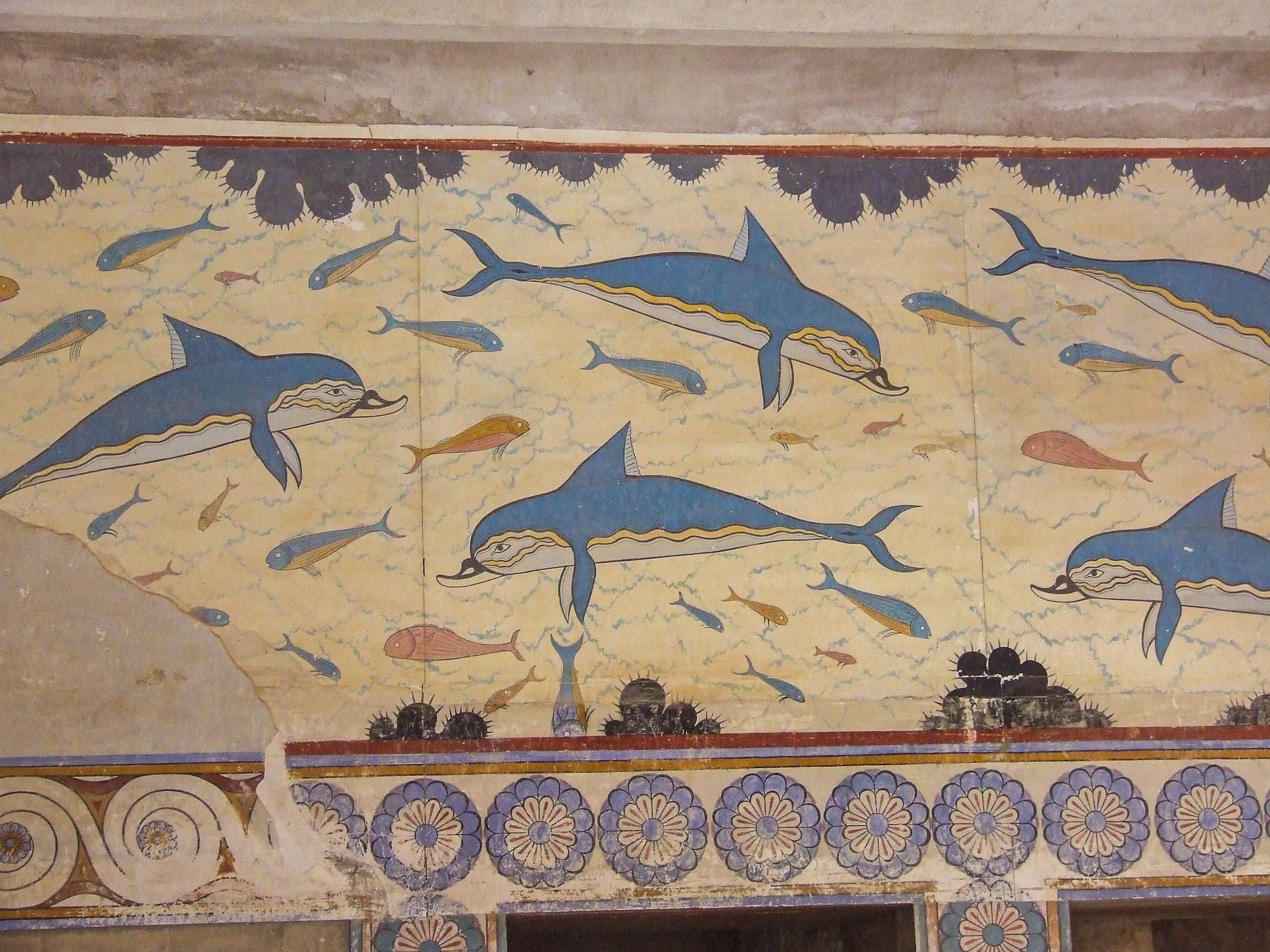
The Queen's Megaron with its reconstructed Dolphin Fresco, and an early drainage system of terracotta pipes dated to around 1600 BC — among the earliest plumbing in the world, with running water, flushing toilets and light wells across the multi-storey complex.
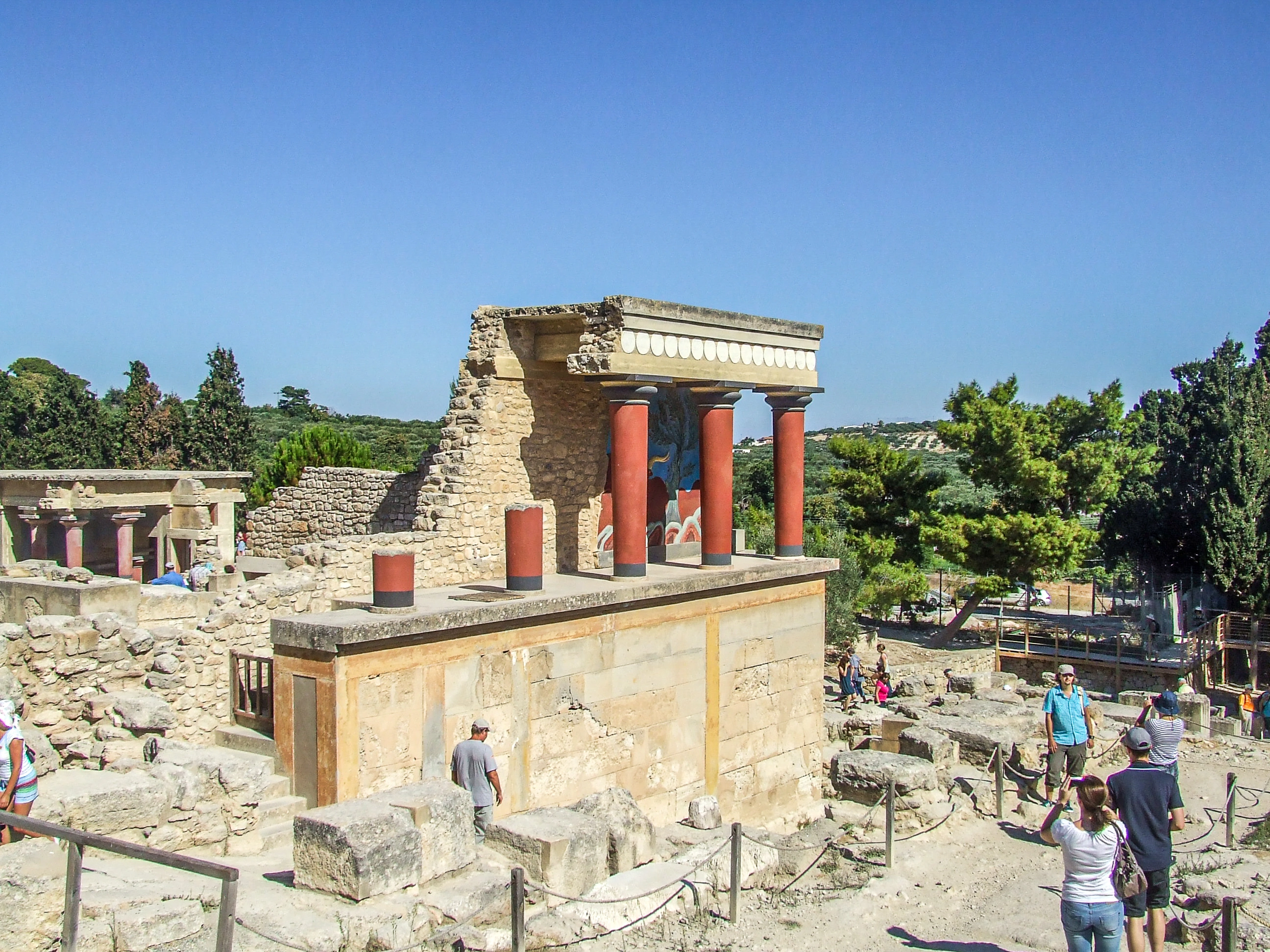
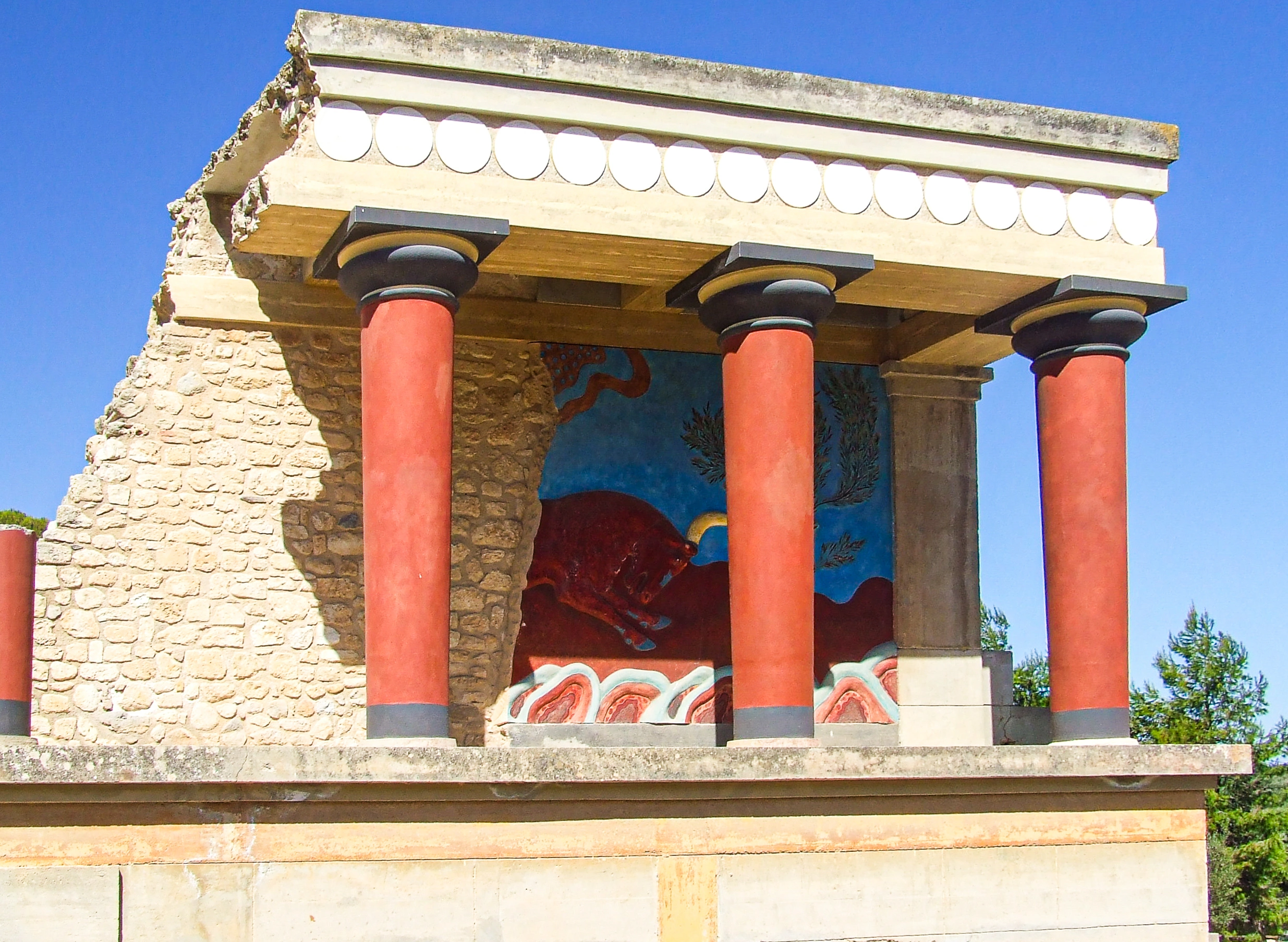
The North Entrance with the Charging Bull fresco, the tripartite Sanctuary, the Royal Road, the ancient theatre, and the Small Palace outside the main complex.
Villa Ariadne and the on-site branch of the British School at Athens, from which excavations and studies continue.
Key Features and Attractions
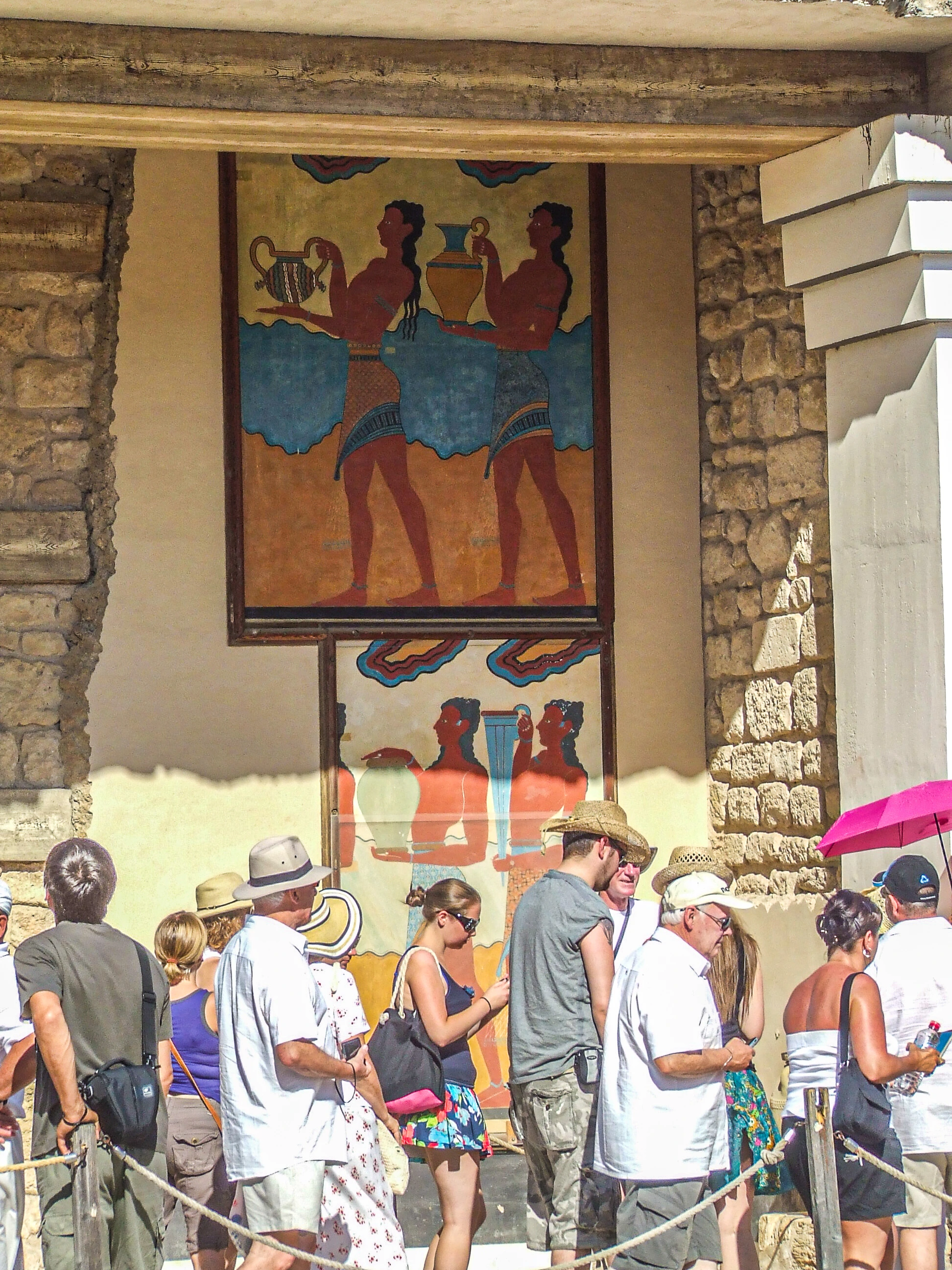
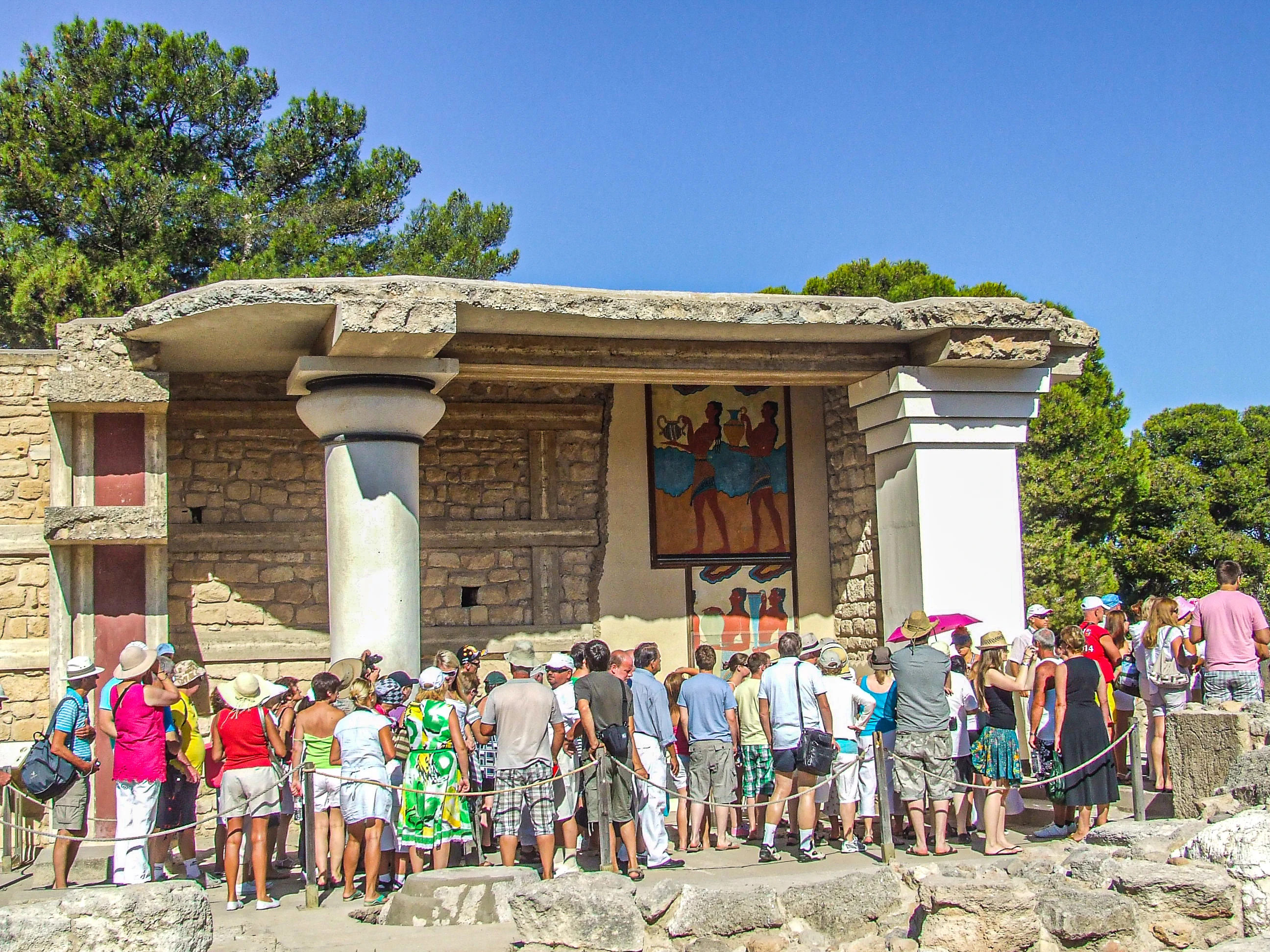
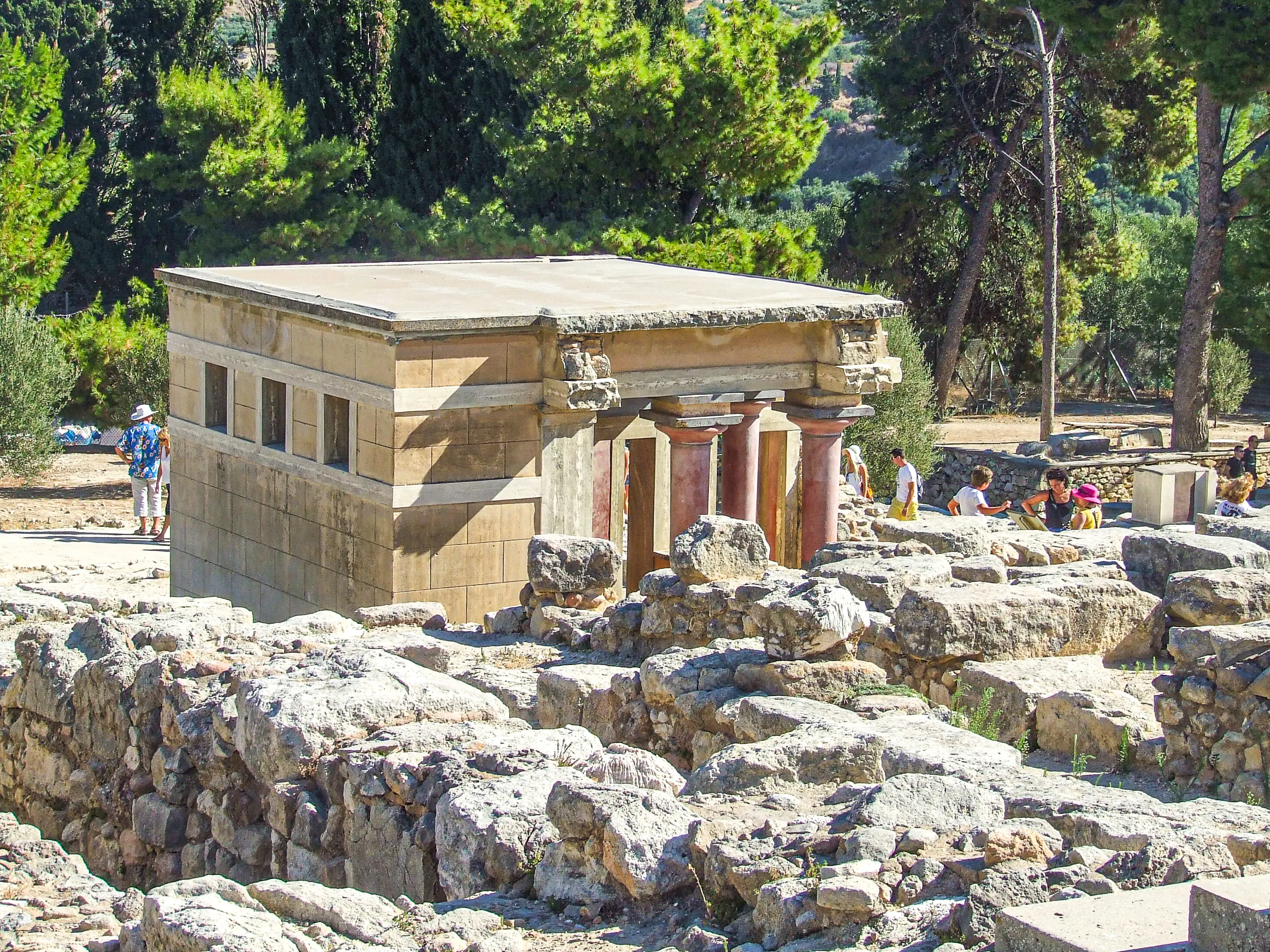
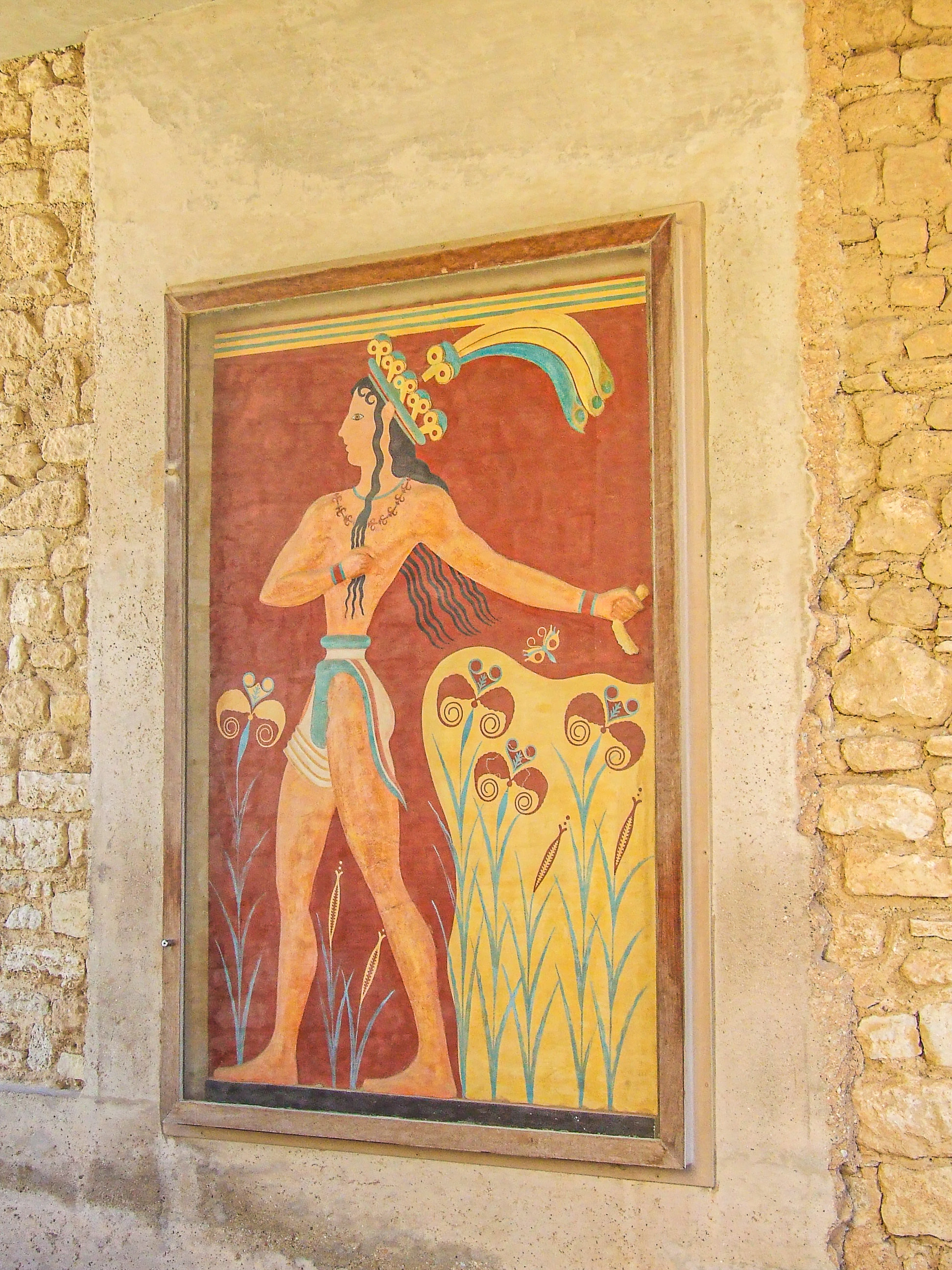
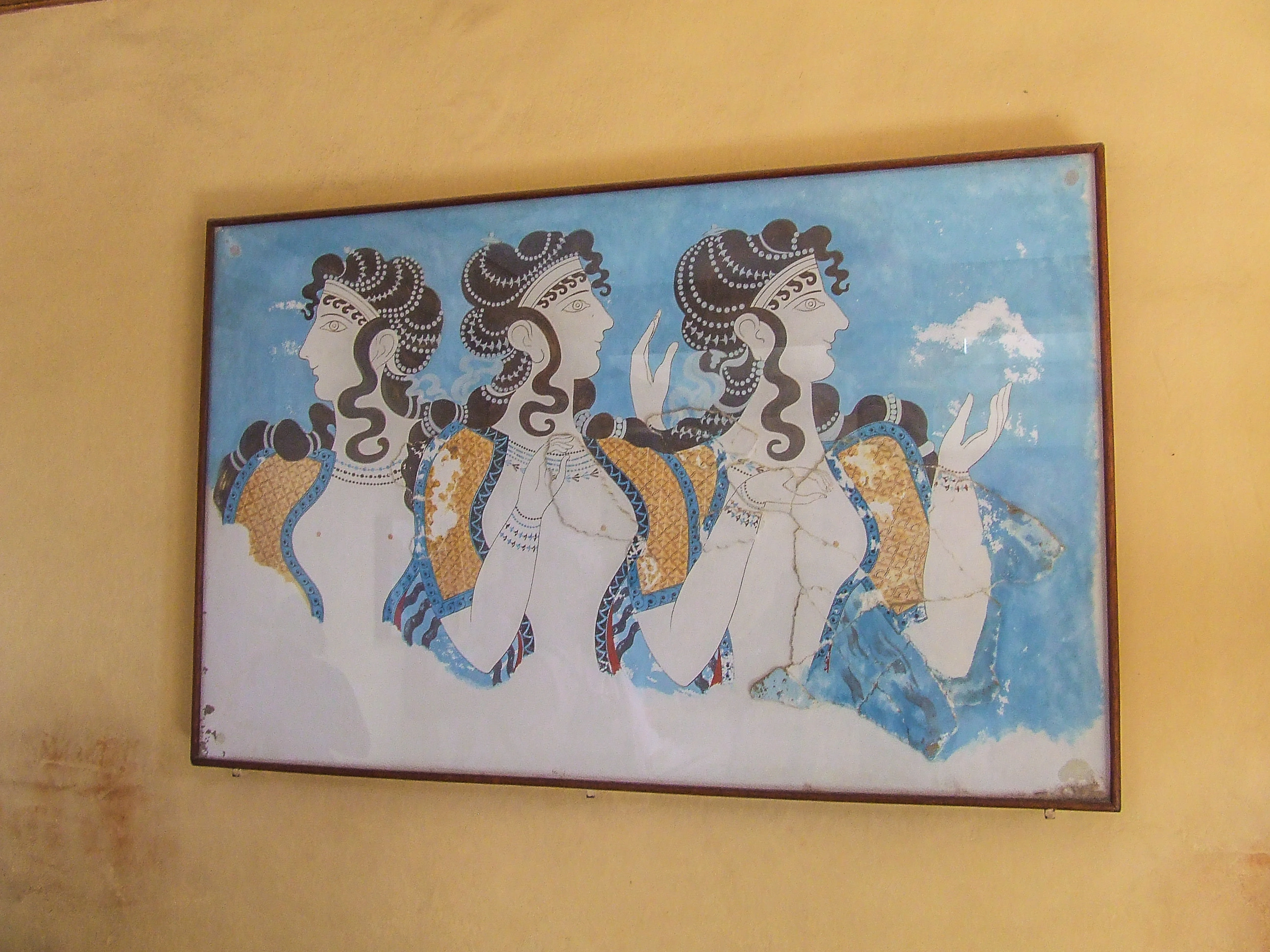
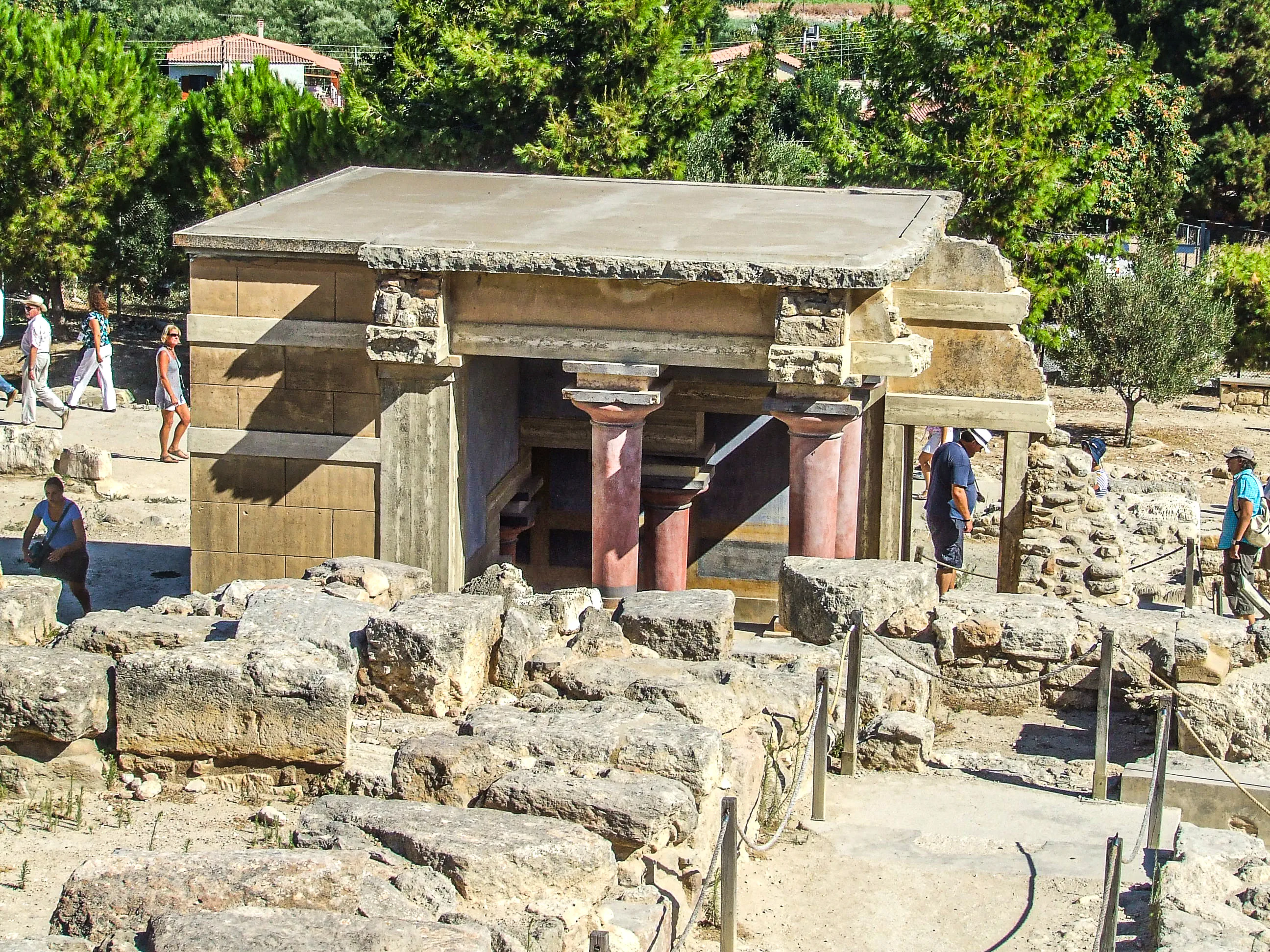
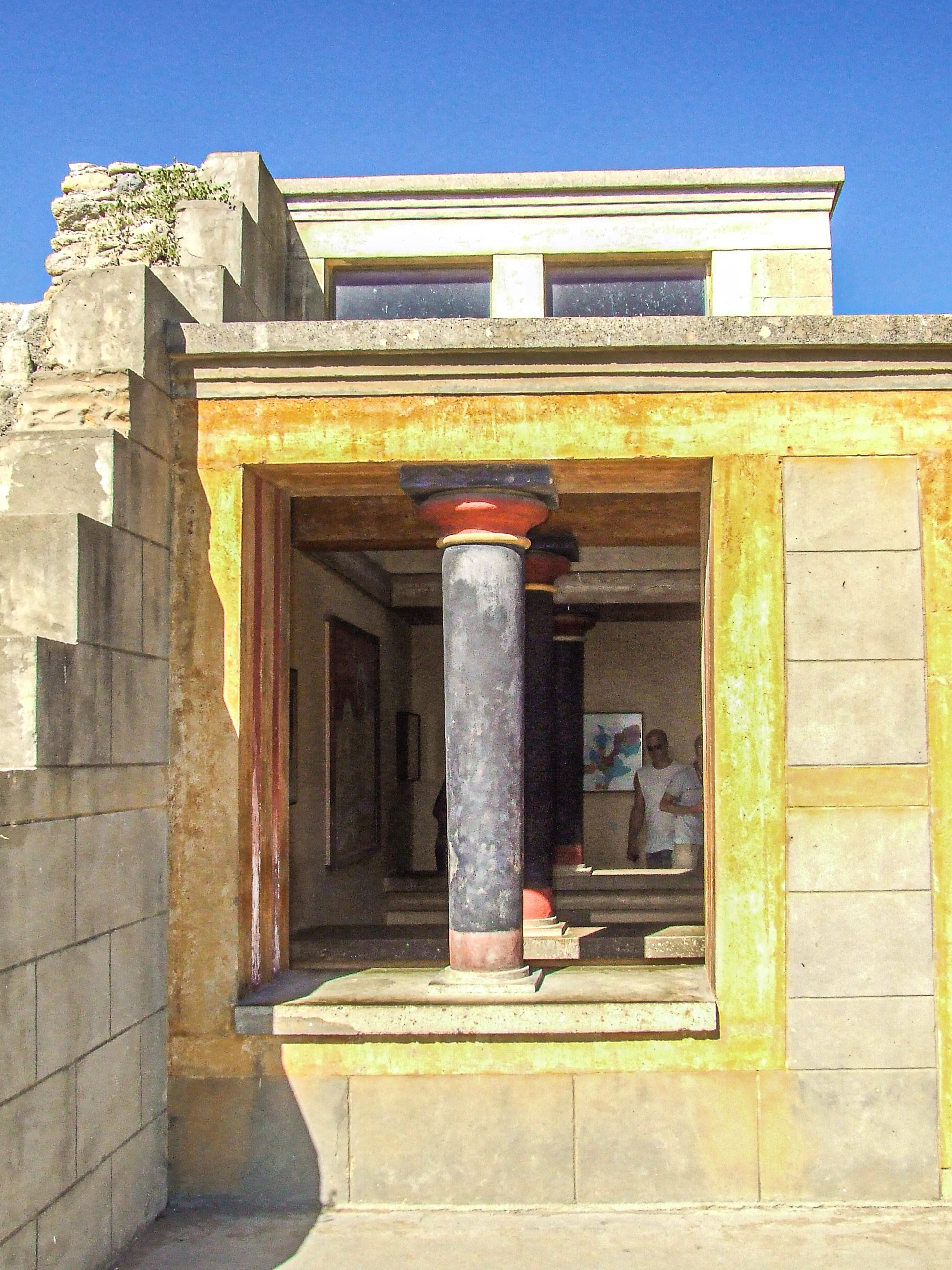
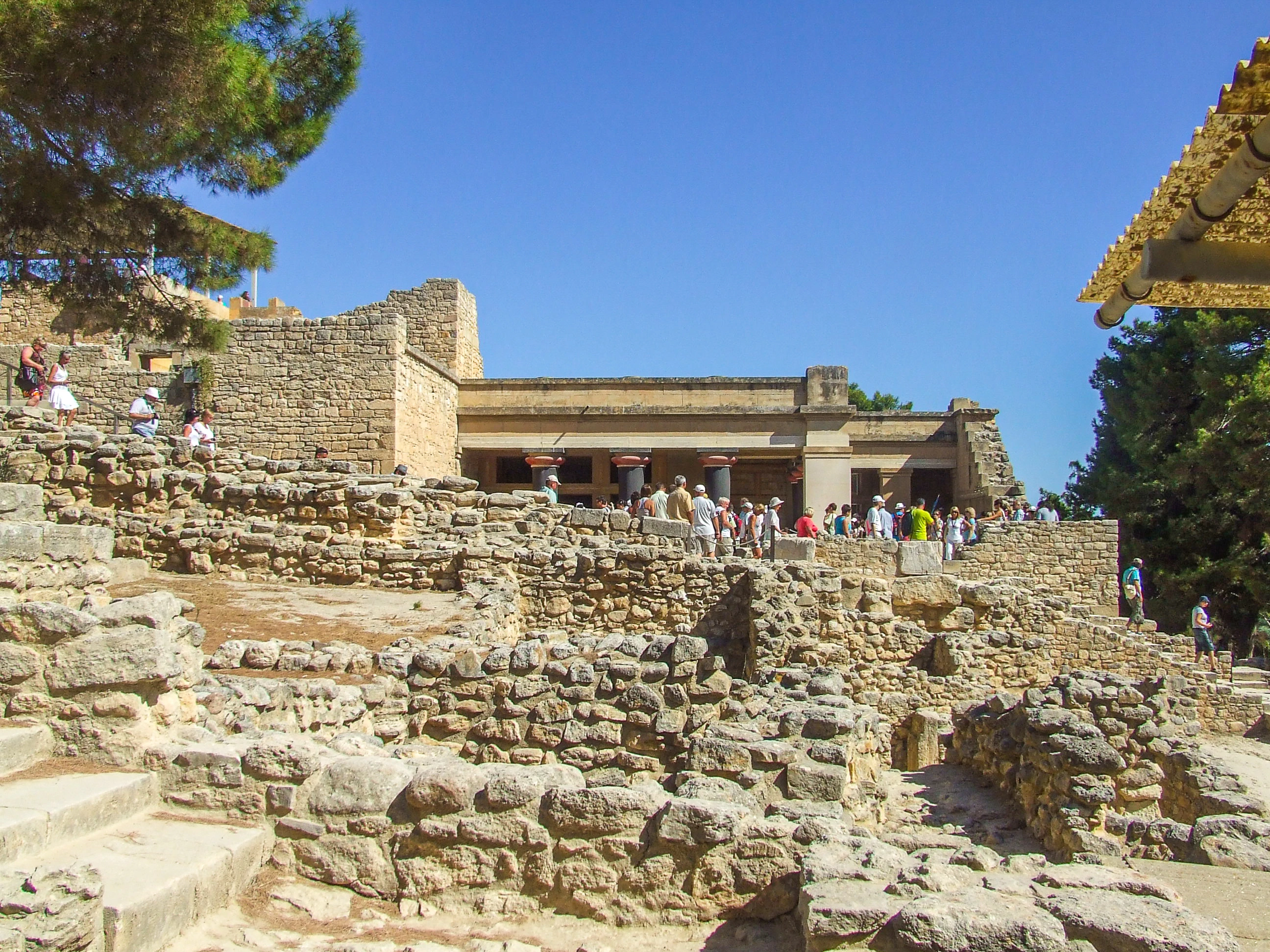
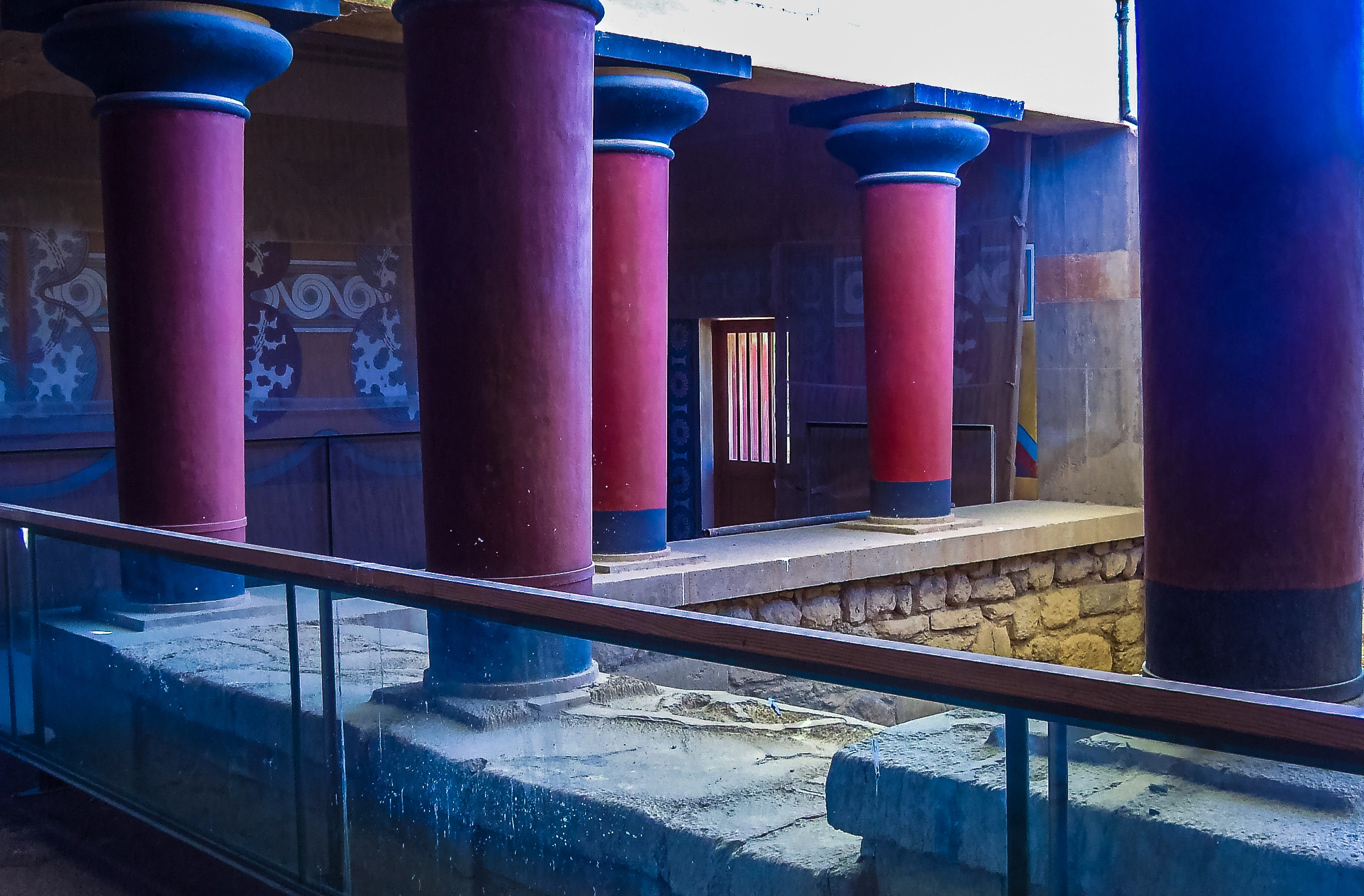
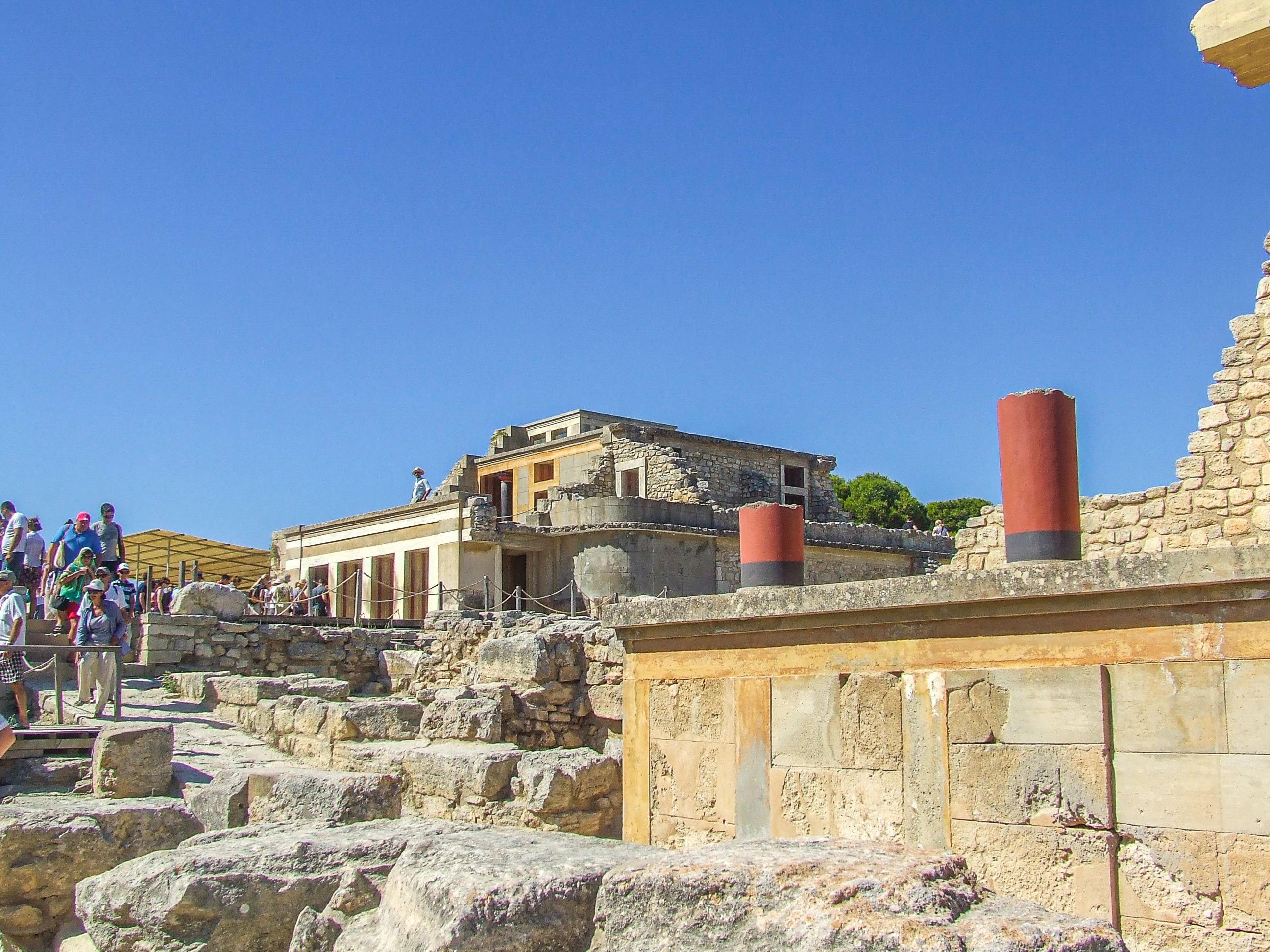
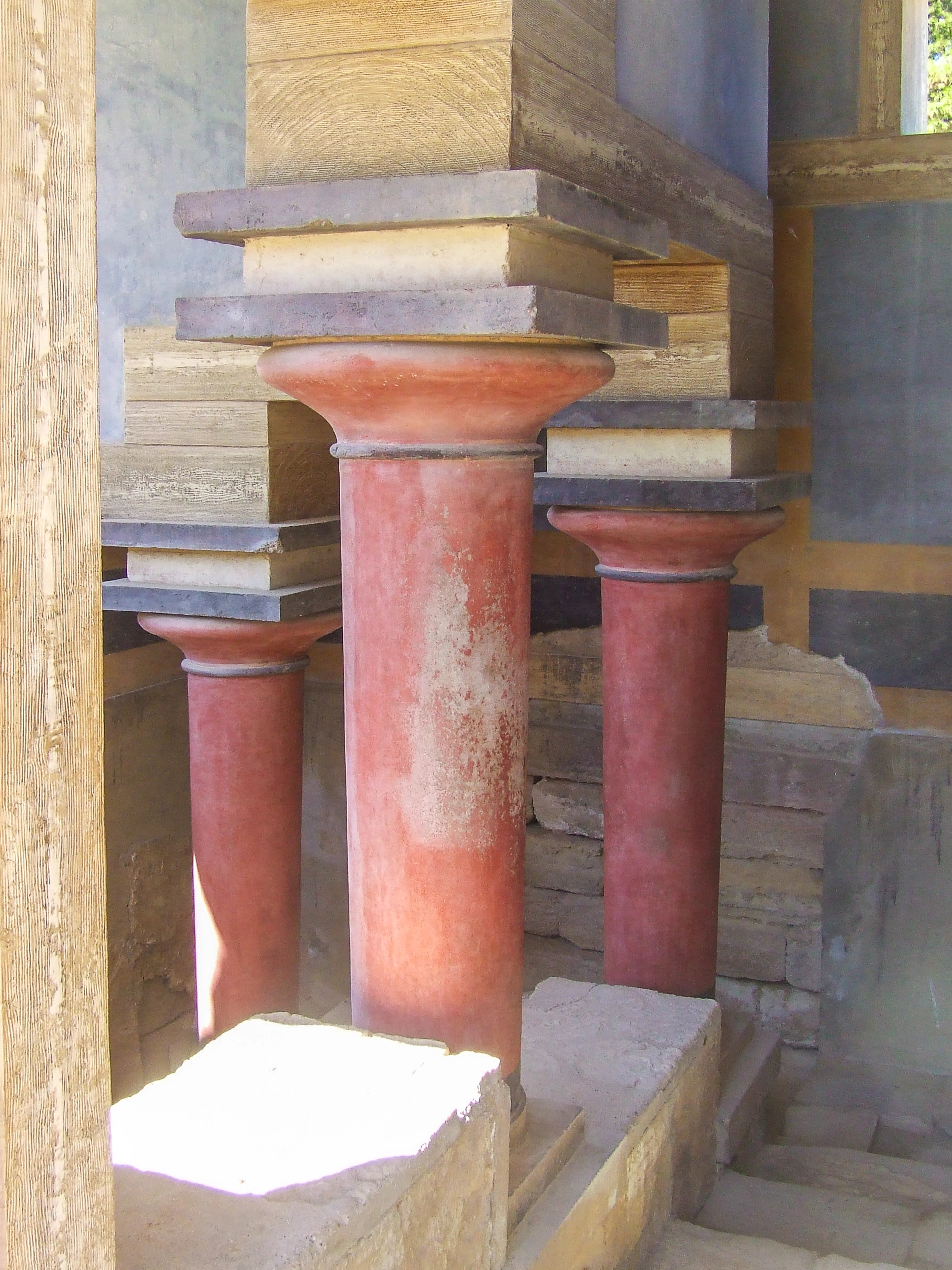
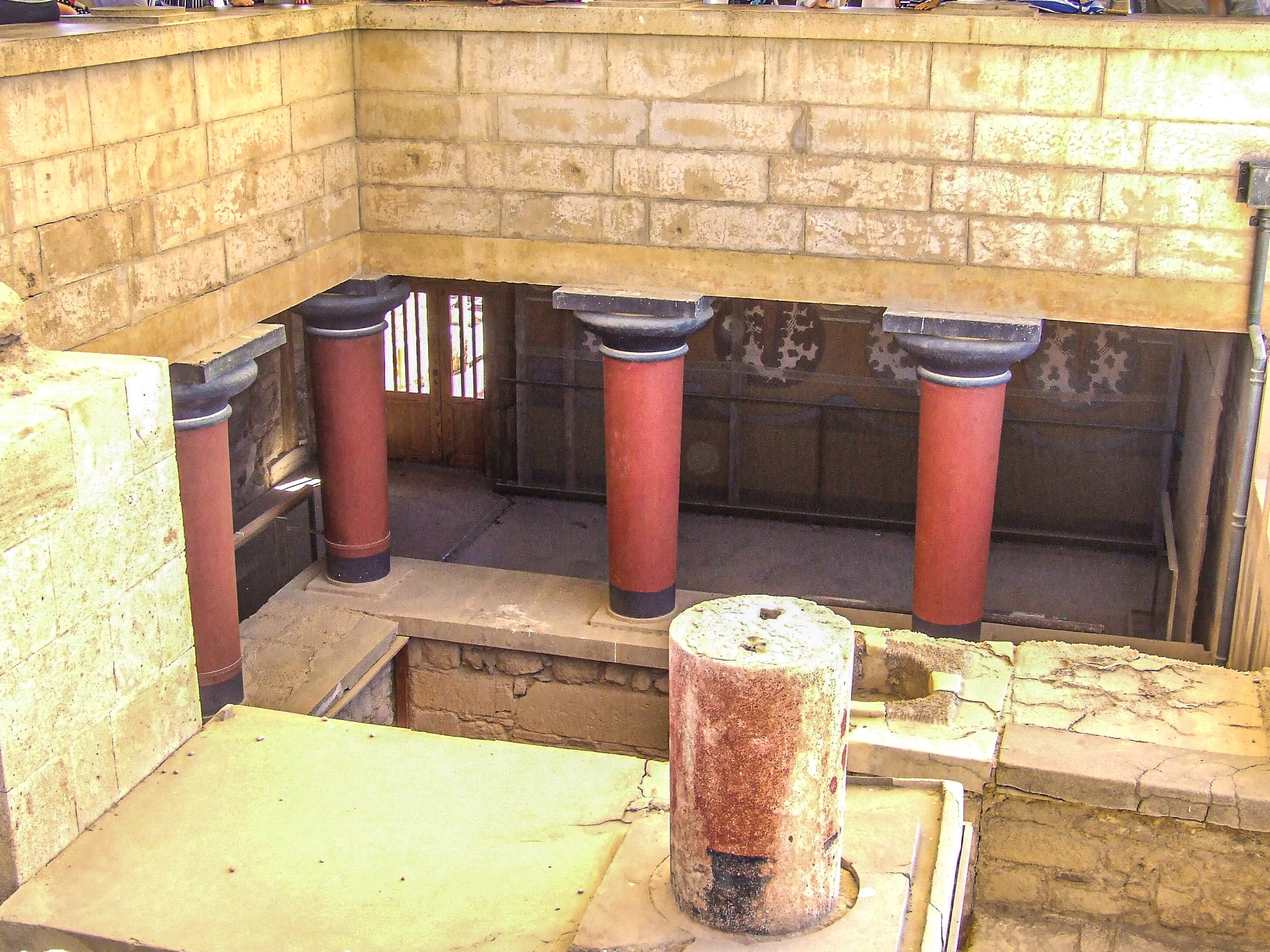
The vivid reconstructed frescoes and red tapering columns that define the site's appearance — with the honest caveat that many were "completed" or repainted by Evans's artists; the originals, including the Bull-Leaping Fresco and Snake Goddess figurines, are displayed at the Heraklion Archaeological Museum.
The controversy itself: the ground plan, walls, storerooms and stone floors are Minoan, while the painted columns, upper storeys and bright frescoes are largely early-20th-century reconstruction — a textbook case of restoration debate.
The Labyrinth and Minotaur mythology, and the labrys double-axe markings carved throughout the palace.
Guided tours with licensed guides, a 3D digital model of the palace developed by the Ashmolean Museum from the Evans Archive, and the archaeological site of Heraklion's museum quarter a short bus ride away.
Easy pairing with Heraklion: Knossos at 08:00, the Archaeological Museum in the afternoon, then the Venetian harbour and Koules at sunset.
Modern Role
Knossos is the flagship archaeological attraction of Crete and a pillar of the island's tourism economy, a permanently active excavation and research site of the British School at Athens and the Greek Archaeological Service, and since 2025 a UNESCO World Heritage monument anchoring the cultural identity of the Minoan civilisation in Europe's heritage.
Visitor Experience
A visit takes 1.5–2 hours (longer with a guide); the site is open daily all year, 08:00–20:00 from April to August with the closing time stepping down through September and October to 08:00/08:30–17:00 in winter, and last entry about 20 minutes before closing. Since 2024, timed-entry tickets are required and should be booked online in advance; admission is about €20 (reduced €10, with free days on 6 March, 18 April, 18 May, the last weekend of September and 28 October). The almost unshaded stone makes midday punishing from June to September, so arrive at the 08:00 opening or after 17:00; May and October are the best overall months, and November–March are far quieter but wetter. Reach the site on Heraklion city bus 2 (every 15–20 minutes, ~€1.70, 20 minutes) or by taxi (~€10–12); there is a paid car park, toilets, a gift shop and a café at the entrance.
Official information and online tickets: https://www.visitgreece.gr/en/experiences/culture/archaeological-sites-monuments/the-palace-of-knossos
Rethymno (Ρέθυμνο/ Rethymnon)
Rethymno,
Rethymno regional unit, Crete,
741 00,
Greece
Key Facts
Third-largest city of Crete on the north coast, roughly halfway between Heraklion (80 km east) and Chania (70 km west); capital of the Rethymno regional unit, which has around 86,000 inhabitants, with about 34,000–40,000 in the city itself.
The Old Town sits on Palaiokastro Hill, a cape jutting into the Cretan Sea, and is considered one of the best-preserved medieval and Renaissance town centres in Greece.
Home to the seat of the University of Crete, making it a youthful city that stays lively all year round.
One of the few Cretan hubs without its own airport — served instead by Heraklion (HER) and Chania (CHQ) — which keeps it quieter and more lived-in than the island's other cities.
Built at, or beside, the site of ancient Rithymna, inhabited since the late Minoan period (c. 1350–1250 BC), with the ancient acropolis believed to lie beneath the Fortezza.
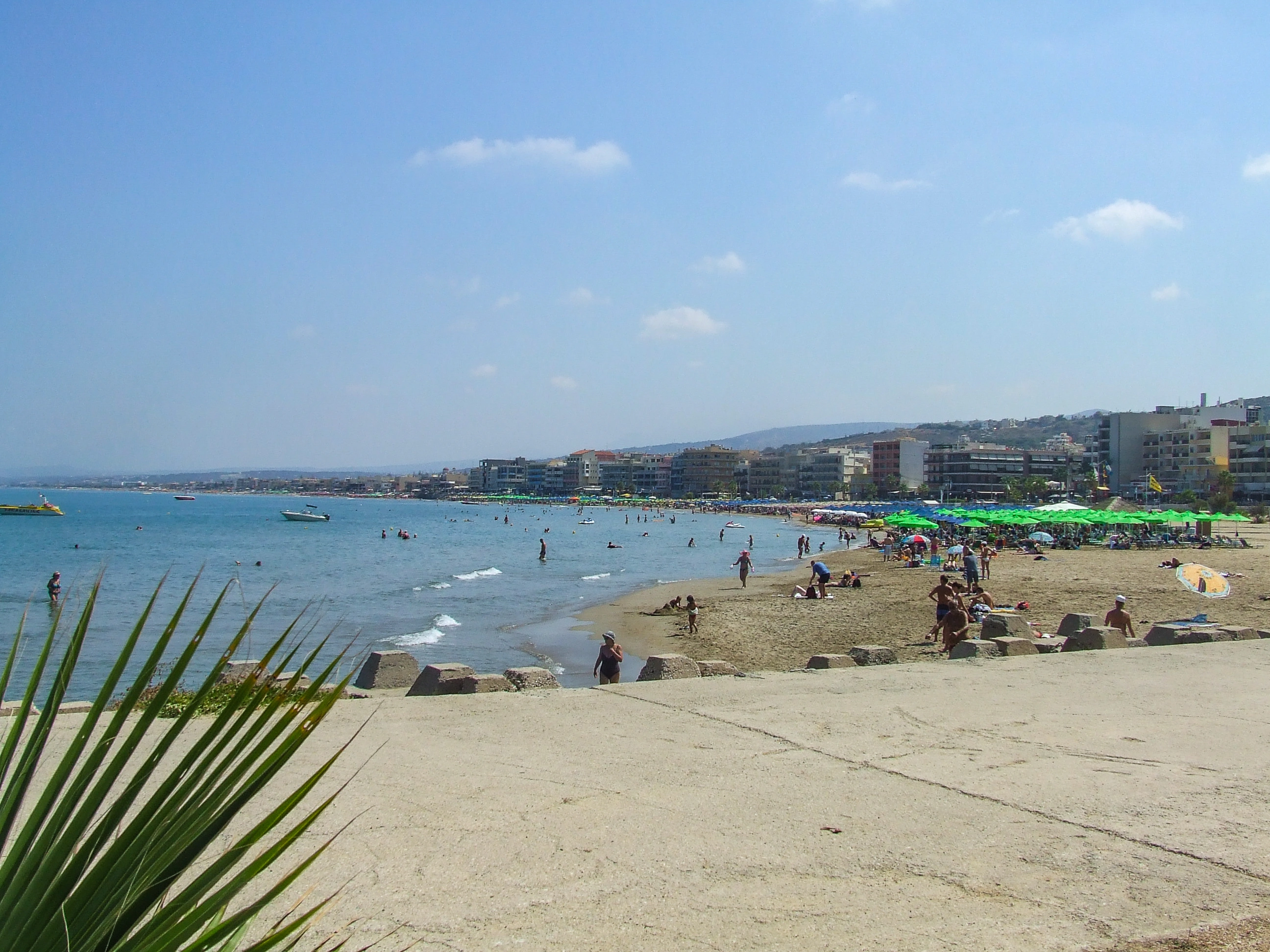
A 13-km sandy beach runs east from the old town — one of the longest town beaches on the island.
Historical Significance
Ancient Rithymna was briefly prosperous enough in the Classical and Hellenistic eras to mint its own coinage before fading into obscurity. The modern city was born under Venice, which built a port and town here as a waypoint between Chania and Candia (Heraklion); the 16th century brought growth to some 10,000 inhabitants — roughly three Greeks for every Venetian — and the great fortifications: the southern wall of 1540 and, from 1573 to 1580, the Fortezza on Palaiokastro Hill. The Ottomans took the city in 1646 with little resistance, converting churches into mosques and raising minarets — including the Neratze Mosque (a Venetian church of 1657 conversion) and the Sultan Ibrahim mosque within the Fortezza. Rethymno's hinterland became the crucible of Cretan resistance: the Arkadi Monastery's self-sacrifice of November 1866 — when its defenders blew up the gunpowder stores rather than surrender, killing over 800 besieged Cretans and more than 1,500 Ottoman soldiers — became a world-famous symbol that helped bring about the Ottoman withdrawal in 1898 and union with Greece in 1913. The city was bombed in the 1941 Battle of Crete, liberated on 13 October 1944, welcomed over 6,000 Asia Minor Greek refugees in the 1920s, and has doubled its population since the 1970s as tourism reshaped the New Town.
Architectural Highlights
The Fortezza (built 1573–1580) — an enormous star-shaped Venetian citadel on Palaiokastro Hill, one of the best-preserved examples of Venetian military architecture in Greece, with bastions, the Sultan Ibrahim Mosque (converted from the church of St Nicholas), the Erofili open-air theatre, governor's quarters and gunpowder stores.
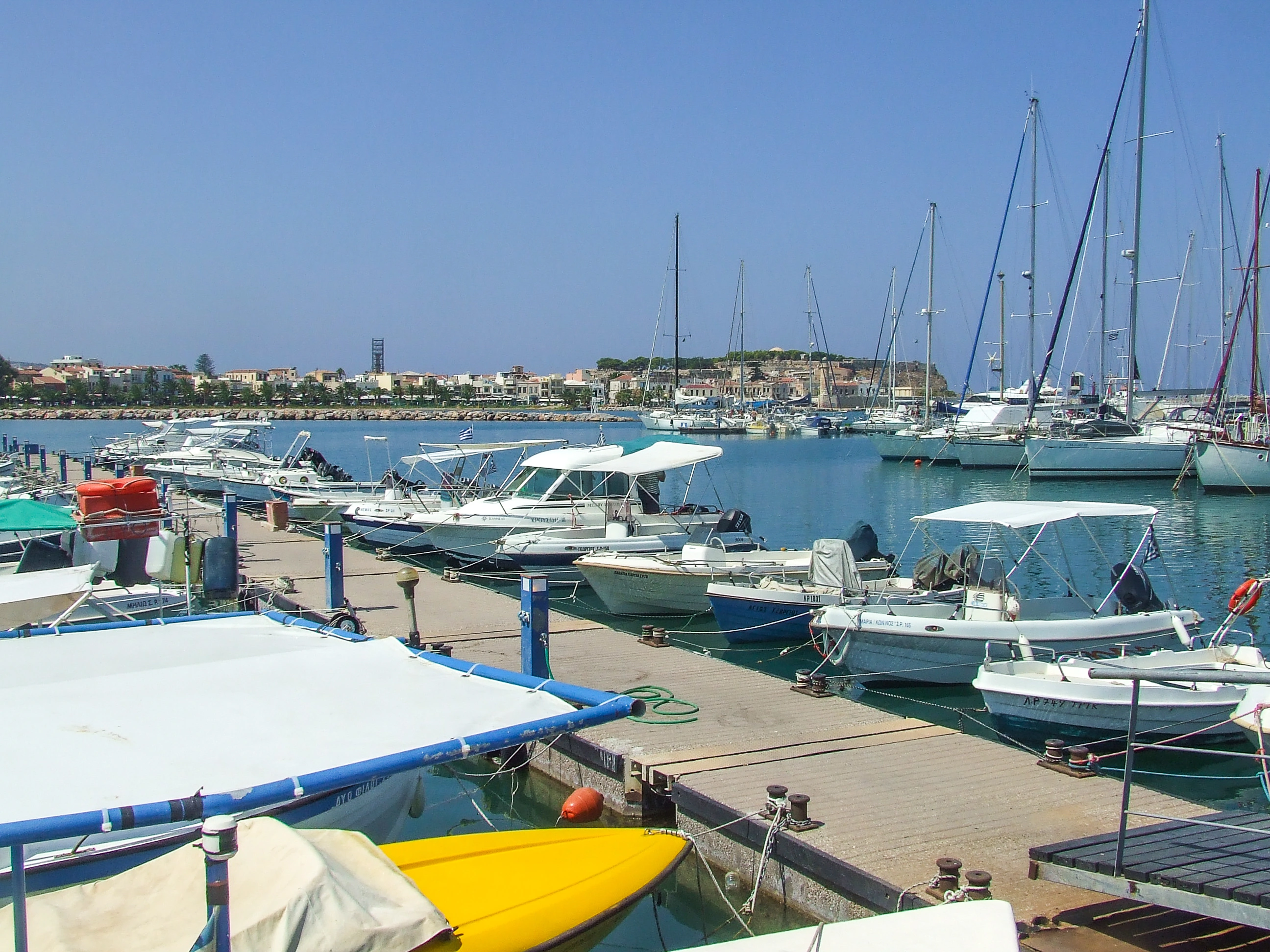
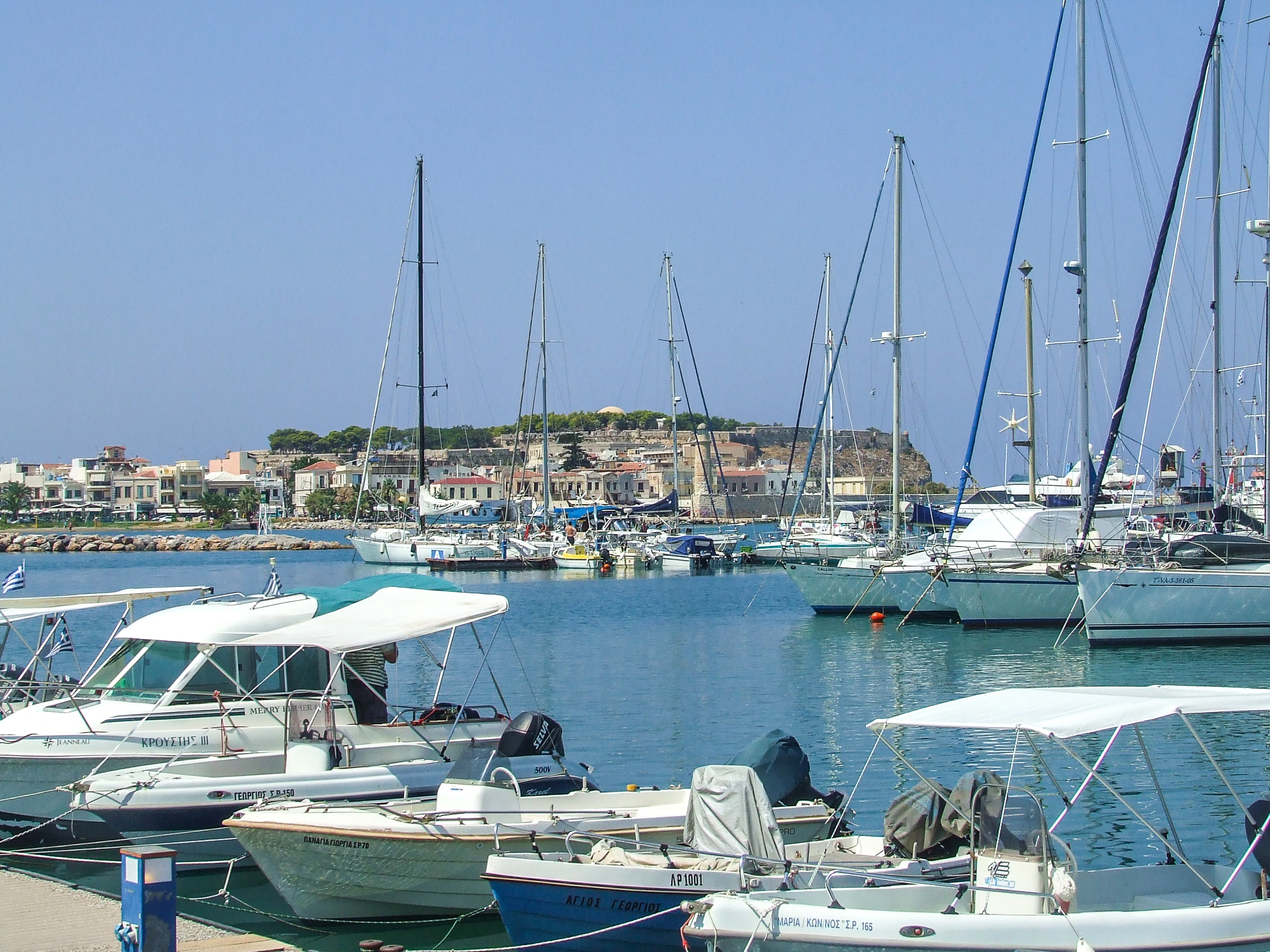
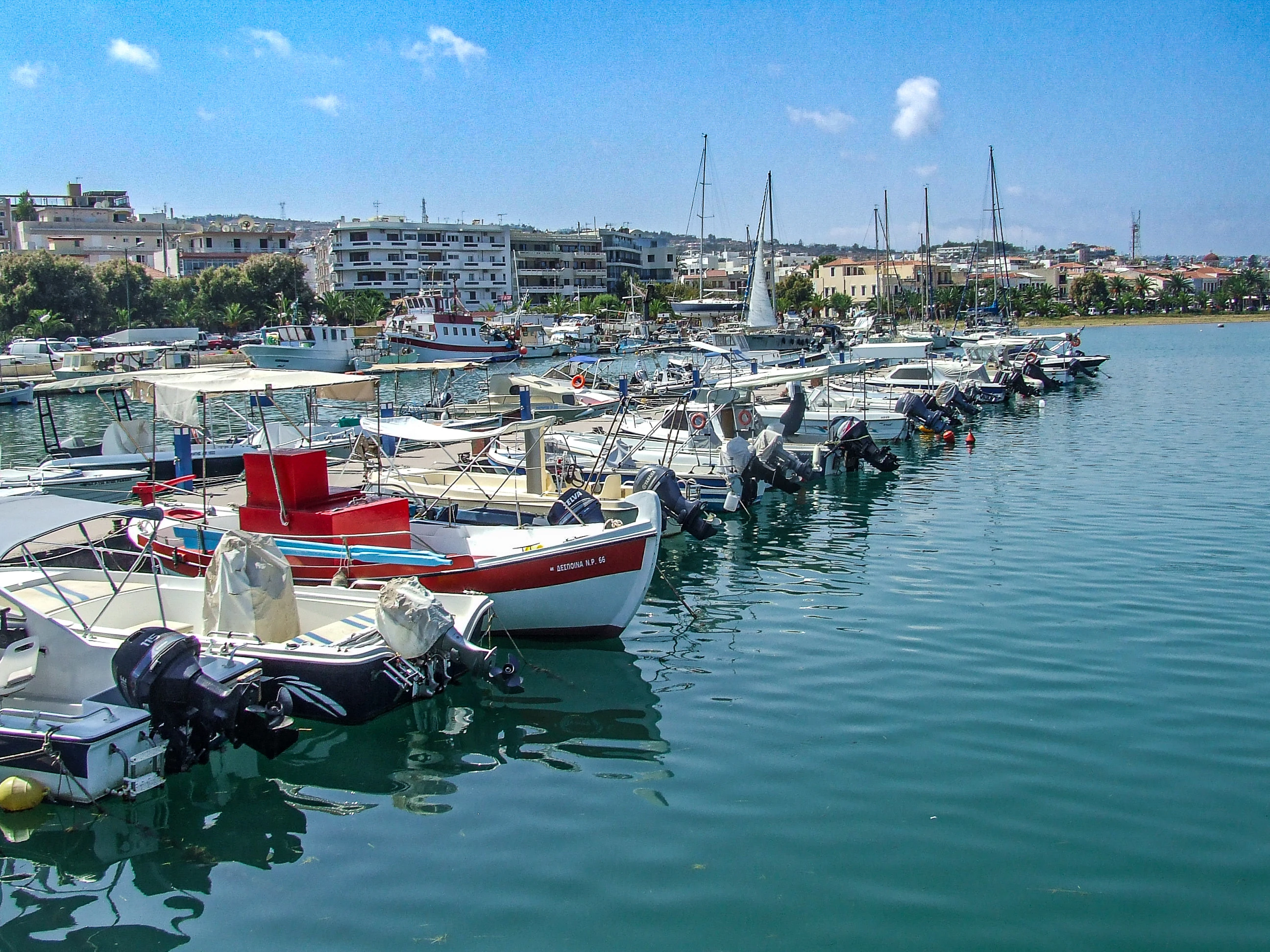
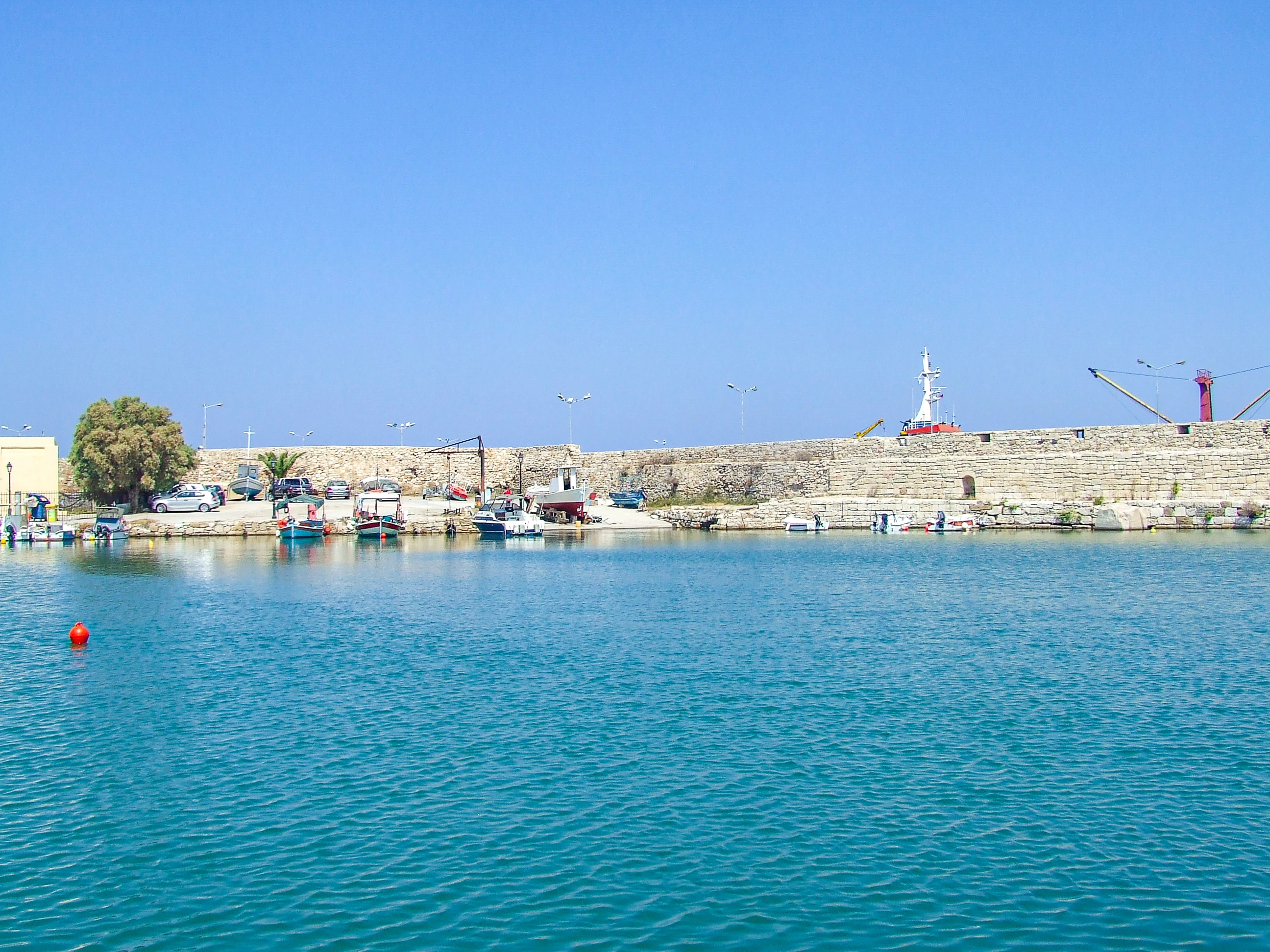
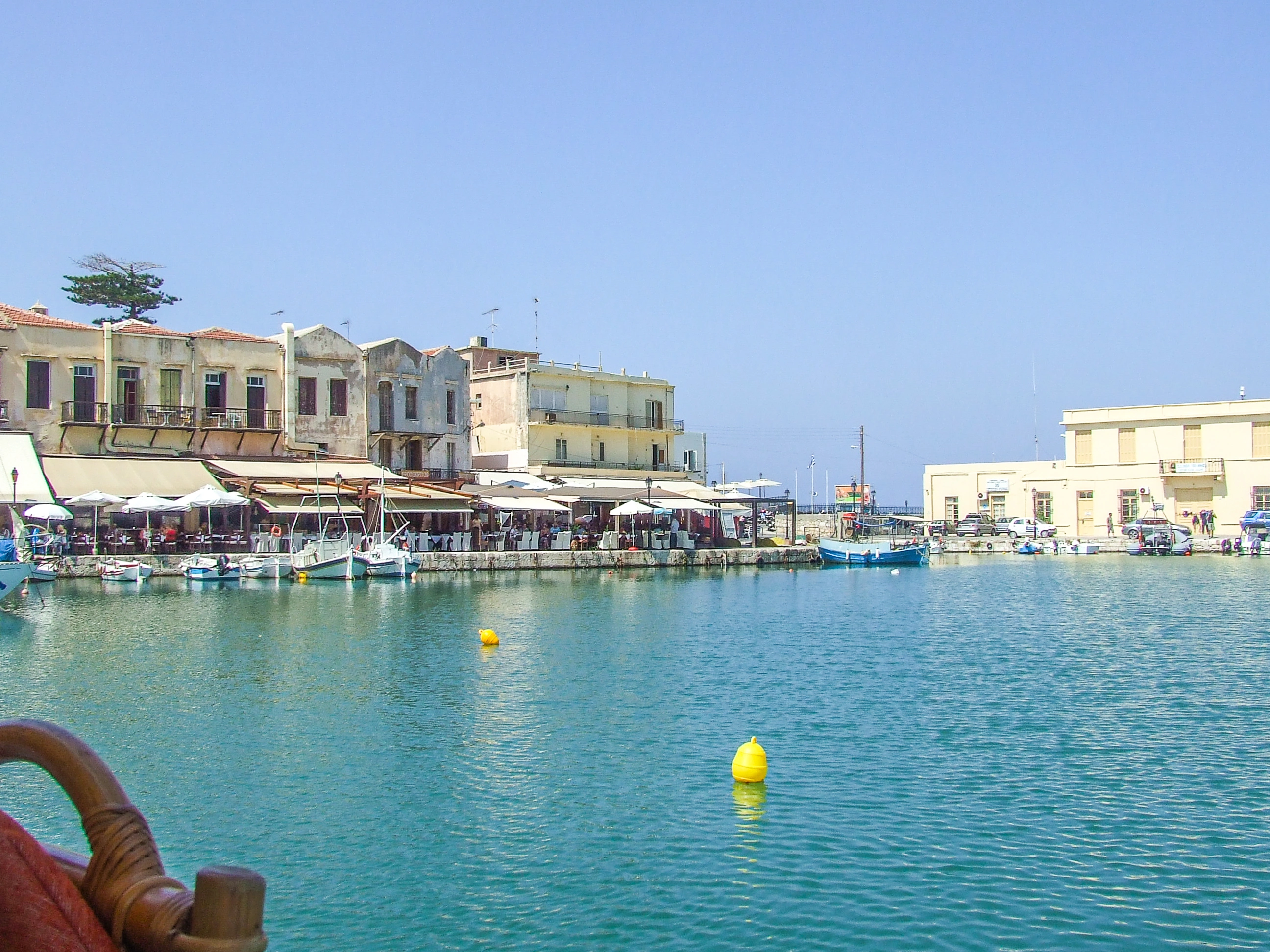
The Venetian harbour with its restored lighthouse (built 1830–1840 under Egyptian administration) and, behind it, the 16th-century Venetian Loggia, once the nobles' meeting house and now a Ministry of Culture outlet.
The Rimondi Fountain of 1626 on Platanou (Petychaki) Square, with its three lion-head spouts and Corinthian columns — still running with drinking water from Mt Vrysinas.
Porta Guora, the 1540s Grand Gate — the only surviving trace of the old city walls — and Makri Steno, one of the most beautiful streets of Venetian houses and marble fountains.
The Neratze Mosque with the tallest minaret in Rethymno, now the Municipal Odeon music school; the church of the Four Martyrs; and the Archaeological Museum, housed in the Venetian church of St Francis (c. 1530), which holds finds from the Stone Age to the Venetian era — including the 130,000-year-old Acheulean handaxes of Plakias.
The Arkadi Monastery, 23 km southeast — a fortress-like Renaissance monastery (16th century) with a celebrated baroque facade and the museum of the 1866 holocaust.
Key Features and Attractions
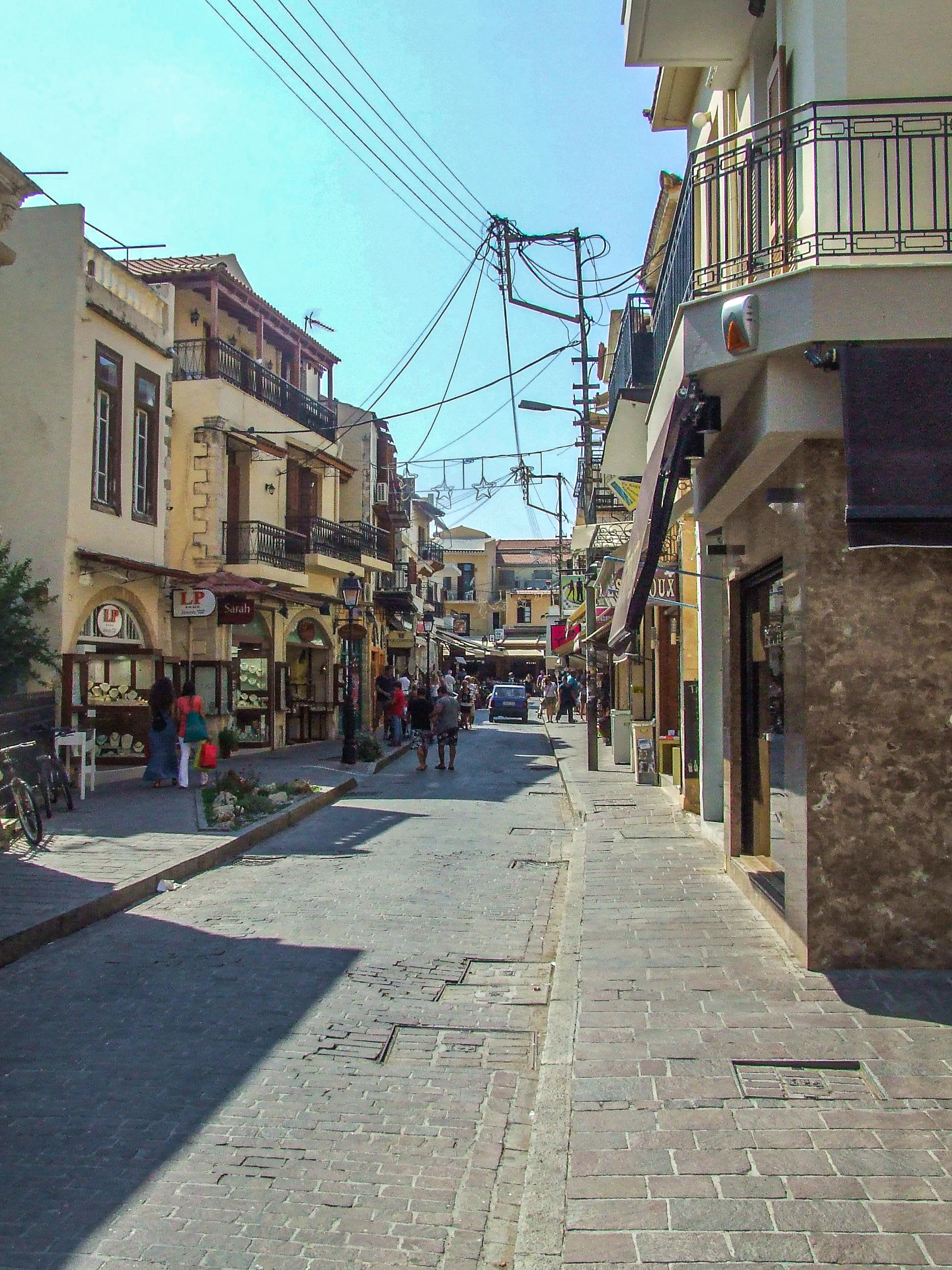
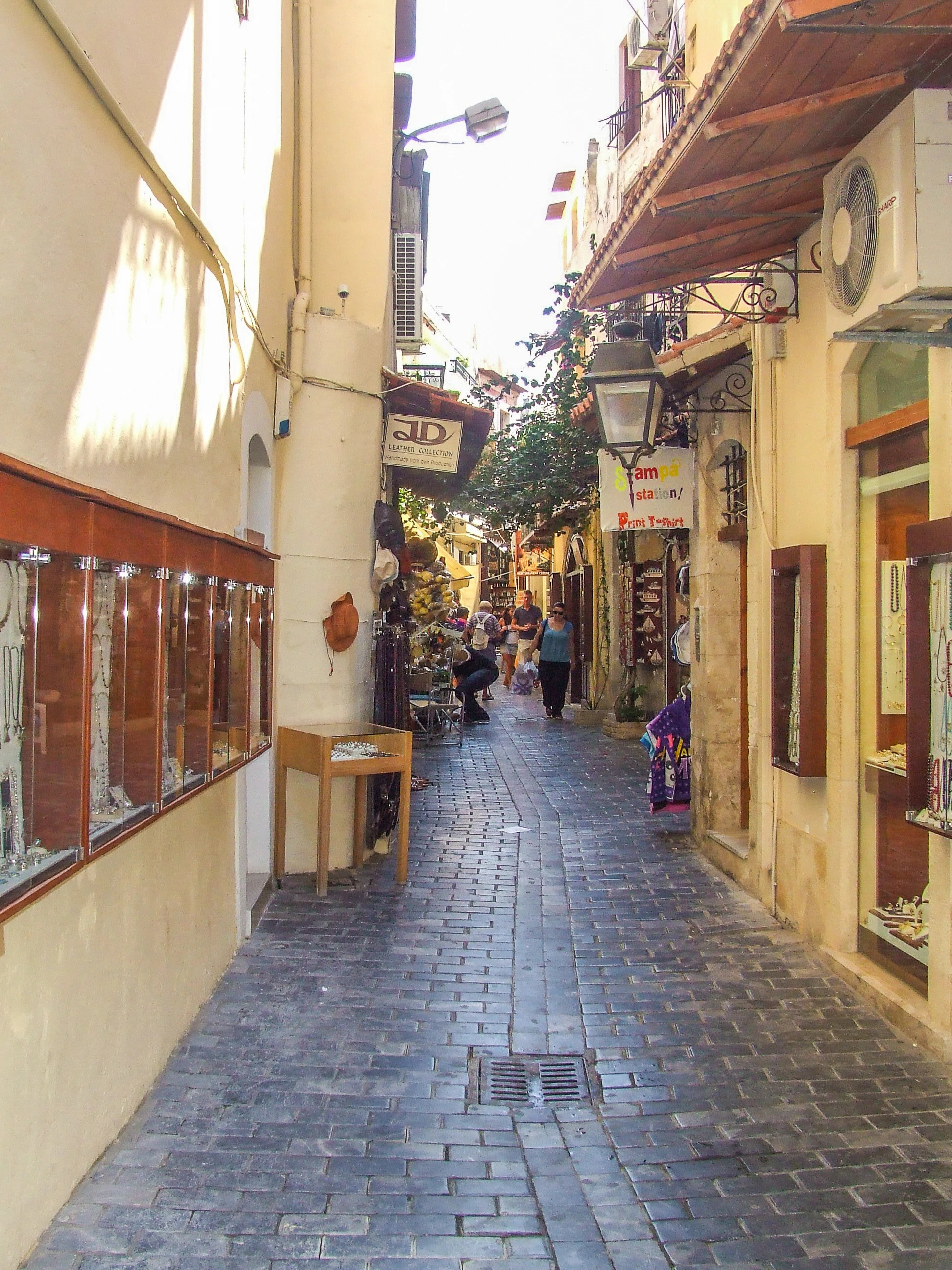
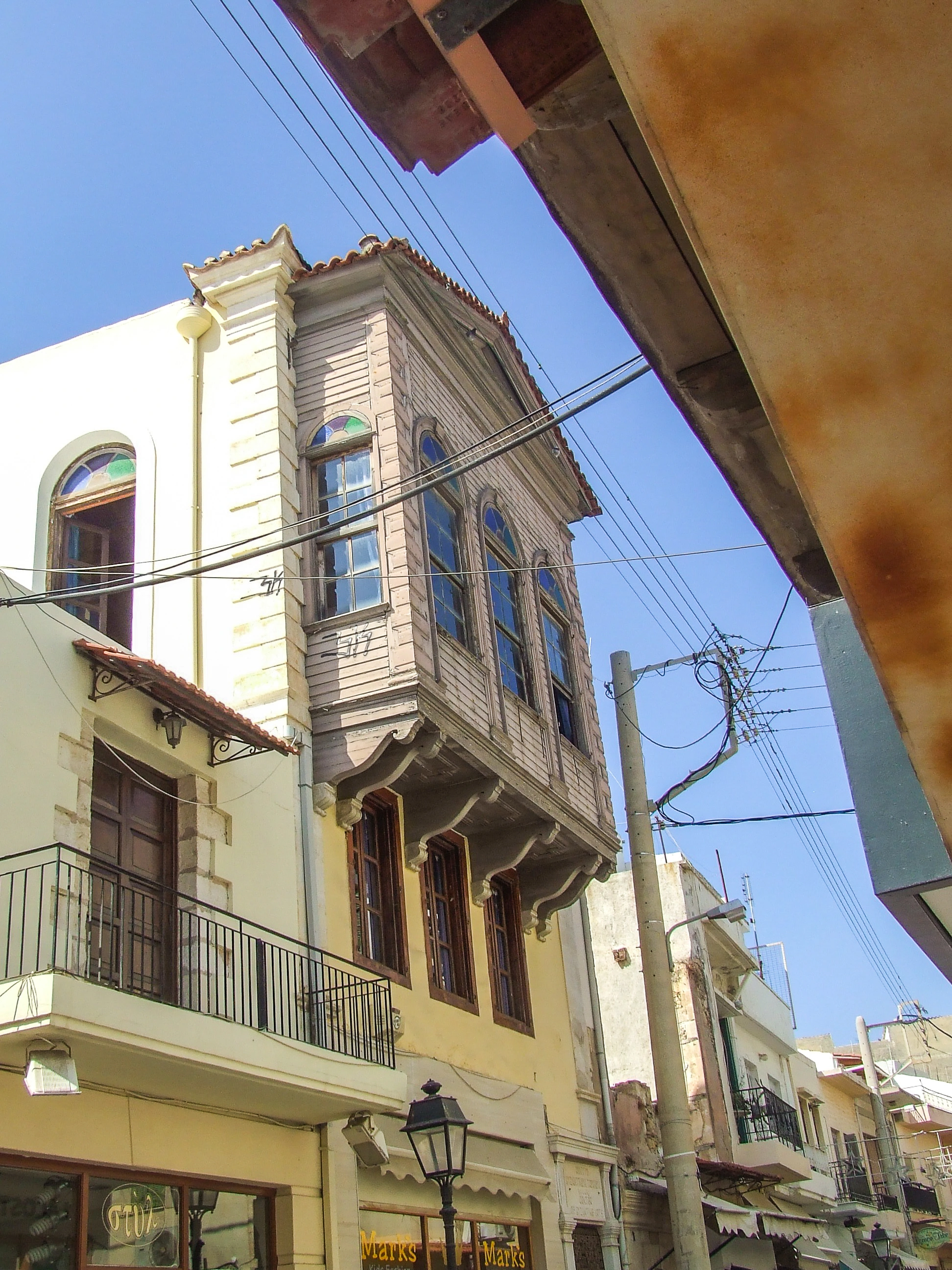
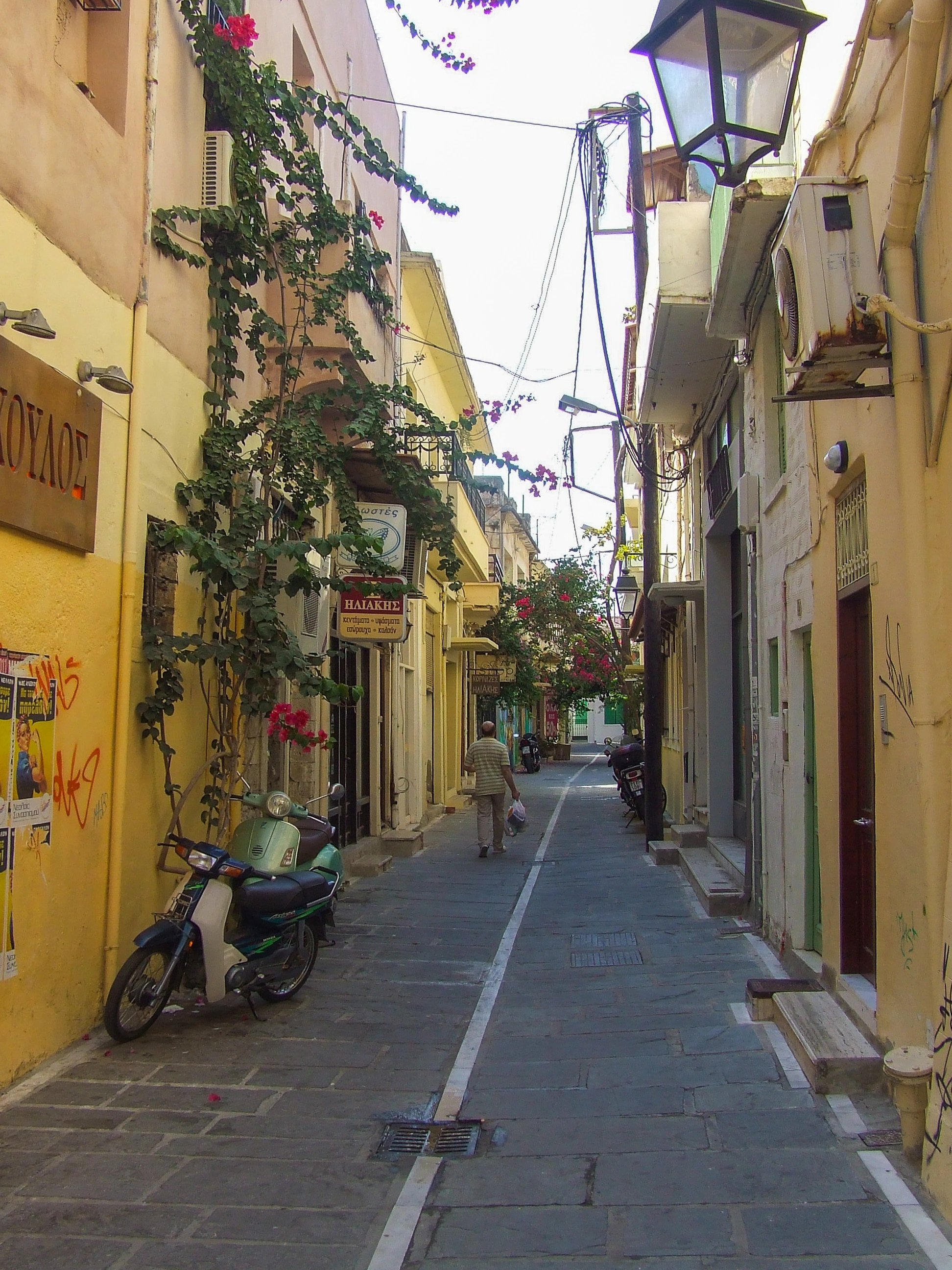
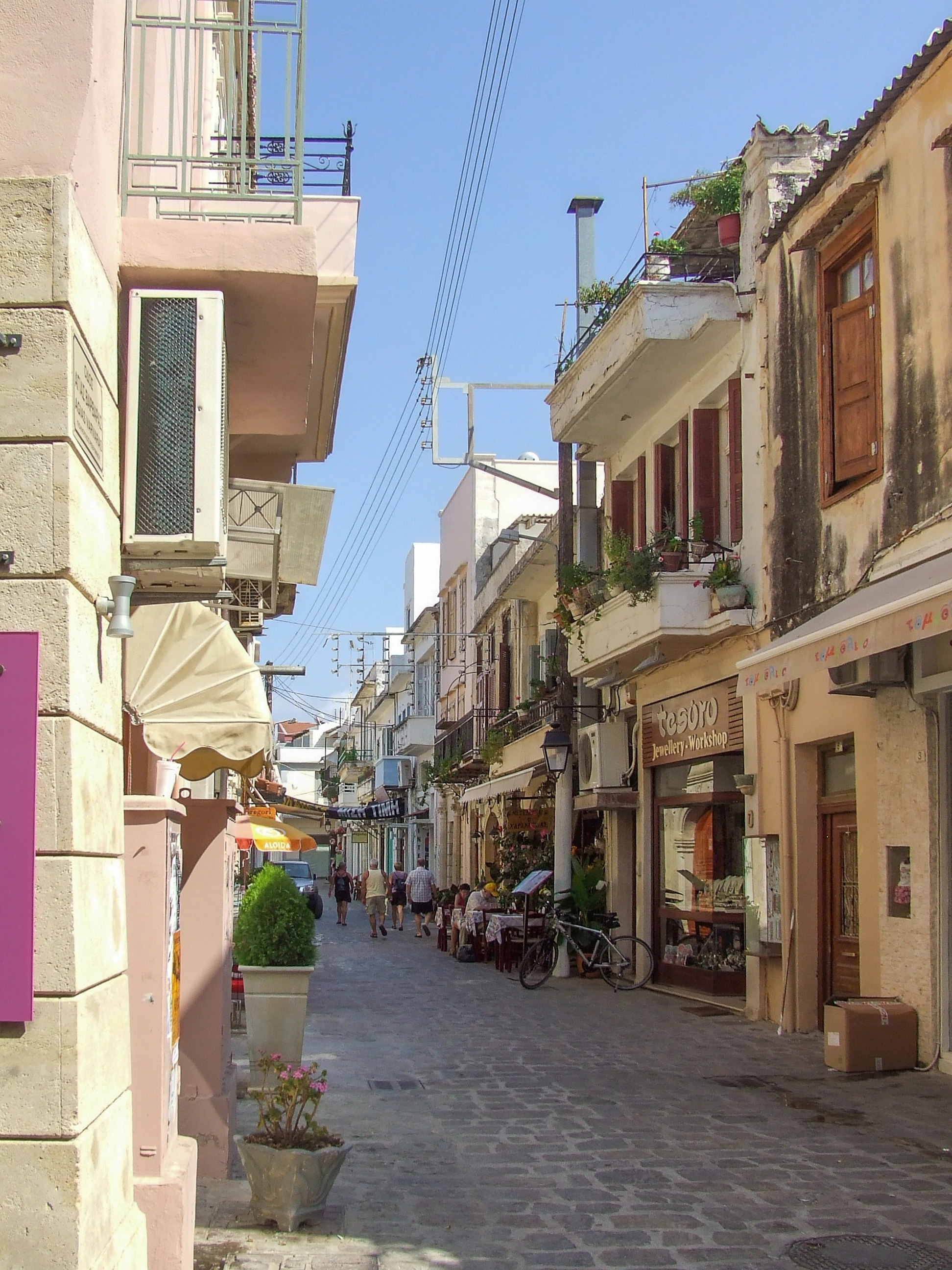
Wandering the Old Town: a honeycomb of marble-cobbled alleys, bougainvillea-draped Venetian doorways, Ottoman wooden overhangs, craft shops and tavernas — best in the late afternoon and evening when the day-trippers leave.
Rethymno Beach — 13 km of soft sand with loungers and lifeguards running east from the old town — and the locals' swimming spot at Koumbes to the west.
Preveli Monastery, Palm Beach and the Kourtaliotiko gorge (7.2 km) on the south coast, where the river meets the Libyan Sea through Crete's iconic native palm forest.
Day trips: Arkadi Monastery (€3, buses daily), Ancient Eleutherna's museum and site, the pottery village of Margarites, Melidoni Cave, the Amari Valley and the Psiloritis massif, Lake Kournas, and — farther afield — Chania and the Samaria Gorge.
Living crafts and food: the hand-made filo workshop of Giorgos Hatziparaschos (in the same Venetian house since 1960), the knife-makers of the old lanes, the restaurants Avli and Prima Plora, and olive-oil and wine estates inland.
Cultural calendar: the summer Renaissance Festival, open-air concerts in the Fortezza, and the Archaeological, Historical-Folklore and Palaeontology museums (the latter in the Veli Pasha mosque).
Modern Role
Rethymno is the administrative, university and cultural capital of its region, a tourism town whose economy depends on trade and visitors, and the best base for exploring central Crete's dramatic interior — the Amari Valley, Psiloritis and the south-coast monasteries and gorges — while retaining the authentic, lived-in character that sets it apart from Chania and Heraklion.
Visitor Experience
The best times to visit are May–June and September–October, with warm seas, 22–28 °C days and far smaller crowds; July and August bring the full beach season and the Renaissance Festival, when the Old Town hosts open-air concerts. Two to three days cover the Old Town, Fortezza and one day trip (Arkadi or Preveli); a fourth adds the gorges and Eleutherna. The Fortezza is open daily, roughly 08:00–20:00 in high season (to 17:00 in low), admission about €4–5. The city itself is entirely walkable, with parking at the port and Fortezza; ferries and buses link it along the north coast, but a hire car is recommended for the south coast and villages. Avoid harbour-front restaurants without checking menus first — eat a street or two inland.
Practical Information
Old Town / Fortezza,
Rethymno,
741 00,
Greece
Contact Information
Official municipal information: https://www.rethymno.gr/ · Arkadi Monastery: +30 2831 083135