HOME

The National Historic Fleet

The National Historic Fleet

The National Historic Fleet is a prestigious collection of historic vessels in the United Kingdom, recognized for their outstanding national or regional significance. Managed by National Historic Ships UK, the fleet includes around 200 vessels that represent the UK’s rich maritime heritage, from historic warships and merchant ships to working boats and replicas. These vessels are selected for their exceptional historical, architectural, or cultural value and are prioritized for conservation and preservation.

HMS Warrior

Victory GateHM Naval BasePortsmouth,   United Kingdom

HMS Warrior (1860) is a groundbreaking iron-hulled, armoured warship and a marvel of Victorian engineering. Launched in 1860, she was Britain’s first ironclad battleship and represented a revolutionary leap in naval technology. Warrior was larger, faster, and more heavily armoured than any ship before her, marking the transition from wooden to iron warships. Today, she is preserved as a museum ship at Portsmouth Historic Dockyard, offering visitors a unique glimpse into 19th-century naval life and the dawn of the ironclad era. mprop="geo" itemscope itemtype="https://schema.org/GeoCoordinates">
The image depicts a large, historic sailing ship docked at a pier in an urban setting. The ship has multiple masts with intricate rigging, and it is moored alongside a modern cityscape featuring various buildings, including tall residential towers and commercial structures. The water in the foreground suggests that the warrior is a harbor or port area.
Historic Ship Anchored in a Modern Harbour ‐ photo by ,
©www.mgaylard.co.uk.
The image depicts a large, historic sailing ship docked at a harbor. The ship features multiple masts with numerous riggings and sails, characteristic of an old-fashioned, multi-masted vessel. The ship is moored alongside a pier, with smaller boats and harbor activities visible in the foreground. The sky is clear with some clouds, and the water is calm, reflecting the ship and the surrounding structures.
Majestic Tall Ship Dominates Harbour Scene ‐ photo by ,
©www.mgaylard.co.uk.
The image shows a large, historic sailing ship docked in a harbor. The ship has multiple masts with intricate rigging and sails, and it features tall smokestacks, indicating it may be a steam-powered vessel. The ship is moored alongside a pier, with several smaller boats floating nearby in the water. The sky is mostly clear with some clouds, and the overall scene suggests a maritime setting, possibly a port or a harbor.
At Berth ‐ photo by ,
©www.mgaylard.co.uk.
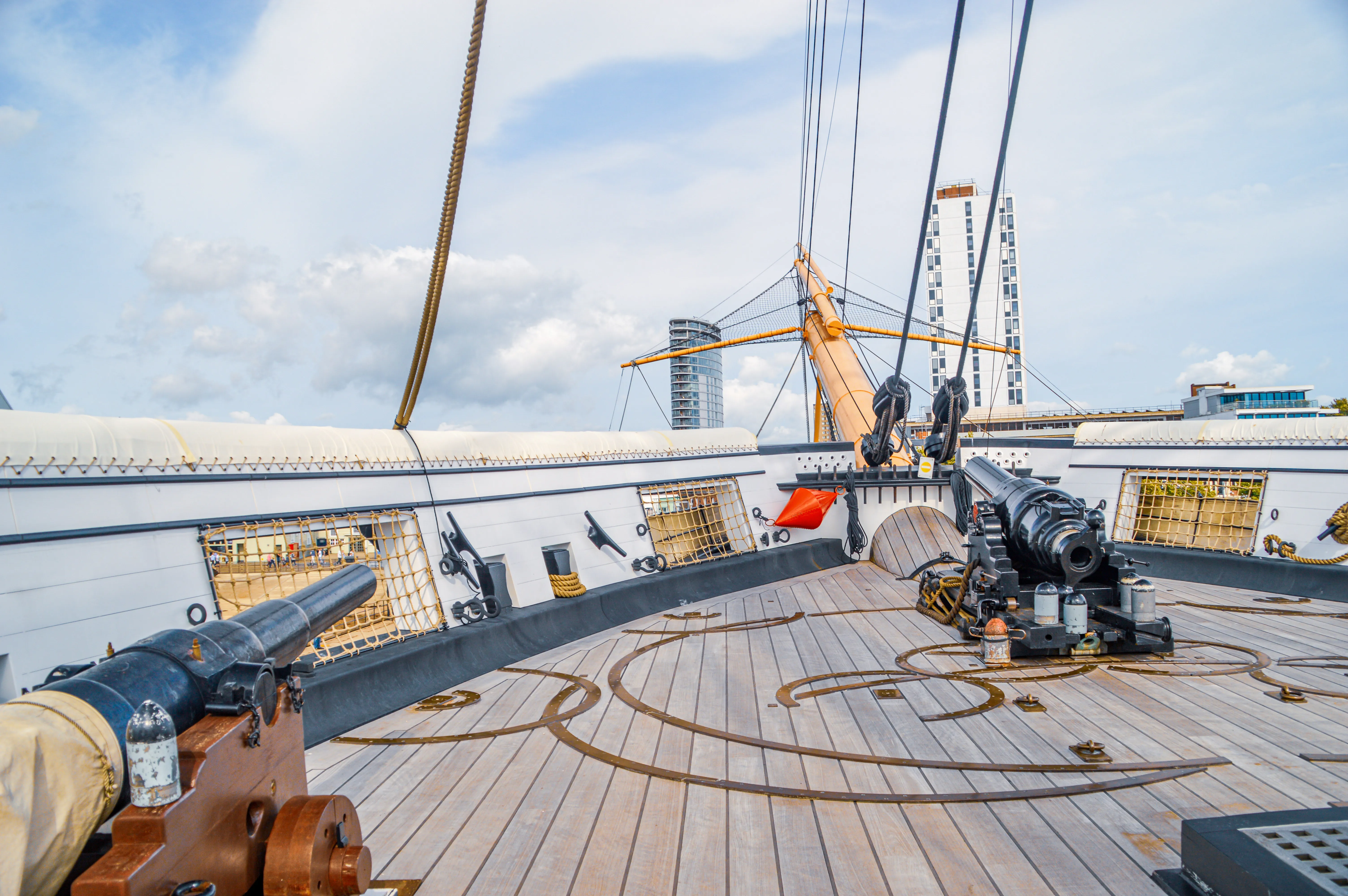
This image offers a fascinating glimpse onto the wooden deck of what appears to be a historic sailing ship. Two cannons are prominently positioned, one in the foreground on the left and another on the right. The deck itself is laid with wooden planks and features interesting circular metal inlays. In the background, modern buildings and a ship's mast create a striking contrast between old and new. The sky above is partly cloudy, suggesting a pleasant day for exploring.
Foredeck ‐ photo by ,
©www.mgaylard.co.uk.
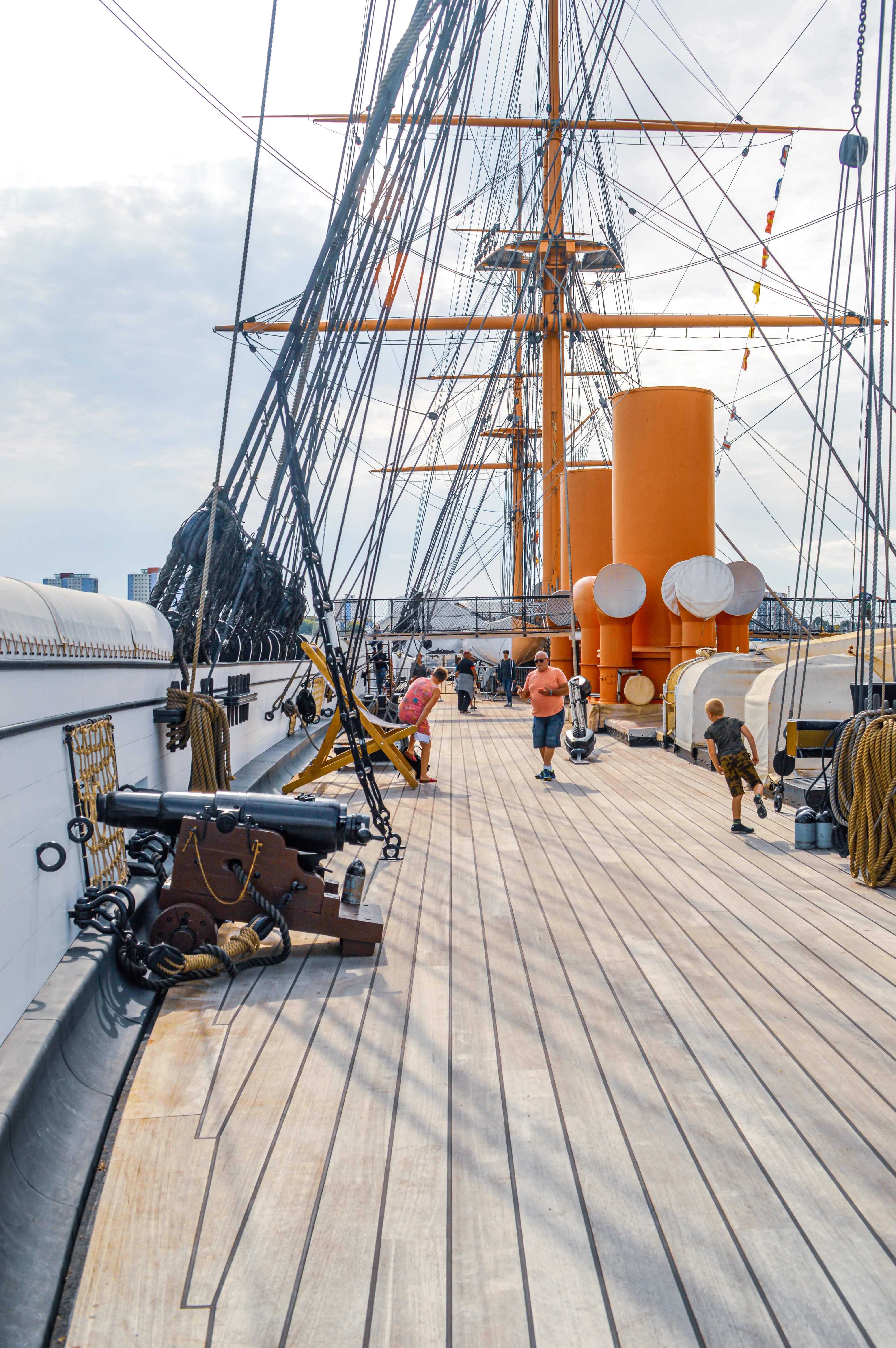
The image shows a lovely view from the deck of a historic sailing ship, bathed in bright sunshine. We can see a wooden deck with several people enjoying the day, including children. In the foreground, there's an old-fashioned cannon, adding to the maritime atmosphere. The masts and rigging of the ship stretch up towards a slightly cloudy sky, giving us a sense of its grandeur. The overall impression is one of a pleasant and engaging visit to a fascinating piece of naval history!
A Sunny Day on Deck! ‐ photo by ,
©www.mgaylard.co.uk.
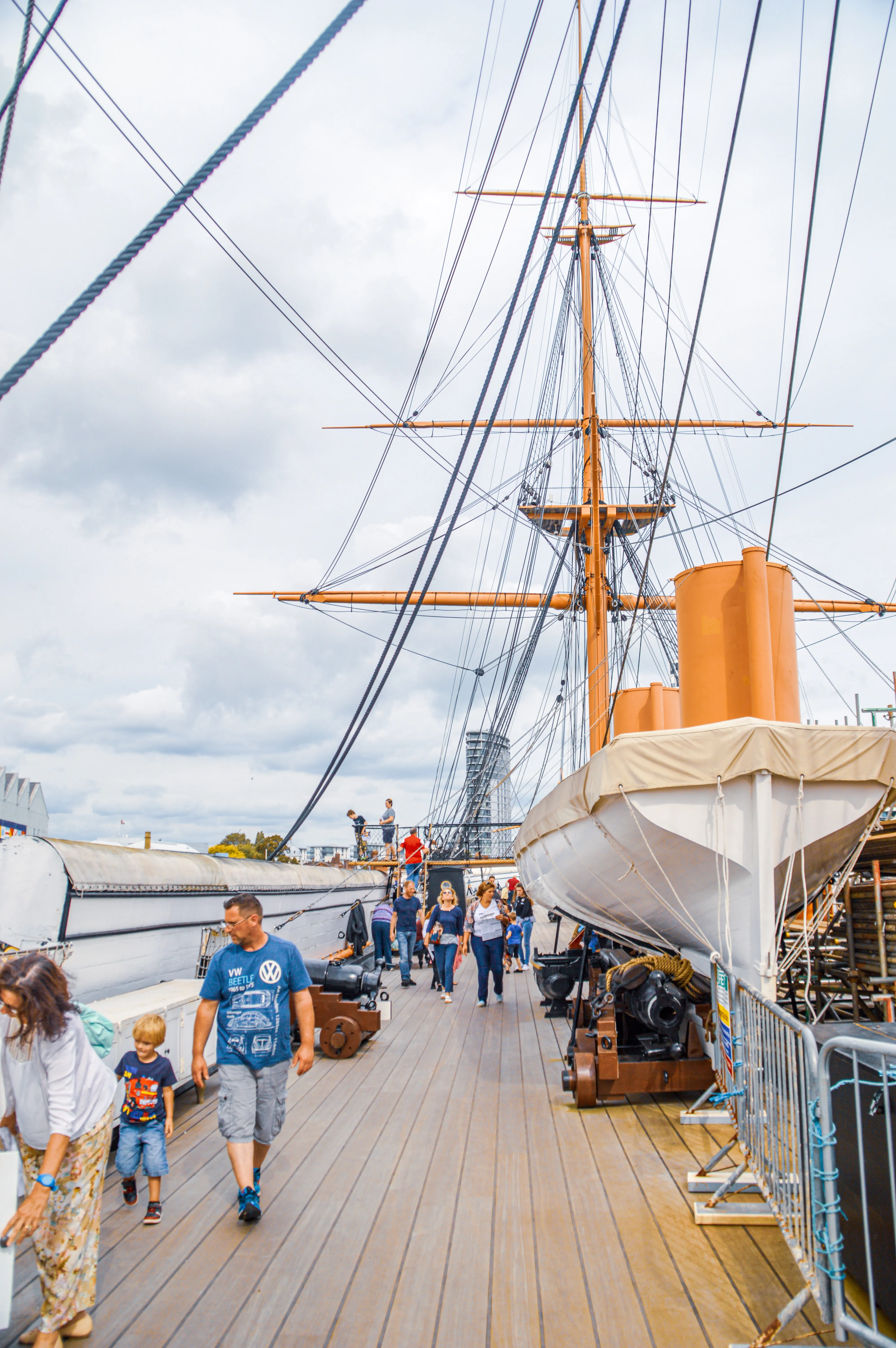
This image captures a lively scene on the wooden deck of what appears to be a historic sailing ship. A number of people are strolling along the deck, taking in the sights. Dominating the background is the ship's impressive mast and rigging, a testament to its grand past. In the foreground, a life-saving boat is neatly stowed, and a couple of old cannons add to the nautical atmosphere. A modern city skyline is visible in the distance, creating a fascinating contrast between old and new
A Stroll On The Deck ‐ photo by ,
©www.mgaylard.co.uk.
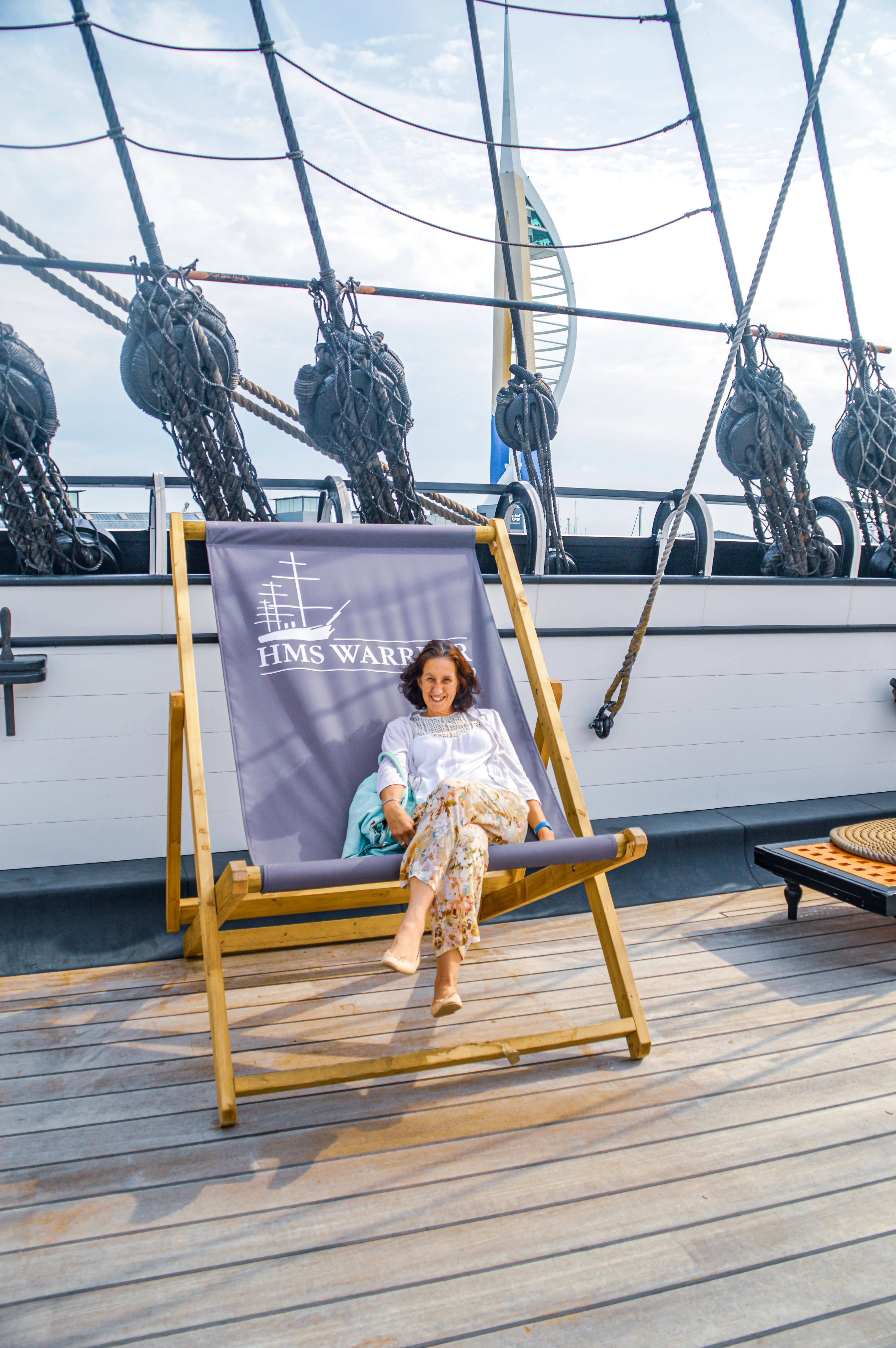
The image shows a person sitting on a deck chair on the deck of a ship named HMS Warrior. The ship has a lot of ropes and pulleys visible in the background, and the deck is made of wooden planks. The person is smiling and appears to be enjoying the sunny weather. In the background, part of a Ferris wheel can be seen, indicating that the ship might be docked near an amusement area.
A Relaxing Day on the HMS Warrior ‐ photo by ,
©www.mgaylard.co.uk.
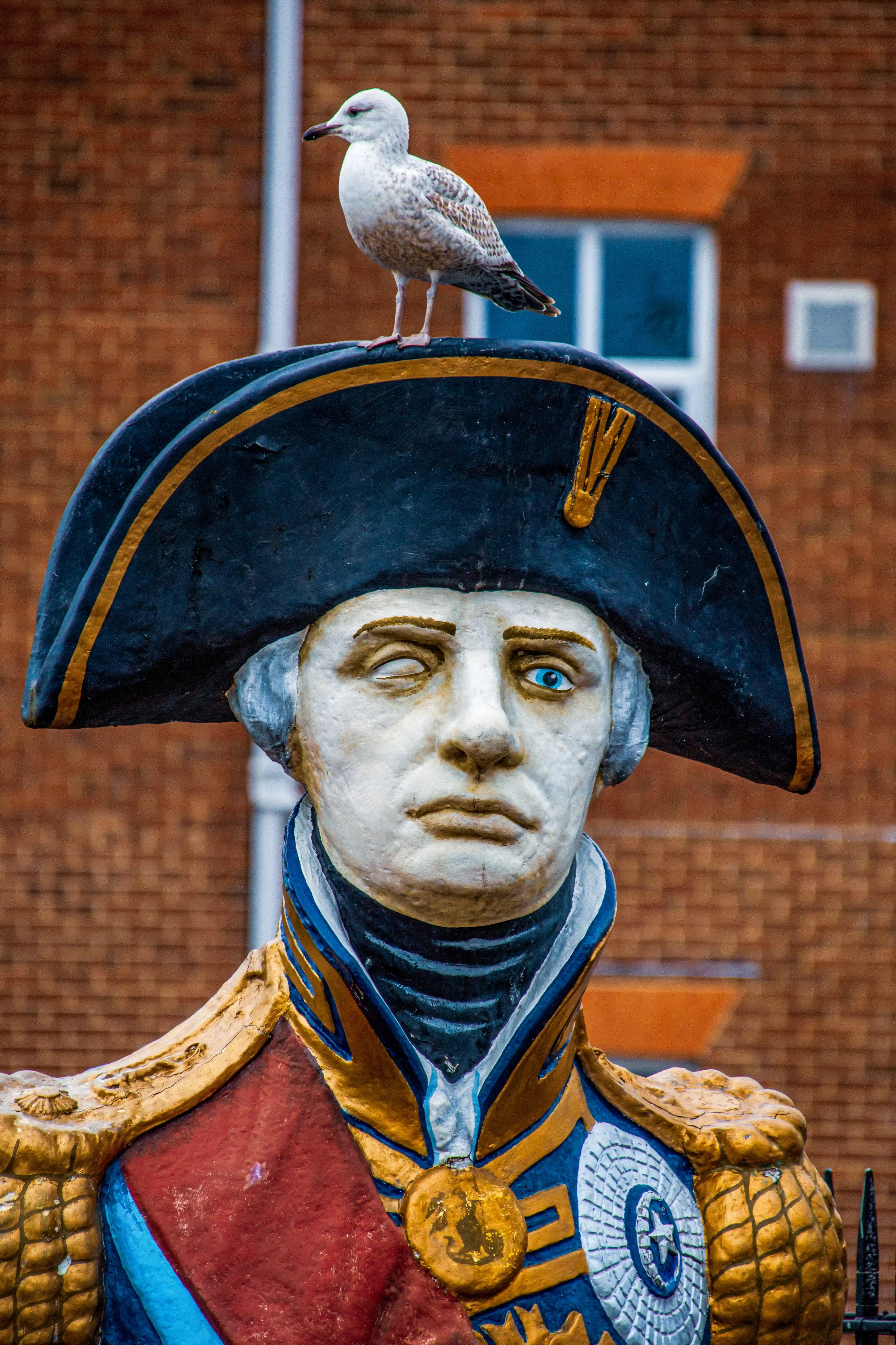
The image depicts a statue of a historical figure in military attire, including a tricorn hat with gold trim and a medal on the chest. A seagull is perched on top of the statue's head. The statue appears to be made of a weathered material, possibly wood or plaster, and is set against a brick building backdrop.
A Seagull's Perch ‐ photo by ,
©www.mgaylard.co.uk.
The image depicts a well-appointed dining room with a long table set with chairs, a tablecloth, and various decorative items including a centerpiece and a chandelier. The room features a checkered floor, a small side table with additional items, and framed pictures on the walls. The overall ambiance suggests a formal or elegant setting, possibly on a ship given the curved ceiling and compact space.
Captains Cabin ‐ photo by ,
©www.mgaylard.co.uk.
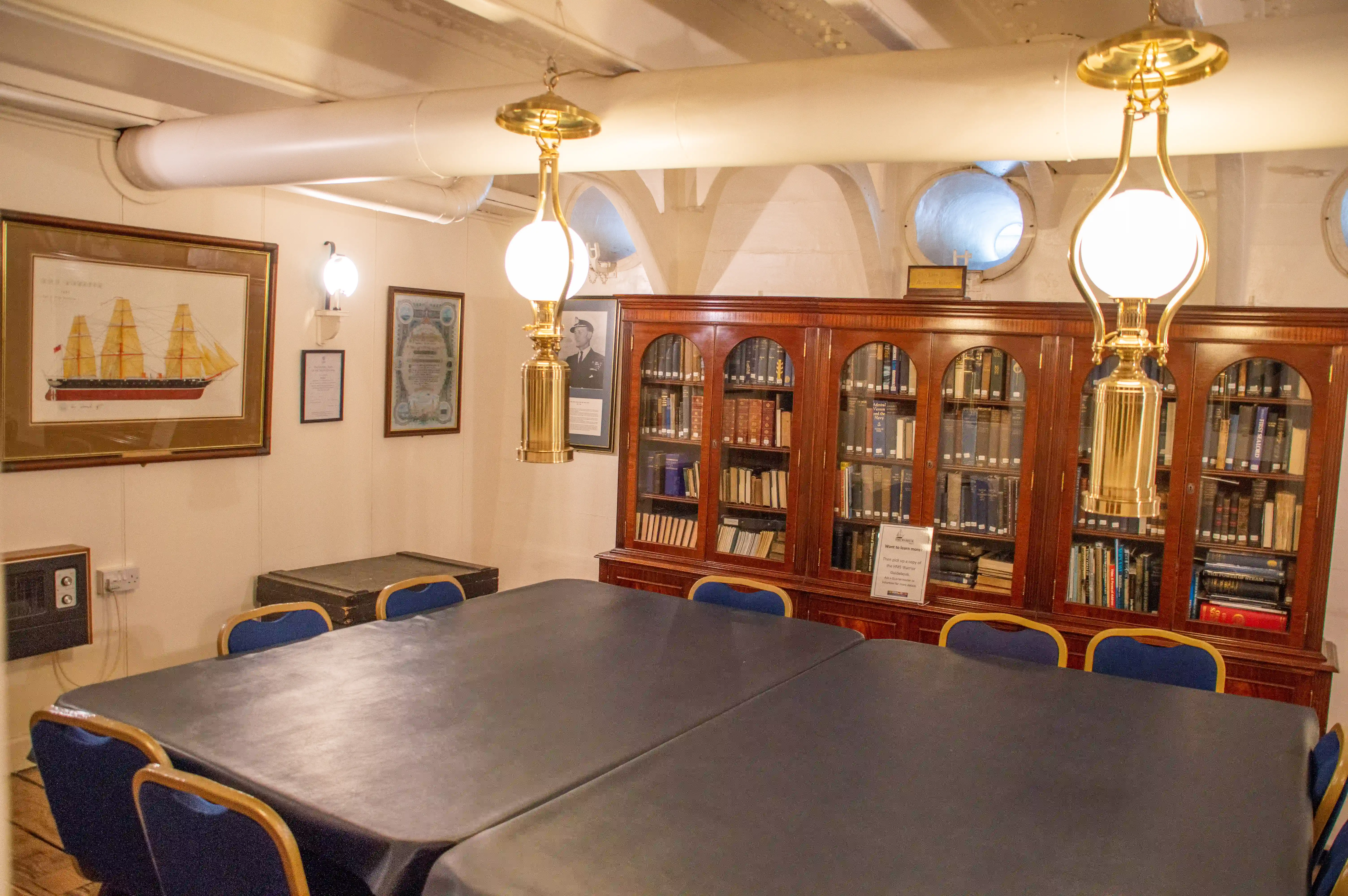
The image depicts a well-appointed room that appears to be a library or a meeting room. The room features a large wooden table surrounded by blue chairs, suggesting a space for meetings or discussions. The walls are adorned with framed pictures, including a detailed drawing of a ship and a photograph of a person in uniform. The room is illuminated by elegant brass lamps hanging from the ceiling. A large wooden bookshelf filled with books and a sign indicating a 'Silent Room' further emphasize the room's purpose as a quiet space for reading or study.
Captains Cabin ‐ photo by ,
©www.mgaylard.co.uk.
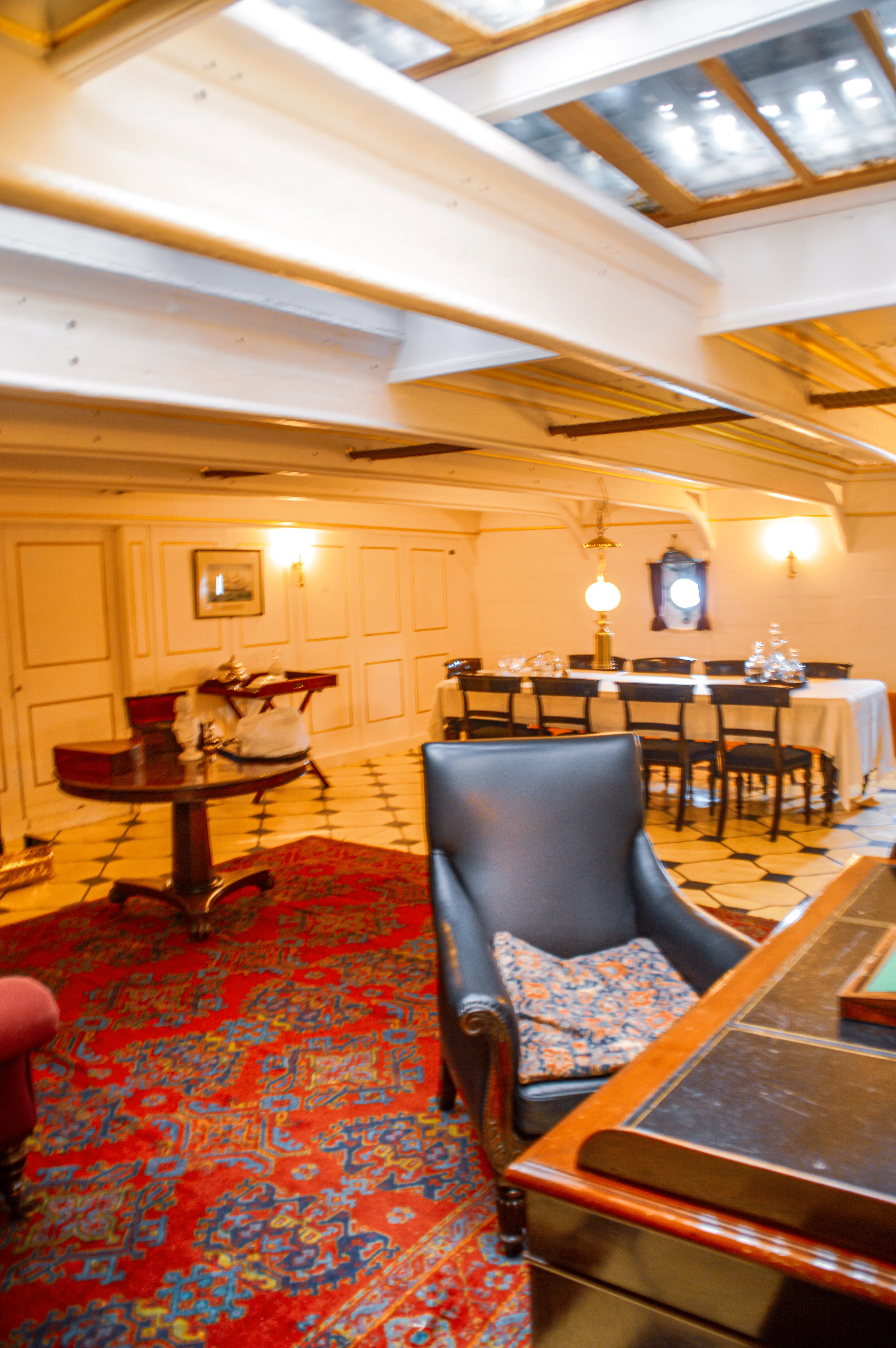
The image depicts an elegantly furnished room with wooden paneling, a patterned rug, and a mix of vintage furniture. The room features a cozy seating area with a blue leather chair and a small table with a lamp. In the background, there is a dining area set with tables and chairs, and a chandelier hanging from the ceiling. The overall ambiance is warm and inviting, suggesting a classic or historical setting.
Captains Cabin ‐ photo by ,
©www.mgaylard.co.uk.
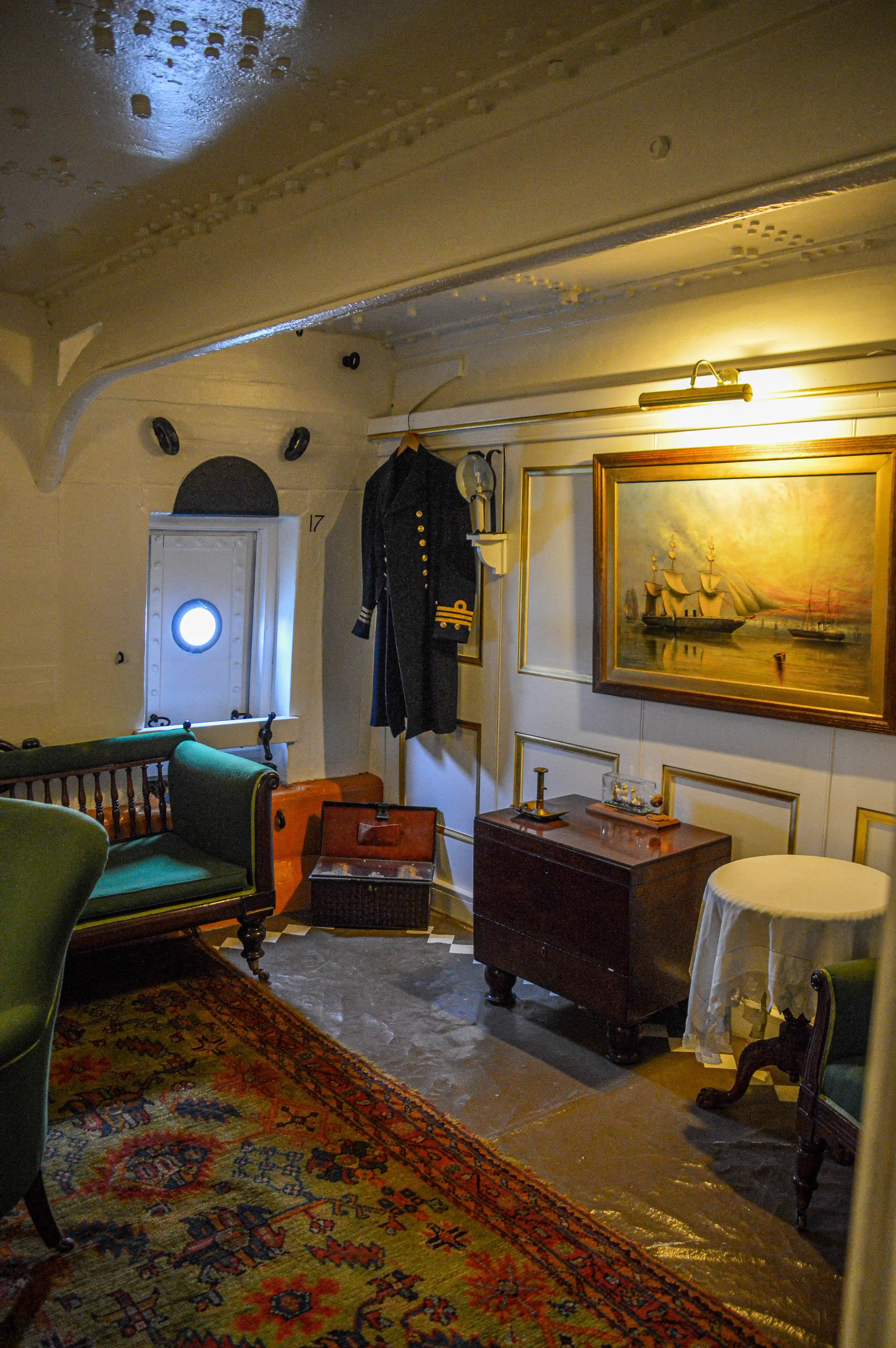
The image depicts an interior room, likely from a historical ship, featuring vintage furniture, a framed painting, a uniform hanging on a wall, and a porthole window. The room is adorned with a patterned rug and has a cozy, well-lit ambiance.
Captains Cabin ‐ photo by ,
©www.mgaylard.co.uk.
The image depicts a vintage office setting with a wooden desk, a green upholstered chair, a leather chair, a framed painting of a ship, a lamp, a telescope, a wall-mounted shelf with books, and a wall clock. The room has a nautical theme and is well-lit with a ceiling light and a wall sconce.
Captains Cabin ‐ photo by ,
©www.mgaylard.co.uk.
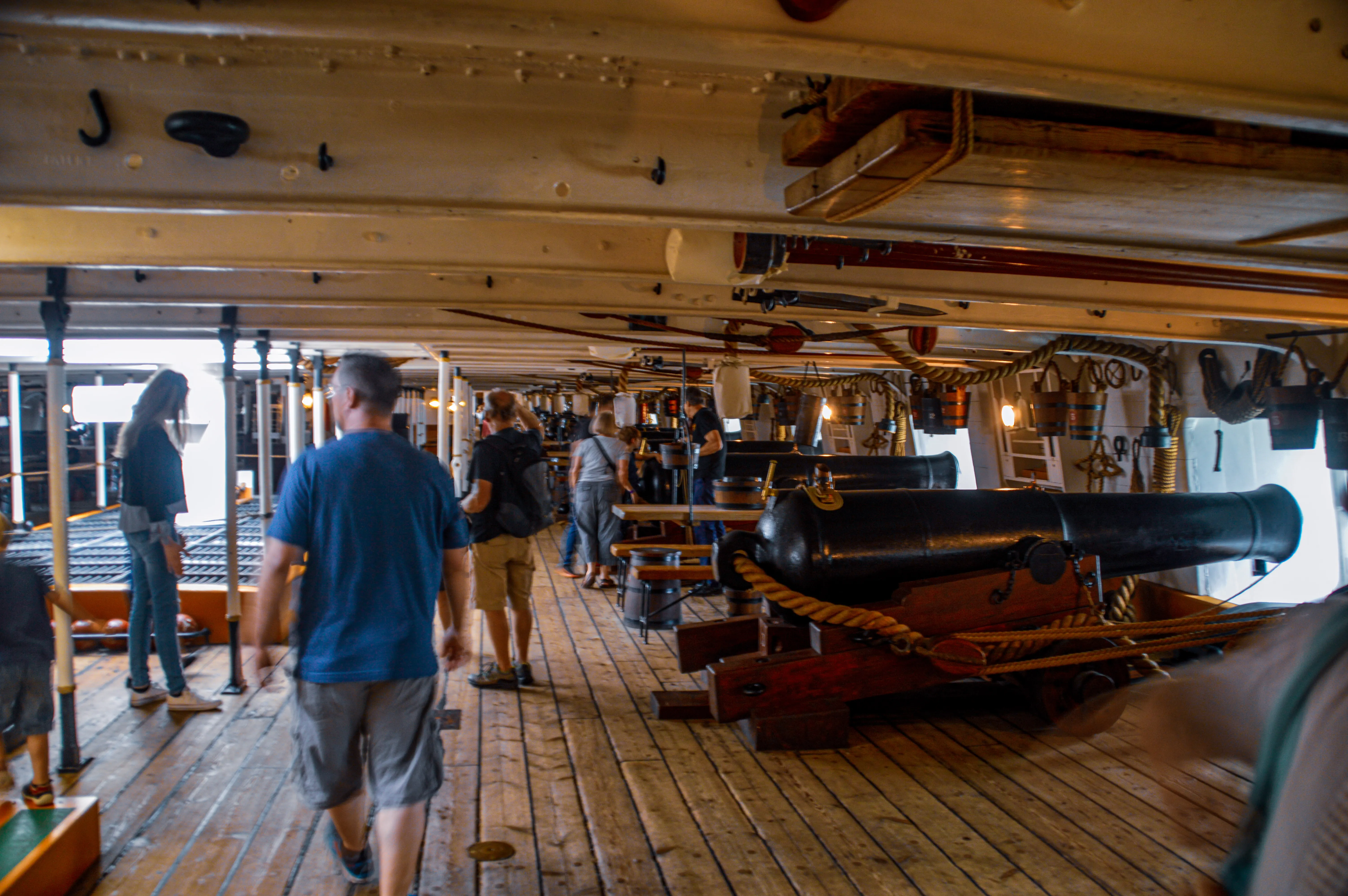
The image depicts the interior deck of an old wooden ship, likely a historical or replica vessel, with several people exploring it. The deck features wooden planks and beams, and is equipped with cannons and various nautical equipment. The visitors appear to be tourists, observing the ship's features and structure.
Gun Deck ‐ photo by ,
©www.mgaylard.co.uk.
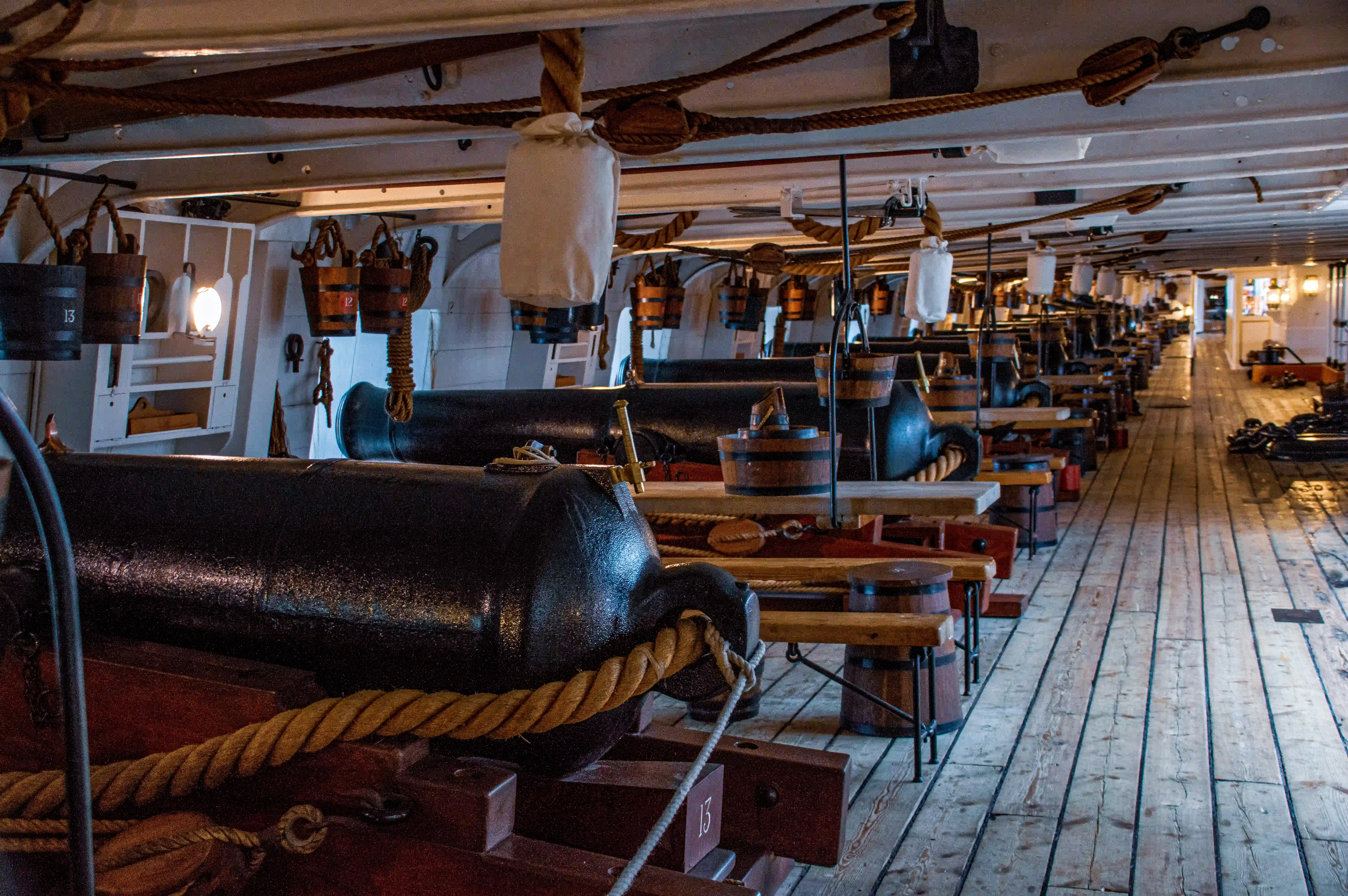
The image depicts the interior of an old ship, specifically the gun deck. It shows a row of cannons lined up along the deck, each secured with ropes and positioned near wooden benches and various equipment. The deck is made of wooden planks, and the ship's structure includes white walls and beams. The lighting is dim, with some light coming from small windows and lanterns. The overall scene gives a sense of historical naval architecture and the operational environment of a warship.
Gun Deck ‐ photo by ,
©www.mgaylard.co.uk.
The image depicts the interior of an old wooden ship, likely a historical or replica pirate ship, featuring cannons, wooden beams, and a deck with various ropes and equipment. The ship appears to be a museum exhibit, with visitors exploring the space in the background.
View of warrior ‐ photo by ,
©www.mgaylard.co.uk.
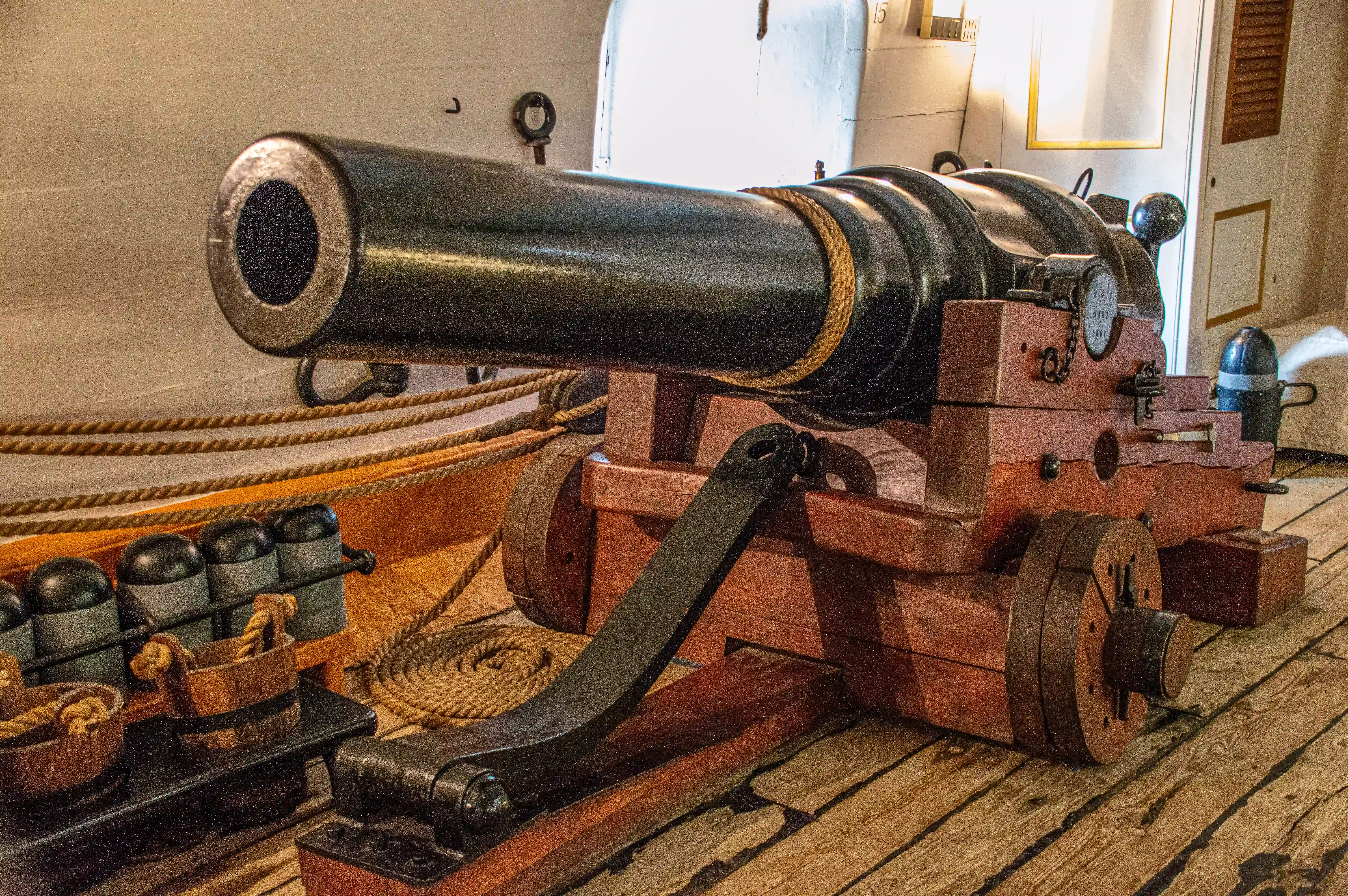
The image depicts an old naval cannon mounted on a wooden carriage, likely from a historical ship. The cannon is situated on a wooden deck, with various associated equipment such as cannonballs, wooden wedges, and ropes visible around it. The setting appears to be part of a museum or historical exhibit, showcasing the artillery used in naval warfare.
Armstrong Naval Gun ‐ photo by ,
©www.mgaylard.co.uk.
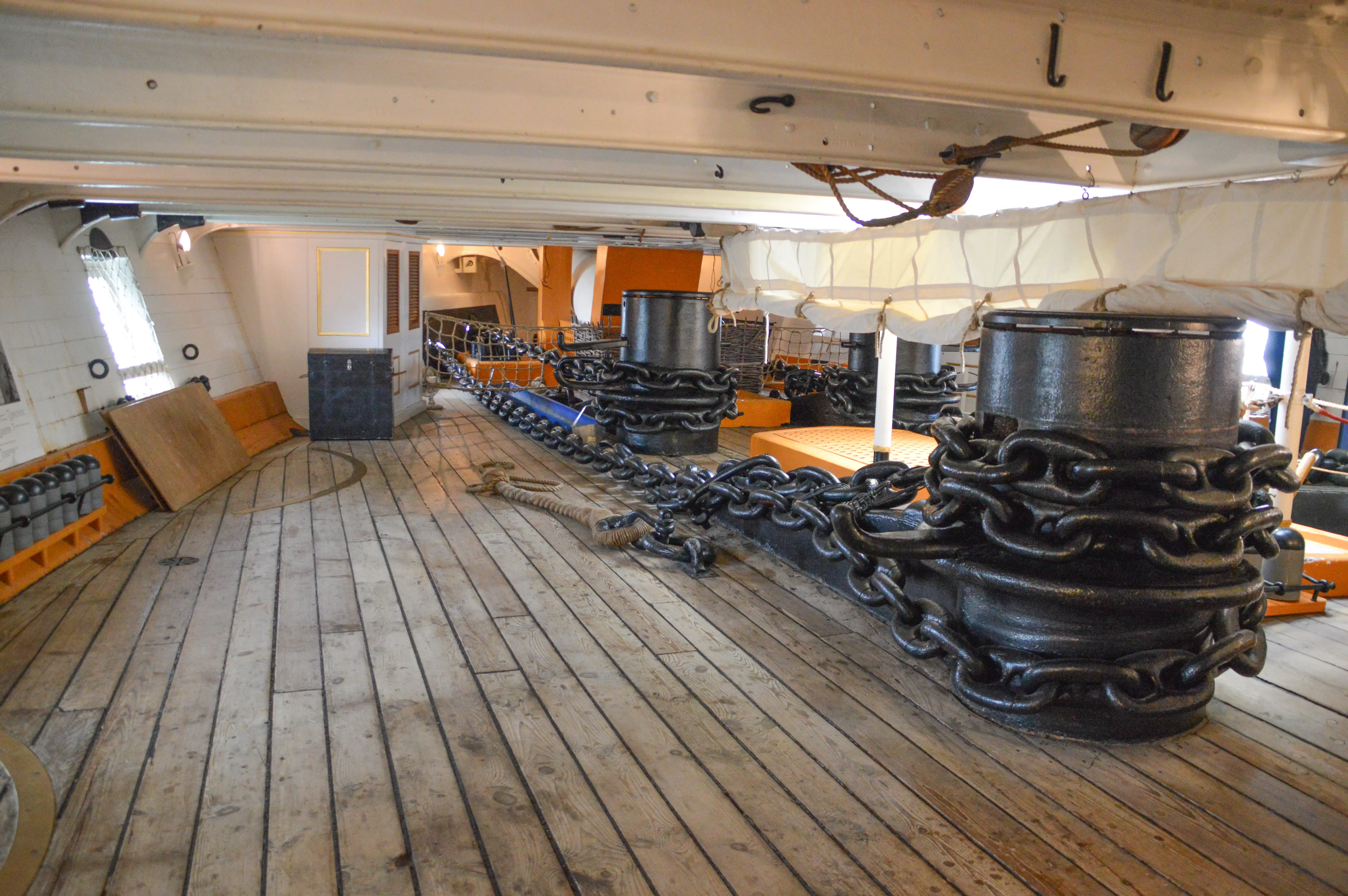
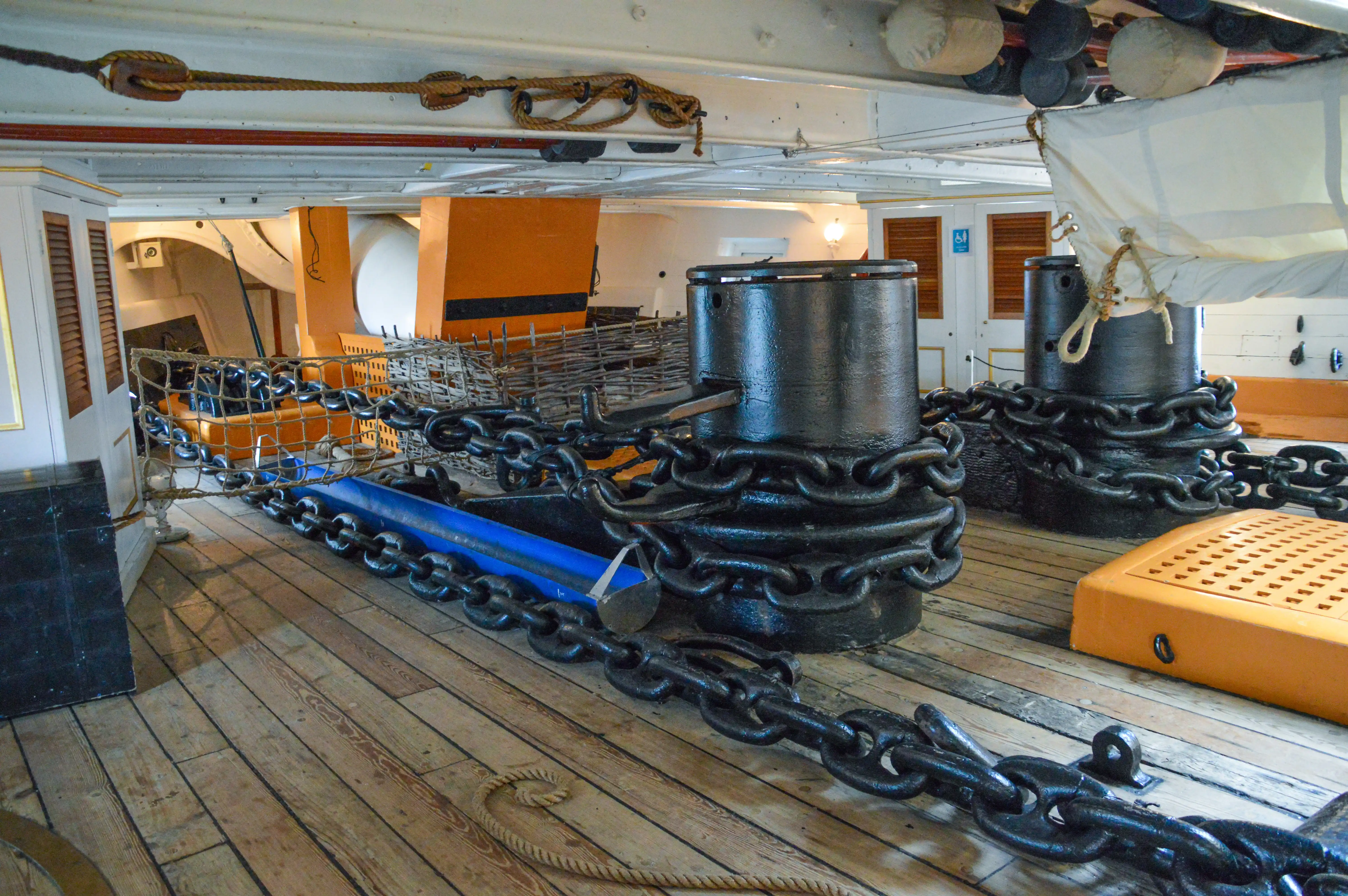
The image depicts the interior of an old ship, likely a historical warship, showing large black cannons secured with thick ropes and chains on a wooden deck. The ship's interior features wooden planks, white walls with portholes, and various naval equipment, giving a glimpse into maritime history and naval warfare.
Anchor Chains ‐ photo by ,
©www.mgaylard.co.uk.
The image depicts the interior of a historical ship, showcasing large black cylindrical objects, likely cannons, secured with thick chains. The deck is made of wooden planks, and various ropes and rigging are visible overhead. The background includes orange-painted walls and wooden structures, suggesting the ship's interior compartments and storage areas.
Anchor Chains ‐ photo by ,
©www.mgaylard.co.uk.
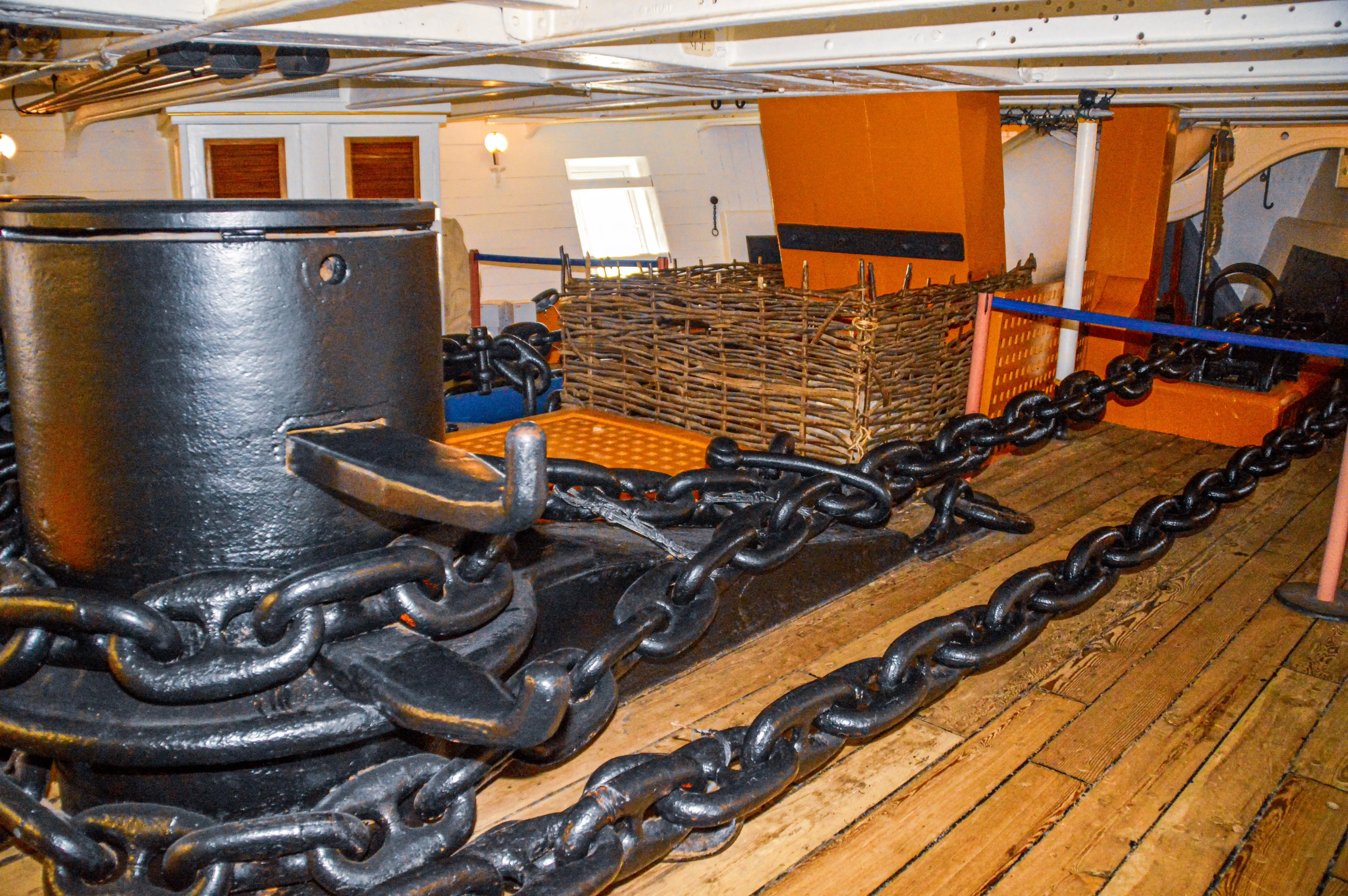
The image depicts the interior of an old ship, likely a warship, featuring large cannons secured with thick chains. The deck is made of wooden planks, and there are wicker barriers and orange structural elements visible in the background. The setting appears to be part of a museum exhibit, showcasing historical naval artifacts.
Anchor Chains ‐ photo by ,
©www.mgaylard.co.uk.
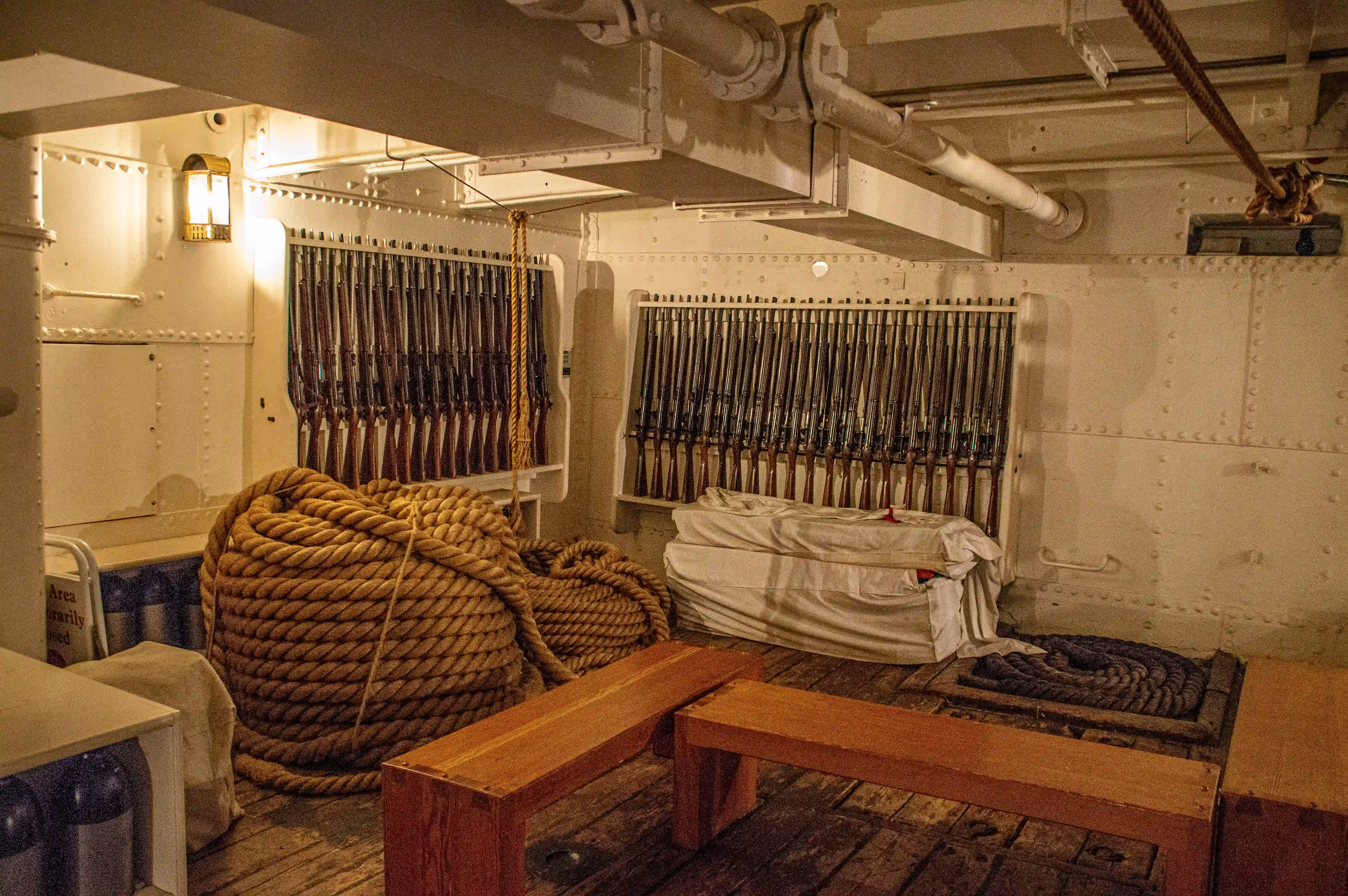
The image depicts the interior of a ship, specifically an area that appears to be a storage or utility room. The room contains various maritime tools and equipment, including multiple boats hooks hanging on racks, coils of rope, covered objects that might be additional tools or supplies, and wooden boxes. The setting suggests a well-organized space designed for easy access to necessary items during maritime activities.
Armoury ‐ photo by ,
©www.mgaylard.co.uk.
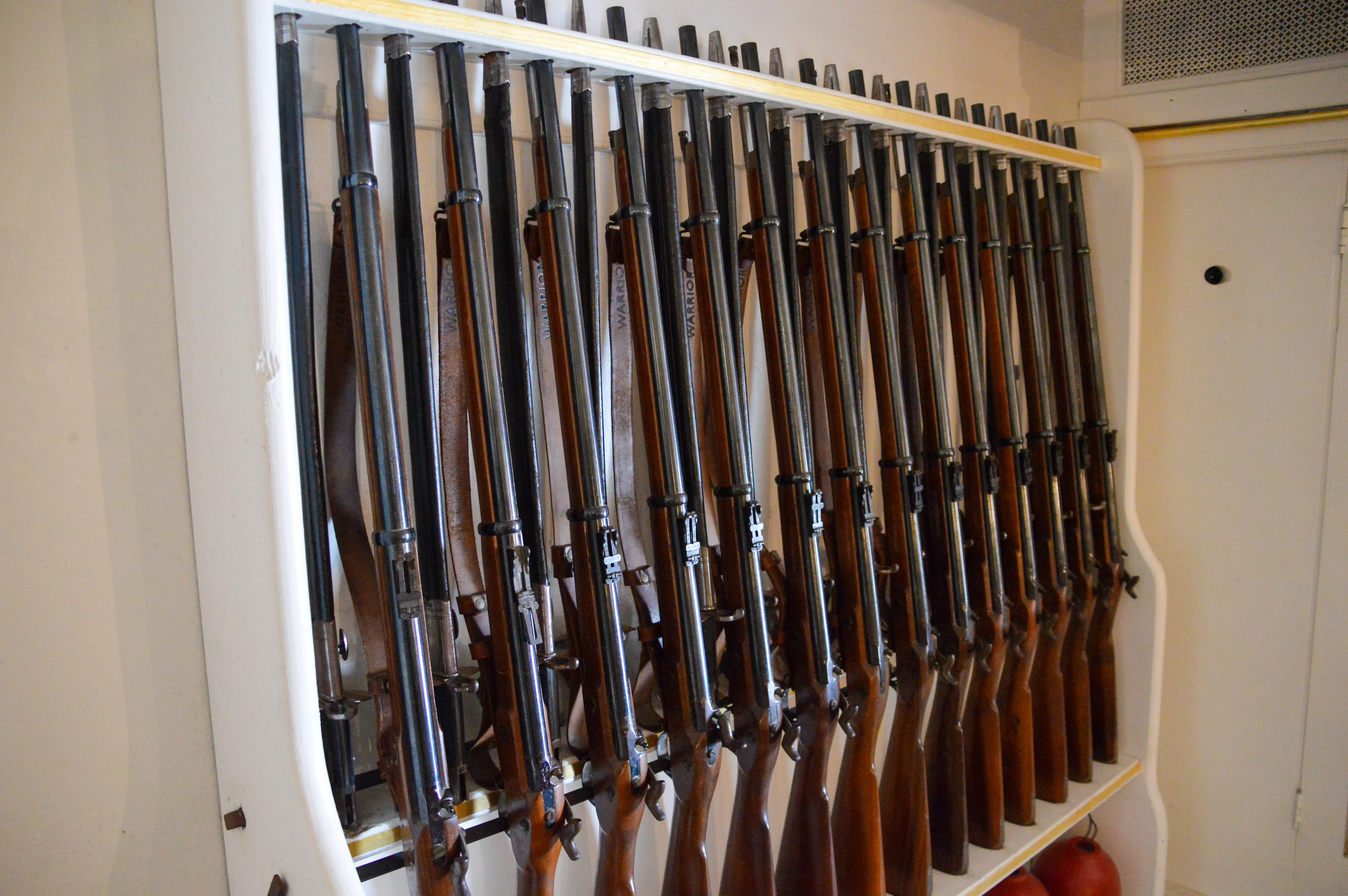
The image shows a collection of rifles neatly arranged in a vertical gun rack. The rifles have wooden stocks and appear to be of similar make and model, with the word 'Warrior' visible on some of the barrels. The rack is mounted on a wall and is designed to hold the rifles securely in place.
Rifle_Rack ‐ photo by ,
©www.mgaylard.co.uk.
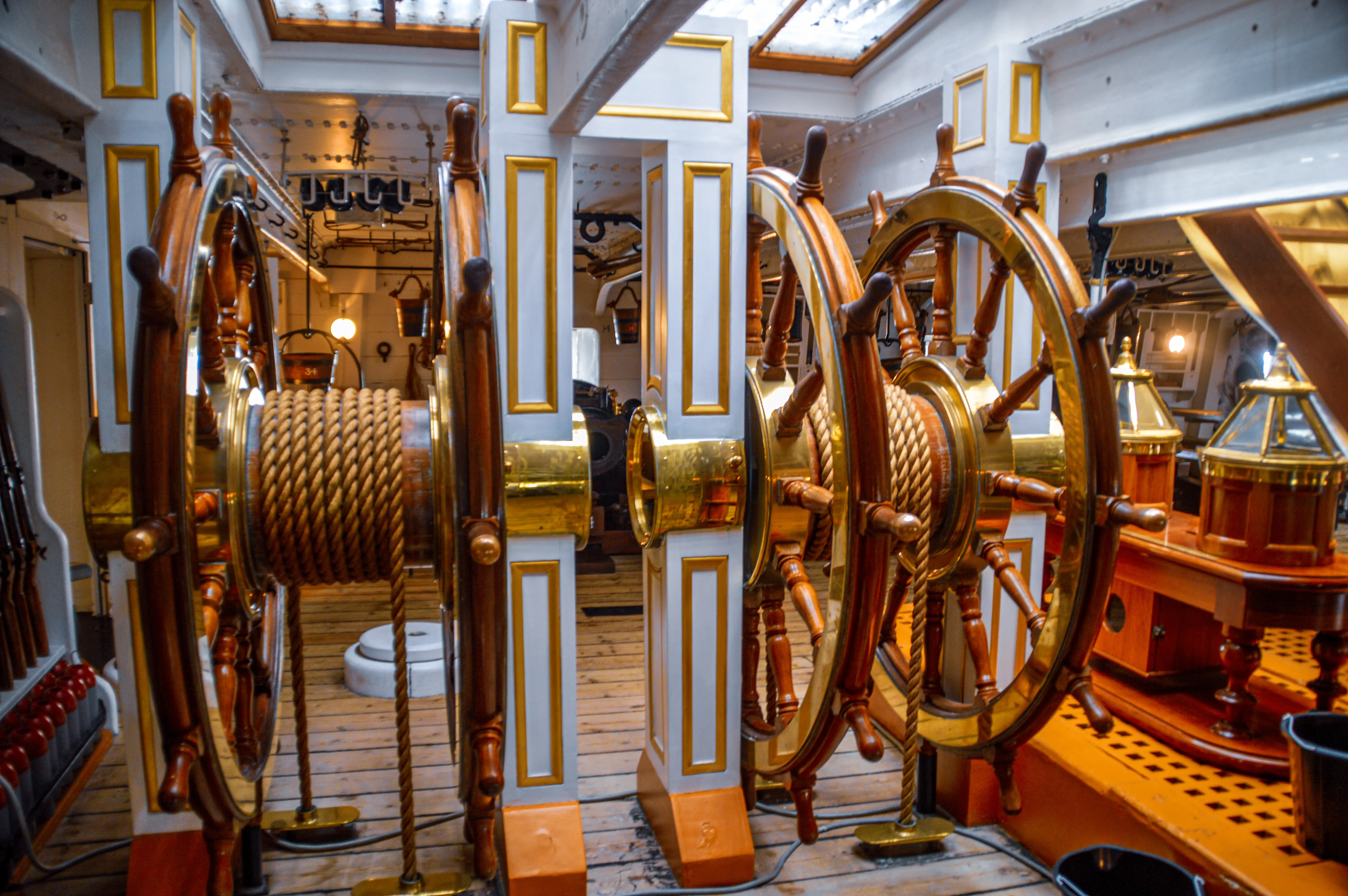
The image depicts the interior of a ship, showcasing ornate steering wheels and ropes, with a well-maintained and polished wooden deck and walls. The area appears to be part of the ship's control or navigation section, featuring intricate gold and wood detailing. The setting suggests a historical or museum context, emphasizing the ship's vintage design and craftsmanship.
/Steering Well ‐ photo by ,
©www.mgaylard.co.uk.
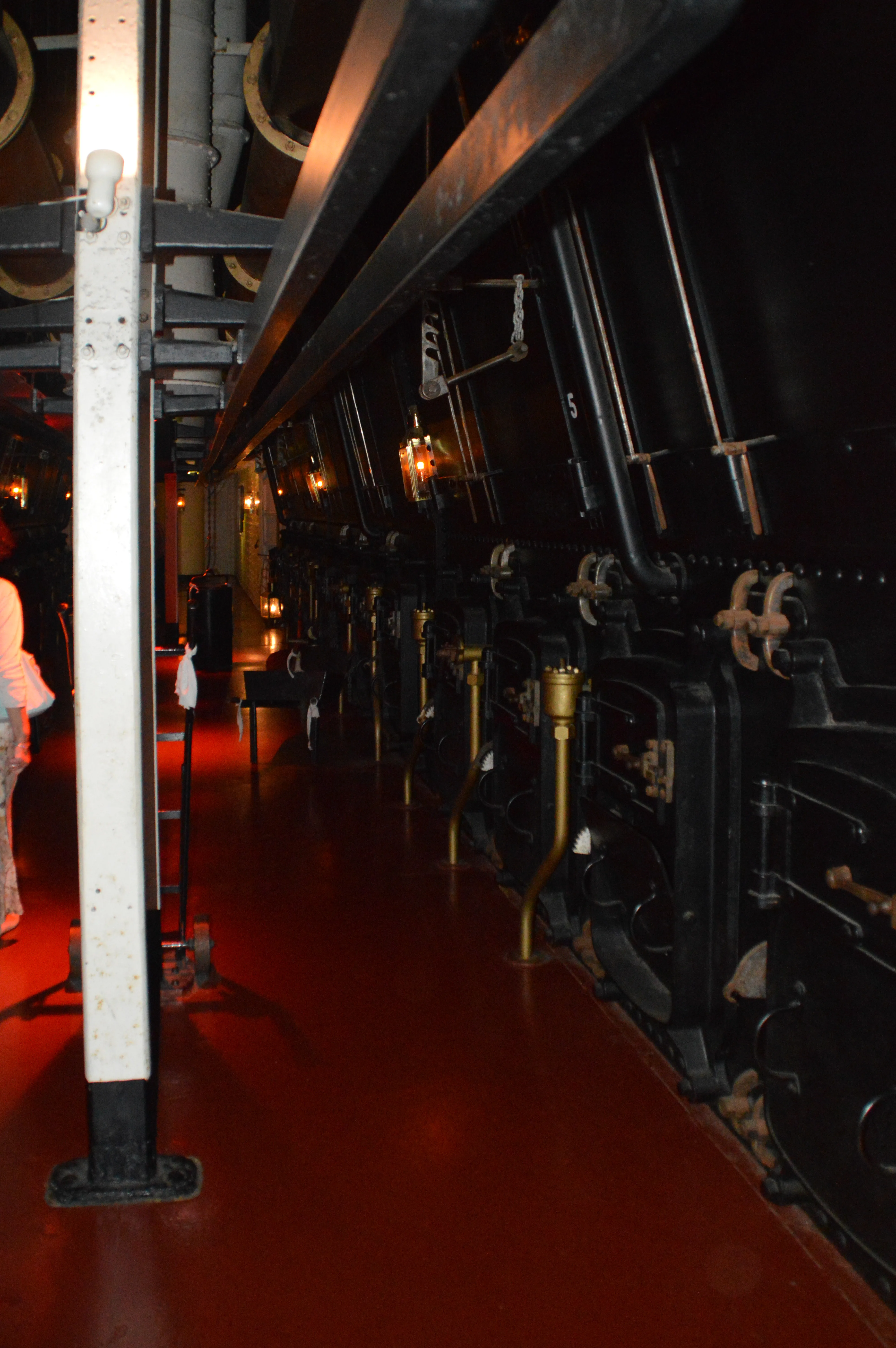
The image depicts the interior of a historical ship engine room, showcasing large, vintage machinery and equipment. The room is dimly lit with warm lighting, highlighting the intricate details of the engine components. The floor is red, and there are visible signs of wear and tear on the machinery, indicating its age. A person in a pink outfit is partially visible on the left side of the image, adding a sense of scale to the scene. The overall atmosphere is one of historical significance and industrial heritage
ship boiler room ‐ photo by ,
©www.mgaylard.co.uk.
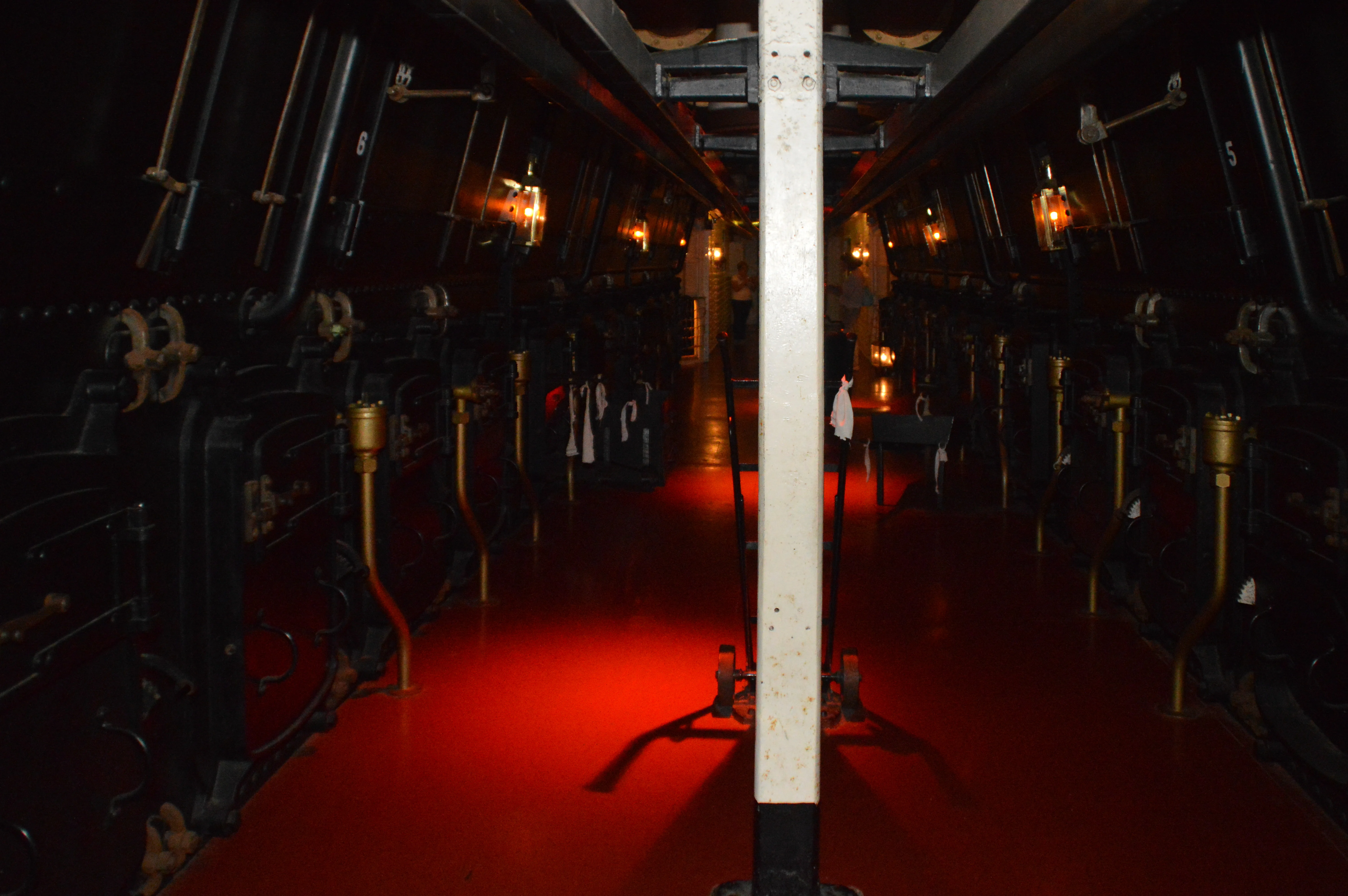
The image depicts an interior space with a red carpet and dim lighting. The room features multiple chairs with brass accents and black upholstery, arranged in rows on either side of a central aisle. The lighting is provided by wall-mounted lamps with a vintage design, casting a warm glow. The overall atmosphere appears intimate and somewhat formal, possibly suggesting a setting like a theater, lounge, or dining area.
ship boiler room ‐ photo by ,
©www.mgaylard.co.uk.
View of warrior ‐ photo by ,
©www.mgaylard.co.uk.
The image shows a steep, narrow ladder leading upwards within an enclosed space. The ladder is secured with ropes on either side, and the area appears to be part of an industrial or maritime setting, possibly a ship, given the visible structure and stored items like barrels and other equipment.
Up To The Light ‐ photo by ,
©www.mgaylard.co.uk.
The image shows a steep, narrow ladder leading upwards within an enclosed space. The ladder is secured with ropes on either side, and the area appears to be part of an industrial or maritime setting, possibly a ship, given the visible structure and stored items like barrels and other equipment.
Down to the Engines and Boilers ‐ photo by ,
©www.mgaylard.co.uk.
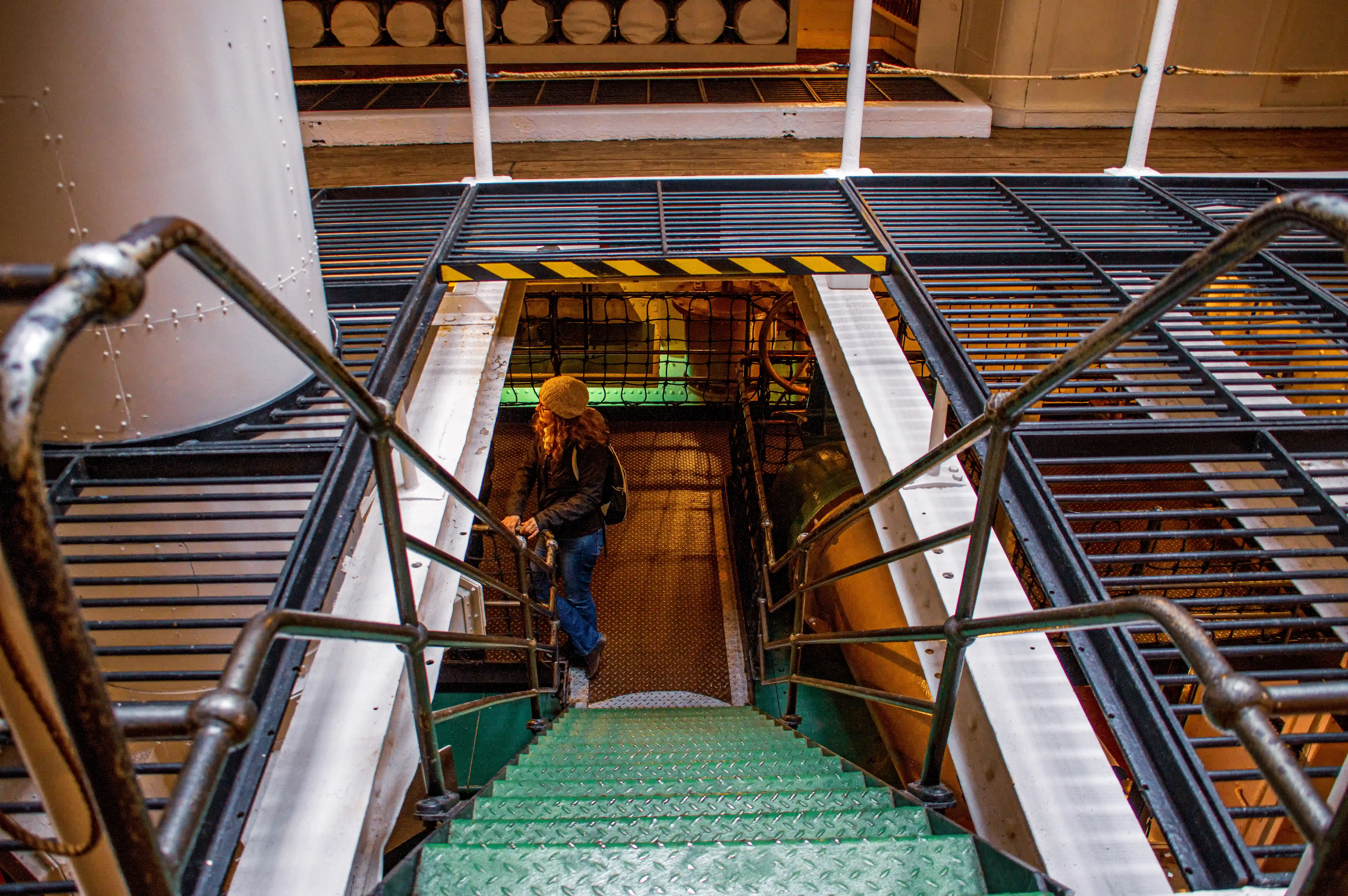
The image depicts a control room with a telemotor for a ship's engine. The telemotor, labeled with '21', has a large circular dial indicating engine commands such as 'STOP', 'SLOW', 'HALF SPEED', 'FASTER', and 'FULL SPEED' for both 'AHEAD' and 'ASTERN' directions. The room features green-painted steps leading up to the control area, with metal railings and various mechanical components visible, including large brass-colored pipes and a mesh-covered section below the steps.
The telemotor ‐ photo by ,
©www.mgaylard.co.uk.
The image depicts a close-up view of an industrial machine, likely a large engine or turbine, with visible components such as pistons, valves, and brass nameplates. The machine appears to be well-maintained and is situated in an industrial setting. The brass nameplates suggest that the machine may be a historical or significant piece of equipment.
Ships Engine ‐ photo by ,
©www.mgaylard.co.uk.
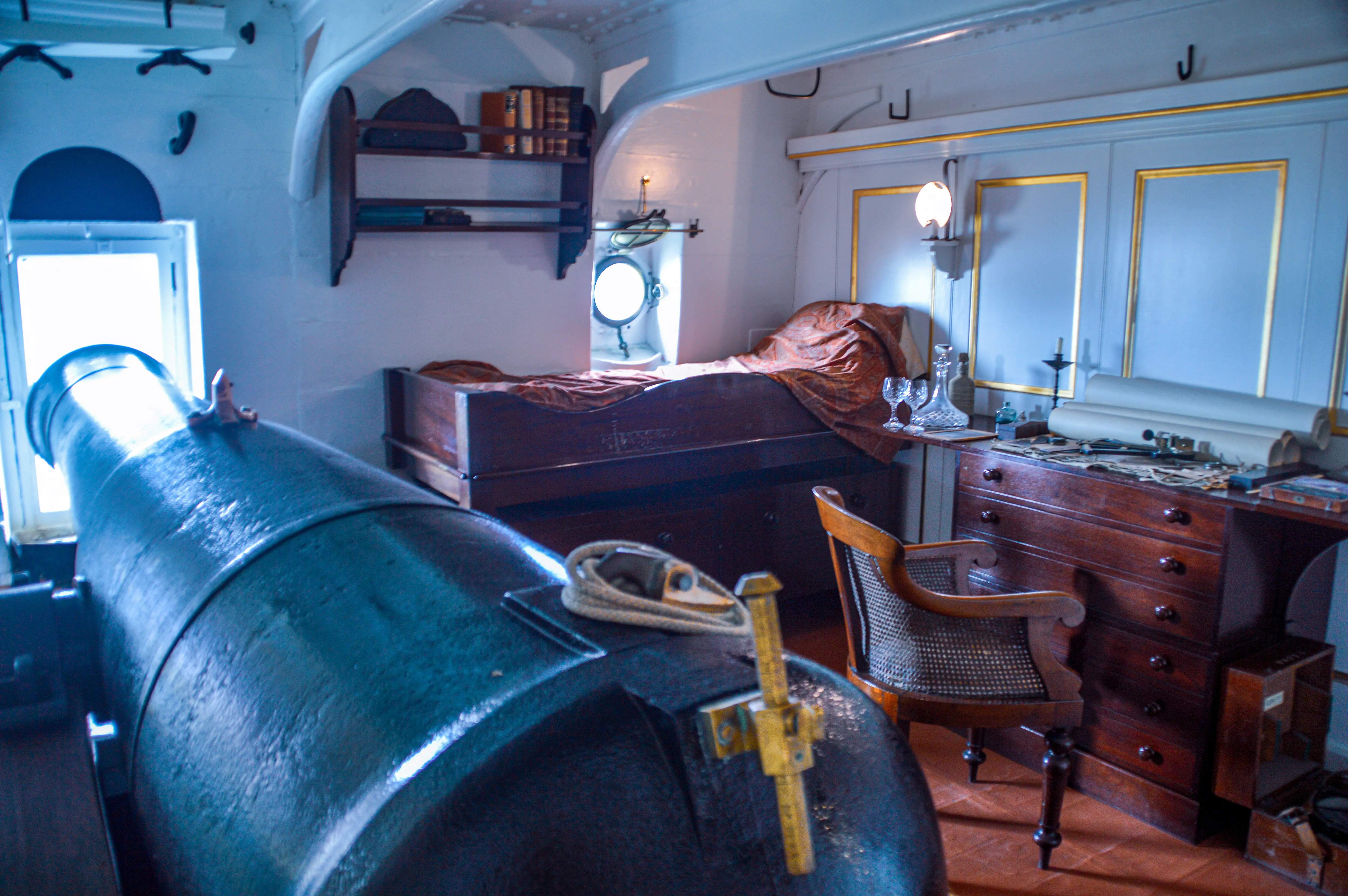
The image depicts a historical ship cabin interior with a neatly made bed, a wooden desk with various items, a wicker chair, and a porthole window allowing natural light to enter. The cabin has a cozy and organized appearance, with books and other personal items neatly arranged on shelves and the desk.
Cabin With A Cannon ‐ photo by ,
©www.mgaylard.co.uk.
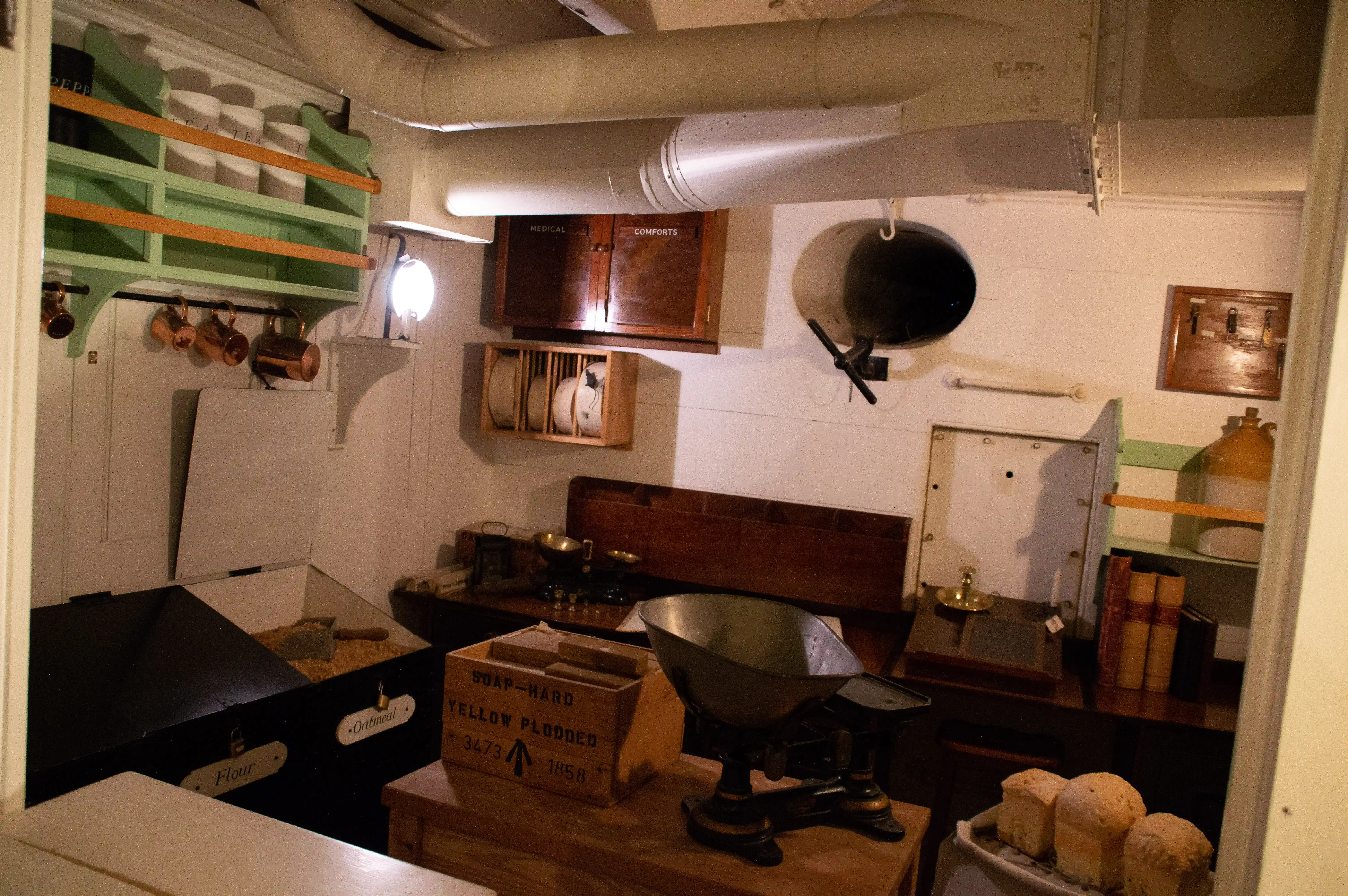
The image depicts a historical ship's galley or kitchen area, featuring various food storage and preparation items. There are labeled containers for flour, oatmeal, and soap, a large wooden cabinet marked 'Medical' and 'Comforts', copper pots hanging on the wall, a weighing scale with a large metal bowl, and shelves stocked with supplies. The setting is compact and utilitarian, reflecting the limited space available in a ship's kitchen.
Galley ‐ photo by ,
©www.mgaylard.co.uk.
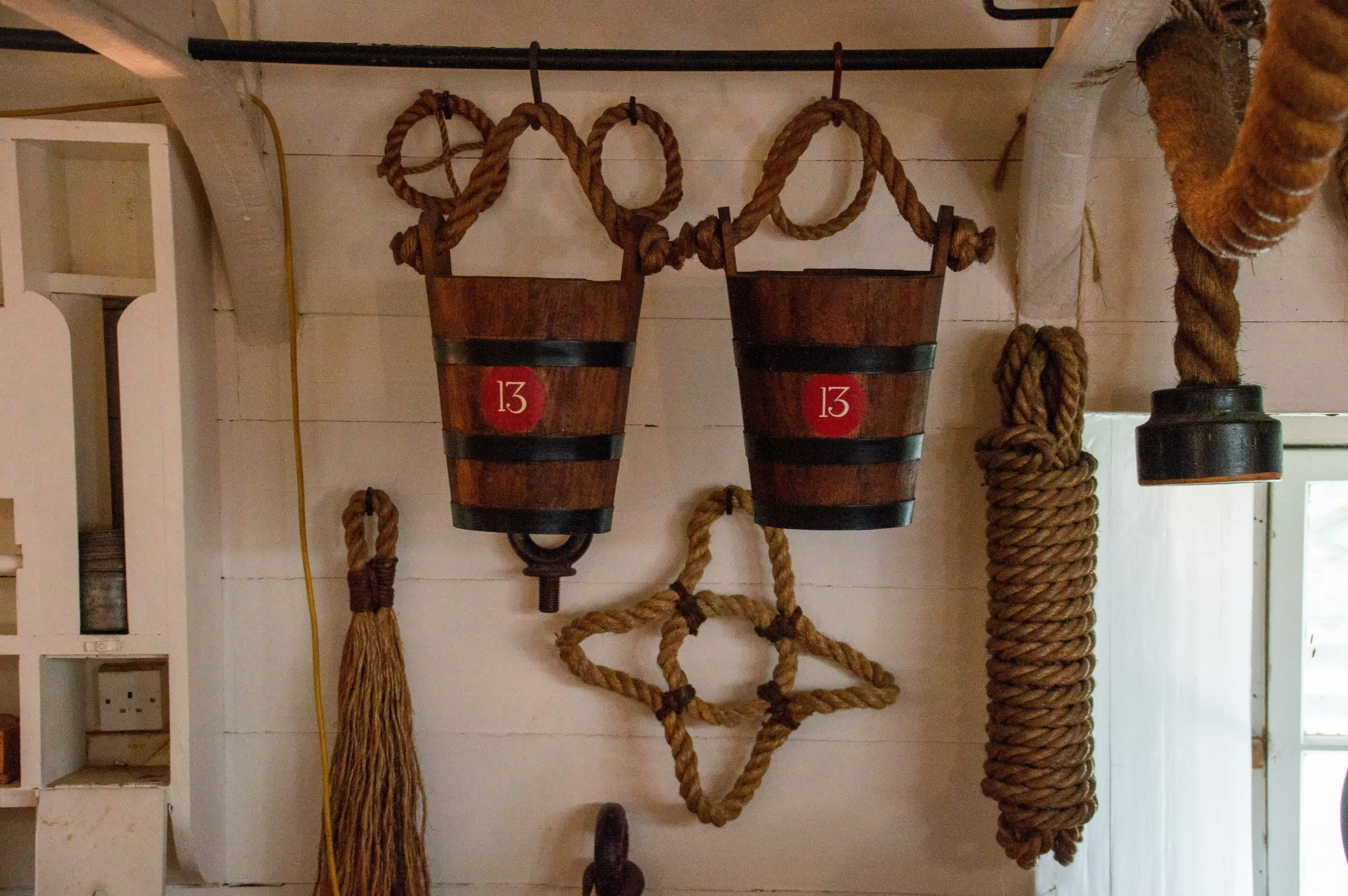
The image shows a nautical-themed display with two wooden buckets labeled '13' hanging from ropes, a coiled rope star, a large rope coil, a broom, and other maritime items arranged on a white wooden wall.
Fire Buckets ‐ photo by ,
©www.mgaylard.co.uk.
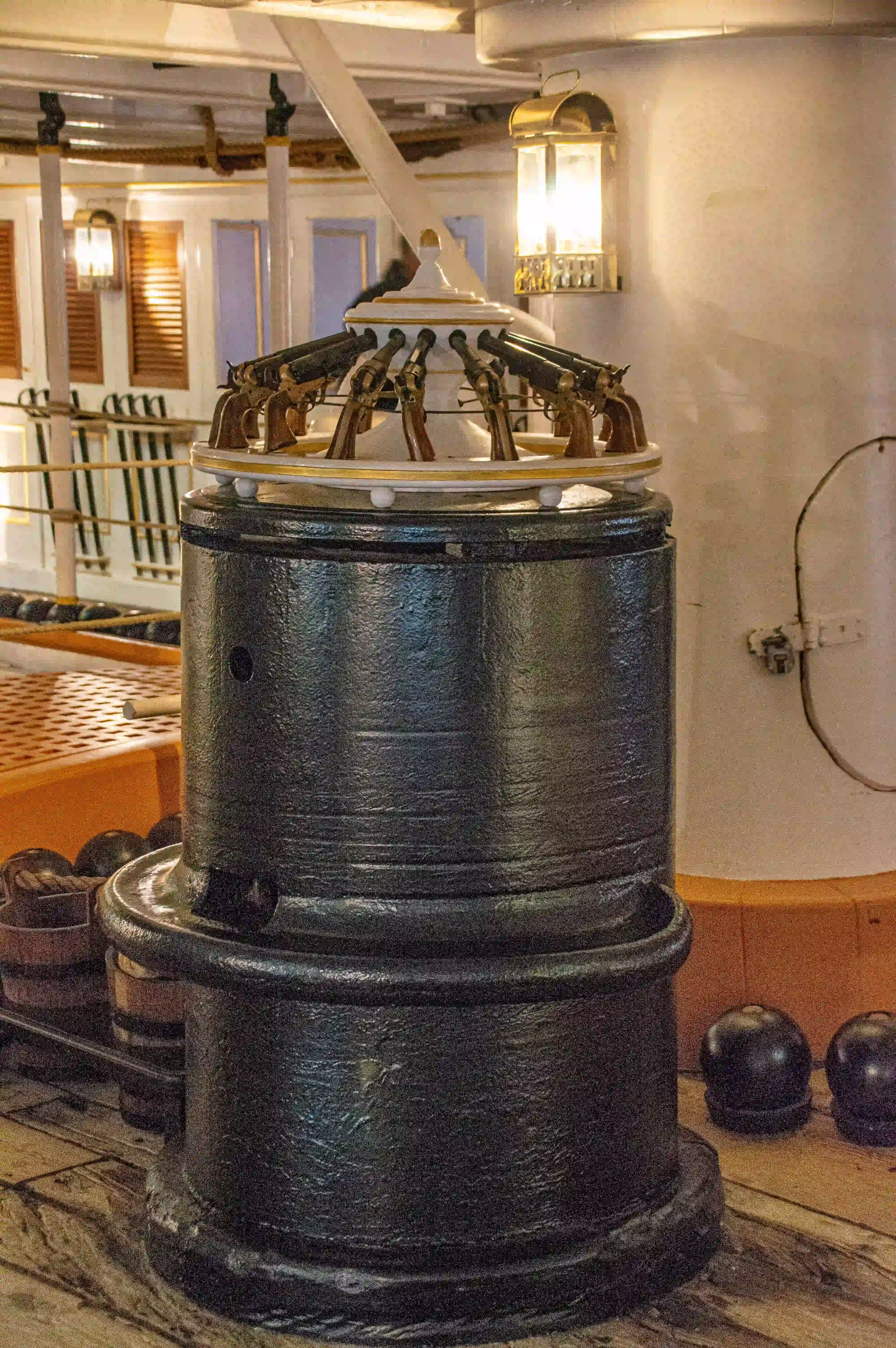
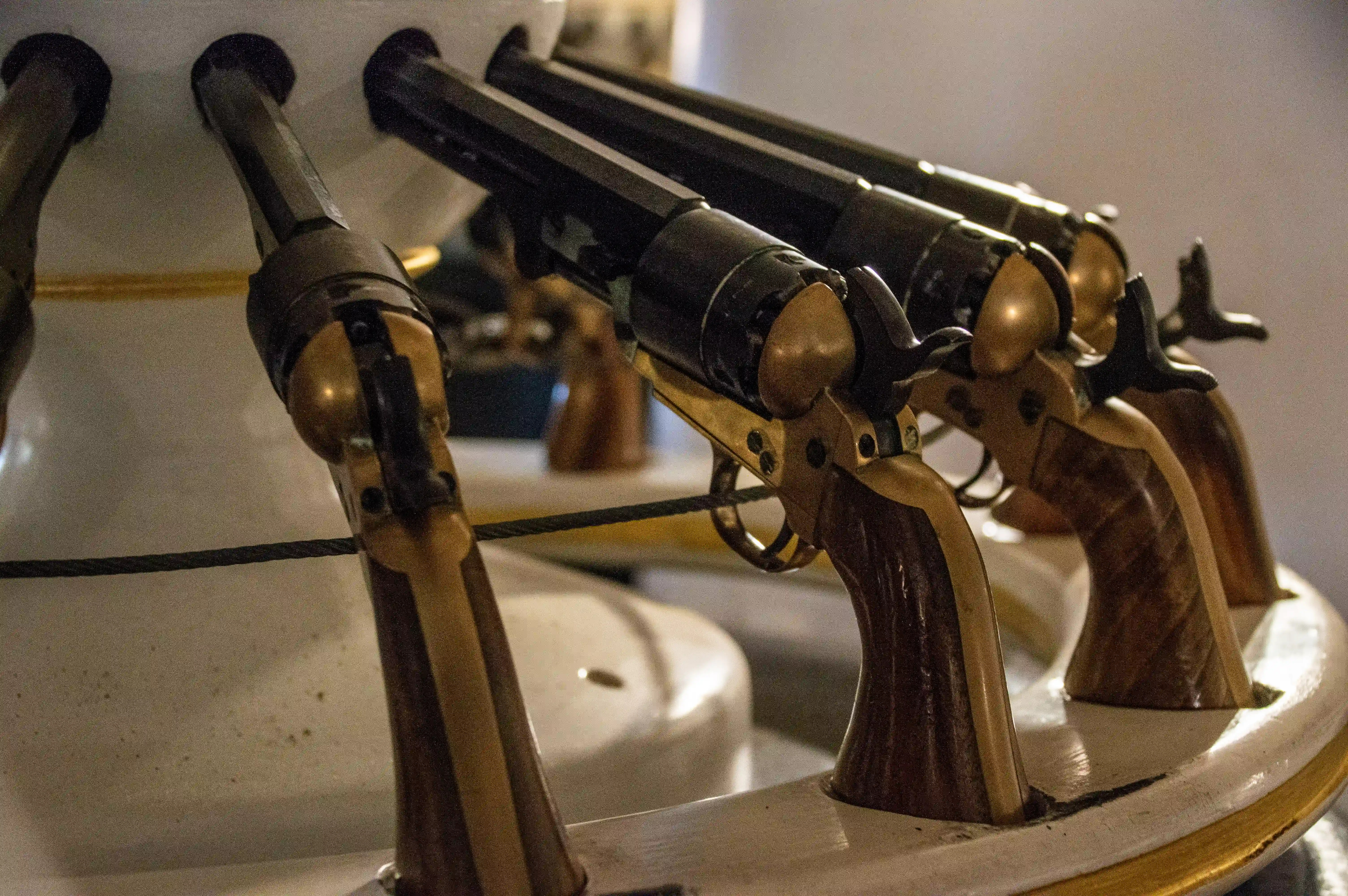
The image depicts an old naval ship cannon mounted on a wooden deck. The cannon is a multi-barreled design, likely a revolver cannon, with multiple barrels arranged in a circular fashion around a central axis. The setting appears to be an indoor display, possibly in a museum or a historical ship replica, with wooden beams, lanterns, and other maritime elements visible in the background.
Revolvers ‐ photo by ,
©www.mgaylard.co.uk.
The image shows a close-up view of an antique sewing machine, highlighting its intricate metal components and mechanisms. The machine features a series of metal arms and knobs, likely used for various sewing functions. The overall design suggests it is an older model, possibly from the late 19th or early 20th century. The metal parts have a worn, aged appearance, indicating they have been well-used over time. The background is blurred, focusing attention on the detailed craftsmanship of the sewing machine.
Revolvers ‐ photo by ,
©www.mgaylard.co.uk.
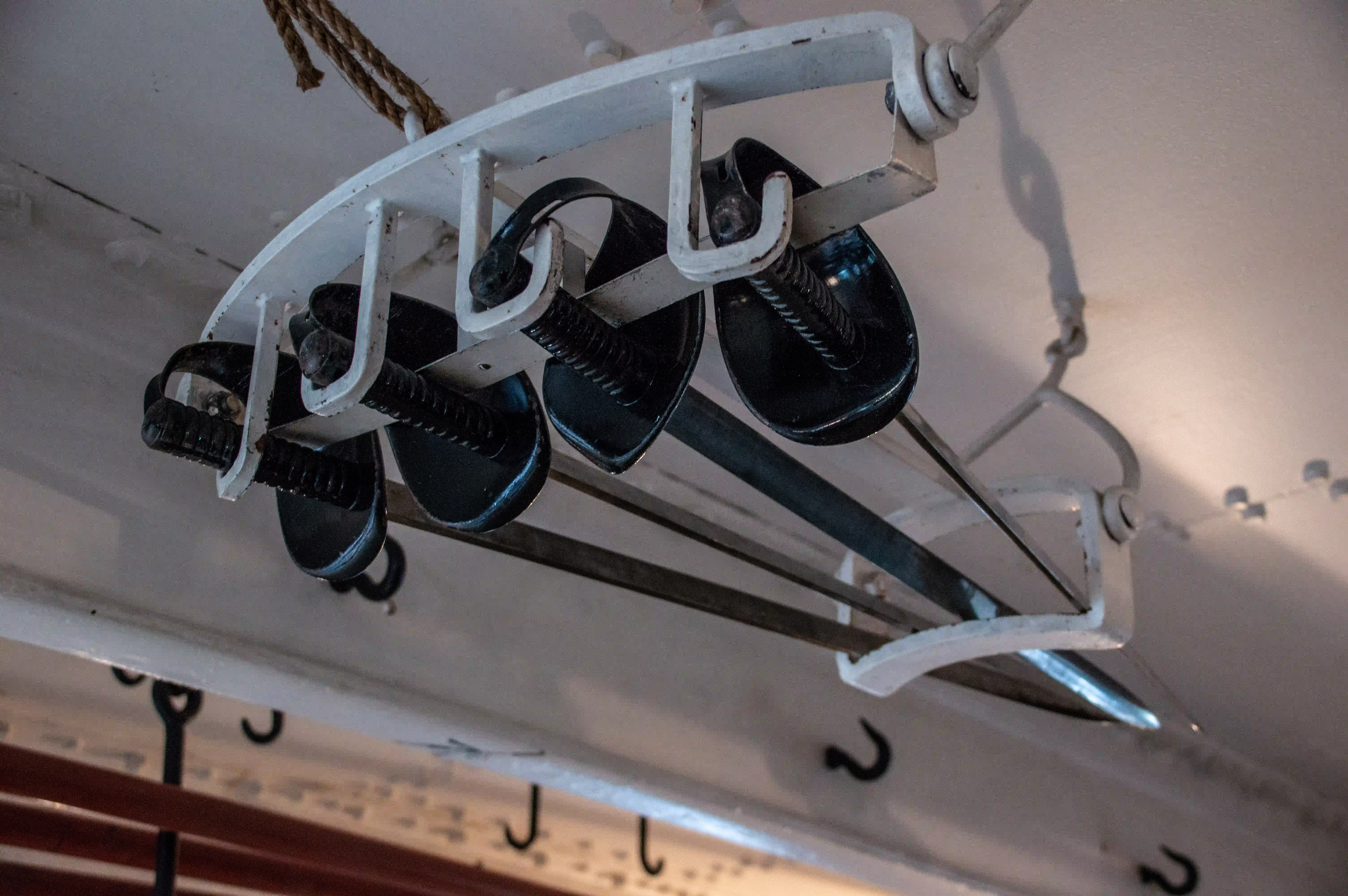
The image shows a close-up of a pulley system with multiple sheaves, likely used for lifting or moving heavy loads. The pulleys are mounted on a white metal frame, and the system is secured with bolts and screws. The background appears to be part of a ship or a similar structure, indicated by the visible wooden planks and metal hooks.
Sword Rack/span> ‐ photo by ,
©www.mgaylard.co.uk.

HMS Warrior (1860): The Ironclad That Changed Naval Warfare

HMS Warrior was the first iron-hulled, armored warship built for the Royal Navy, launched in 1860. She combined steam and sail power, revolutionizing naval warfare with her advanced design, and now serves as a museum ship in Portsmouth, UK.

A Revolution Afloat

When HMS Warrior slid into the water at Blackwall Yard in 1860, she didn’t just launch a ship—she launched a revolution. The world’s first iron-hulled, armored warship, Warrior was Britain’s bold response to France’s Gloire, a wooden-hulled ironclad that had sent shockwaves through the Admiralty. With her sleek black hull, towering masts, and 4.5-inch wrought-iron armor, Warrior was larger, faster, and more formidable than anything afloat. She was a floating fortress, a marvel of Victorian engineering that rendered every other warship obsolete overnight. Her steam engine and screw propeller could drive her at 14 knots, while her 40 guns—protected by an armored citadel amidships—promised devastating firepower. Warrior was not just a ship; she was a statement: Britain would rule the waves, not with timber and canvas, but with iron and steam

A Ship Built for Show and Strength

Warrior’s design was a masterclass in innovation. Her hull, inspired by the fast wooden frigate HMS Mersey, was clad in iron plates, making her nearly impervious to enemy fire. Her rigging and sails were a nod to tradition, but her steam engine and propeller were the future. Below decks, the contrast between the officers’ spacious wardroom—with its polished mahogany and silver—and the cramped, soot-filled engine room told the story of a navy in transition. Warrior’s 1863 publicity tour of Britain drew crowds in the hundreds of thousands, her sleek lines and gleaming armor a source of national pride. Yet her active career was brief. By the 1870s, she was obsolete, her armor no match for the new rifled guns. Still, her legacy endured. She became a floating workshop, a depot ship, and finally, in 1979, a museum ship in Portsmouth Historic Dockyard, where she now stands as a monument to the age that birthed her

From Warship to Time Capsule

Today, HMS Warrior is more than a relic; she is a portal to the past. Restored to her 1860s glory, her decks are alive with the sights, sounds, and even the smells of Victorian naval life. Costumed interpreters bring her story to life, from the clatter of the galley to the thunder of her guns. Visitors can explore her wardroom, where officers once plotted strategy over port and biscuits, or descend into the engine room, where the heat and noise of her steam plant would have been deafening. Her figurehead—a fierce warrior clutching a shield—glares out over Portsmouth Harbour, just as it did when she first arrived in 1860. Warrior is not just a ship; she is a time machine, a tangible link to the moment when the old navy of wood and wind gave way to the ironclad future

A Symbol of British Ingenuity

Warrior’s story is one of ambition, adaptation, and enduring pride. Though her active service was short, her impact was profound. She proved that iron and steam could dominate the seas, setting the stage for the dreadnoughts and battleships that would follow. Today, as part of the National Historic Fleet, she is a symbol of British innovation—a ship that changed the course of naval history and still captivates all who step aboard. Whether you’re drawn by her technical brilliance, her dramatic history, or simply the romance of the age of sail and steam, HMS Warrior remains a must-see: a ship that defined an era and still stands tall in the dockyard where she was born

References

en.wikipedia.orgwww.nationalhistoricships.org.ukhistoricdockyard.co.ukwww.nmrn.org.uk , Text generated by Mistral AI , Text generated by Microsoft CoPilot

The National Historic Fleet: Britain’s Floating Heritage

The National Historic Fleet is the UK’s core list of the most important surviving historic vessels — the maritime equivalent of Grade I listed buildings. It highlights around 200 ships of exceptional national significance that together tell the full story of Britain’s naval, merchant, and working-boat heritage.

A Fleet of National Treasures

The National Historic Fleet is the crown jewel of Britain’s maritime heritage—a carefully curated collection of over 200 vessels that tell the story of the nation’s relationship with the sea. These ships, ranging from mighty warships and merchant vessels to humble working boats and lifesaving craft, are more than just wooden hulls and iron plates; they are living links to the past, each with a tale of adventure, innovation, or endurance. To earn a place in the fleet, a vessel must be at least 50 years old, substantially intact, and of outstanding historical, architectural, or cultural significance. Many are tied to pivotal moments in British history, from the age of sail to the world wars, and all are preserved as tangible reminders of the craftsmanship, courage, and ingenuity that shaped the nation.

From Warships to Workboats: A Diverse Maritime Legacy

The fleet is a microcosm of Britain’s seafaring story. Here, you’ll find legendary ships like SS Great Britain, Isambard Kingdom Brunel’s revolutionary iron steamship, and HMS Belfast, the last big gun armament afloat from World War II. Smaller but no less significant are the fishing boats, lighters, and pilot cutters that plied the coasts and rivers, their simple lines and sturdy builds a testament to the everyday heroes of the maritime world. The fleet also includes vessels of exceptional technical or social importance, such as early lifeboats and innovative rescue craft, each representing a leap forward in safety or design. Whether preserved afloat, in dry dock, or as static exhibits, these ships are maintained with meticulous care, their stories shared through museums, restoration projects, and public access programs.

Preserving the Past for Future Generations

The National Historic Fleet is overseen by National Historic Ships UK, an advisory body that works with government, heritage organizations, and vessel owners to ensure these irreplaceable assets are protected and celebrated. The fleet is part of a broader National Register of Historic Vessels, which documents over 2,000 ships and boats, providing a comprehensive record of the UK’s surviving maritime heritage. Regular reviews and conservation priorities help identify vessels at risk, ensuring that funding and expertise are directed where they are most needed. For the ships themselves, preservation can mean anything from in-situ maintenance in their original watery environments to major dry-dock restorations, all aimed at keeping these floating time capsules seaworthy—or at least structurally sound—for generations to come.

A Fleet That Inspires

The National Historic Fleet is more than a collection; it is a source of pride and inspiration. These vessels connect us to the sailors, shipwrights, and communities that built and sailed them, offering a window into the lives and labors that shaped Britain’s coastal and riverine landscapes. Many are still afloat, participating in maritime festivals, educational programs, and even the occasional voyage, ensuring that their stories remain alive and accessible. For anyone who loves the sea, history, or the enduring craftsmanship of wooden hulls and iron rivets, the National Historic Fleet is a treasure trove—a reminder that Britain’s maritime legacy is not just preserved in books and museums, but in the very timbers and decks of these extraordinary ships.

References

en.wikipedia.orgwww.nationalhistoricships.org.ukwww.nationalhistoricships.org.ukgrokipedia.comwww.scotfishmuseum.org , Text generated by Mistral AI , Text generated by Microsoft CoPilot
To the top
Powered by w3.css. The images are all stored on link to www.gaylard.co.uk Photostream on Flickr   This website is hosted by link to 123Reg Web Hosting